
A rigid checkers board is usually easier for a small class that can store boards flat and wants a playing surface ready as soon as it reaches the table. A roll-up board is usually easier for a larger program that must fit many matching boards into a cabinet, cart, or carrying bag.
The right format depends less on a product label than on the classroom routine: where boards live, who sets them up, how pieces are matched to square size, and whether a curled or shifting surface will interrupt short lessons.
The Good Chess & Checkers may earn commissions from qualifying purchases.
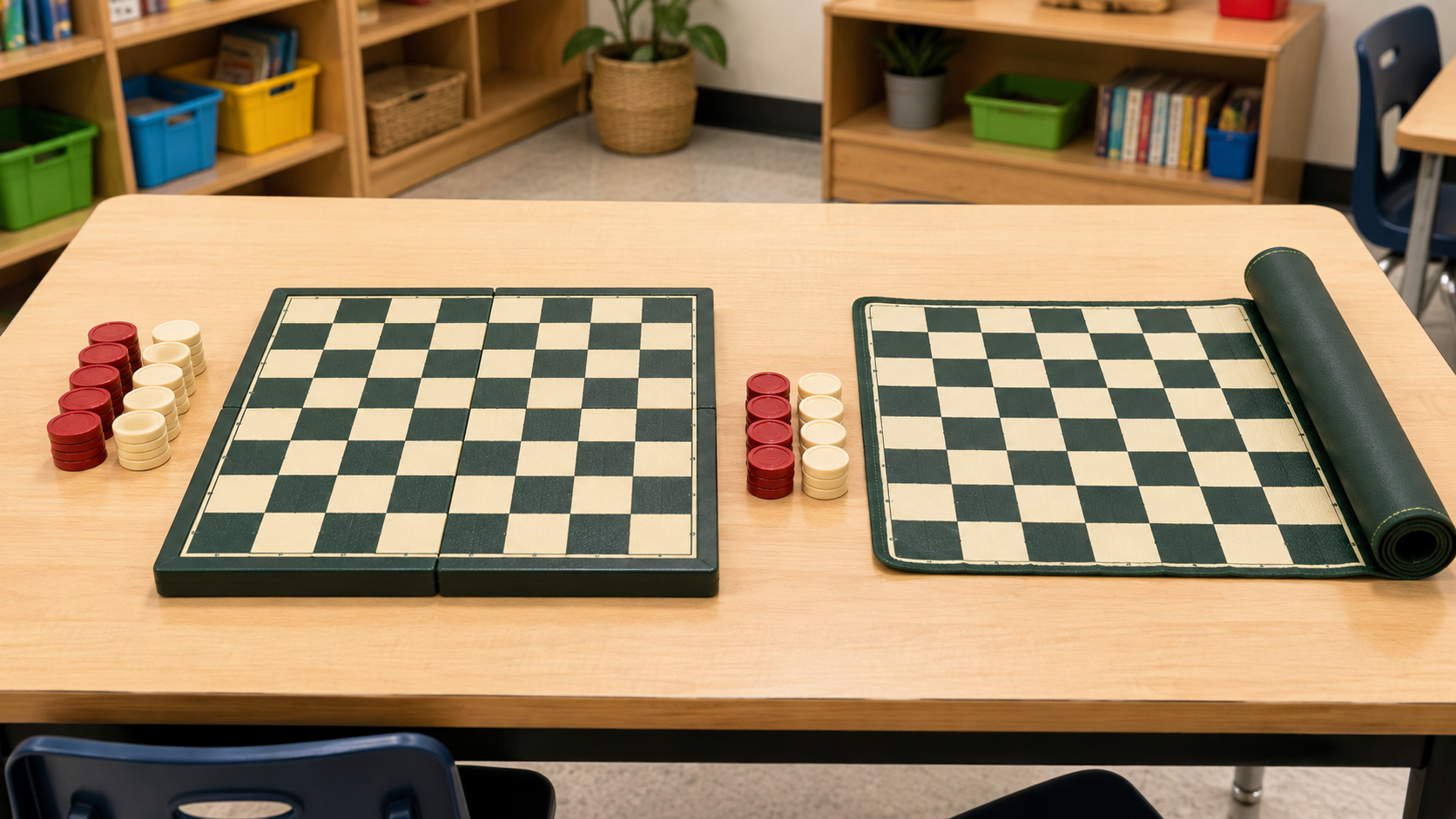
Quick decision aid
Compare the two board formats before buying a class set
Confirm an 8-by-8 grid, stated dimensions, readable contrast, and enough square clearance for your existing checkers. Then decide whether instant flatness or compact storage matters more.
Quick decision
- Choose rigid boards when a few boards can stay flat on a shelf and quick, predictable setup matters most.
- Choose roll-up boards when many playing surfaces must share a narrow cabinet, cart, or travel bag.
- Use a mixed set when demonstration tables need steady boards but extra practice stations need compact storage.
- Delay the purchase when the square size, complete grid, material, or cleaning instructions are not shown clearly.
The main tradeoff: flatness versus storage density
A rigid board supplies a firm surface and normally lies flat without preparation. Folding versions reduce the stored footprint, but hinges and thick edges can still make a stack bulky. Boards also need shelf width and protection from bent corners.
A roll-up board stores as a tube and several can fit in a long bag. The compromise is setup discipline. A mat rolled too tightly may curl at an edge, while a very light surface may shift when children reach across it. Material and storage diameter matter more than the word “portable.”
When a rigid board works better
Rigid boards fit a classroom with a permanent game shelf, a small number of tables, or short activities where every setup minute matters. They also help when the table has seams or a slightly uneven surface because the board creates its own support.
Check the opened dimensions, the folded dimensions, the hinge, and whether the frame steals usable space around the outer squares. If boards will be stacked, place a thin separator between printed surfaces and follow the maker's care instructions.
Skip rigid boards when the cabinet cannot hold them flat, volunteers must carry many sets between rooms, or bent corners and separated folding seams would be hard to replace consistently.
When a roll-up board works better
Roll-up boards fit clubs and classrooms that deploy many stations, move supplies on a cart, or share storage with other subjects. Matching mats can be numbered and stored with one bag of 24 checkers plus a few compatible spares.
Compare vinyl and thicker fabric-backed or mousepad-style formats by rolled diameter, weight, grip, and manufacturer cleaning guidance. Store each board around a wide tube or in a loose roll rather than folding it, unless its instructions explicitly allow folding.
Skip a roll-up board when the available shelf forces a tight roll, tables are too small for curled edges, or the class needs a board that a single young player can place flat immediately.
Classroom criteria to check side by side
- Grid: confirm a complete 8-by-8 board for ordinary American checkers; other draughts variants can use different boards.
- Square and piece fit: measure a square and the checker diameter. Leave room to move and stack two pieces for a king without crowding neighboring squares.
- Contrast: both square colors and both piece colors should remain easy to distinguish under the room's normal lighting.
- Setup: rigid boards open quickly; roll-up boards may need a reverse roll or a few minutes lying flat.
- Storage: compare shelf width and stack height for rigid boards with tube length and rolled diameter for mats.
- Cleaning: use only the method stated for the material. “Wipeable” does not mean every cleaner is suitable.
- Replacement: standardize board and piece measurements so one damaged set does not leave a pile of mismatched parts.
A simple one-board trial
- Measure the intended tables, shelf, cabinet, cart, and carrying bag.
- Buy or borrow one board in the preferred format before ordering a class quantity.
- Pair it with the exact checkers the class will use and stack two on one square.
- Ask a learner to retrieve, set up, reset, and store the set using the planned labels.
- Time the routine and check whether the board shifts, curls, catches, or blocks another player.
- After several sessions, inspect the hinge or edges, printed grid, and storage container before standardizing the set.
This is a workflow trial, not a durability test. It reveals whether the format fits your room and routine without predicting how long a particular product will last.
Who should use both formats?
A mixed inventory can be practical when one or two rigid boards stay at a teaching table while roll-up boards supply temporary player stations. Keep the square size similar so the same replacement pieces fit both formats, and label every board so cleanup remains simple.
For a closer look at mat materials, flatness, and storage tubes, continue to the roll-up checkers board guide. For the wider purchasing plan—including pieces, bags, spares, and reset routines—use the classroom and club station guide.
Bottom line
Pick a rigid checkers board for instant flatness, supported play, and a small inventory with adequate shelf space. Pick a roll-up board for compact group storage and transport when the classroom can manage careful rolling and a brief flattening routine. Test one complete board-and-piece setup in the real room before buying multiples.
The planned classroom-and-club pillar is not yet built, so the existing classroom station and set guides are the most useful next steps.