
A tutor who teaches from a planned sequence needs a different paper system from a club helper who hands out several kinds of loose sheets. A ring binder makes pages easy to browse in order; an accordion file makes categories easy to separate and replenish. The better choice depends on what happens during the lesson, not which organizer has more advertised capacity.
This comparison covers product categories rather than named winners and does not claim hands-on testing. Verify internal dimensions, ring or pocket capacity, sheet-protector fit, closure, handle, materials, and filled size in the current listing.
As an Amazon Associate, The Good Chess & Checkers may earn from qualifying purchases.
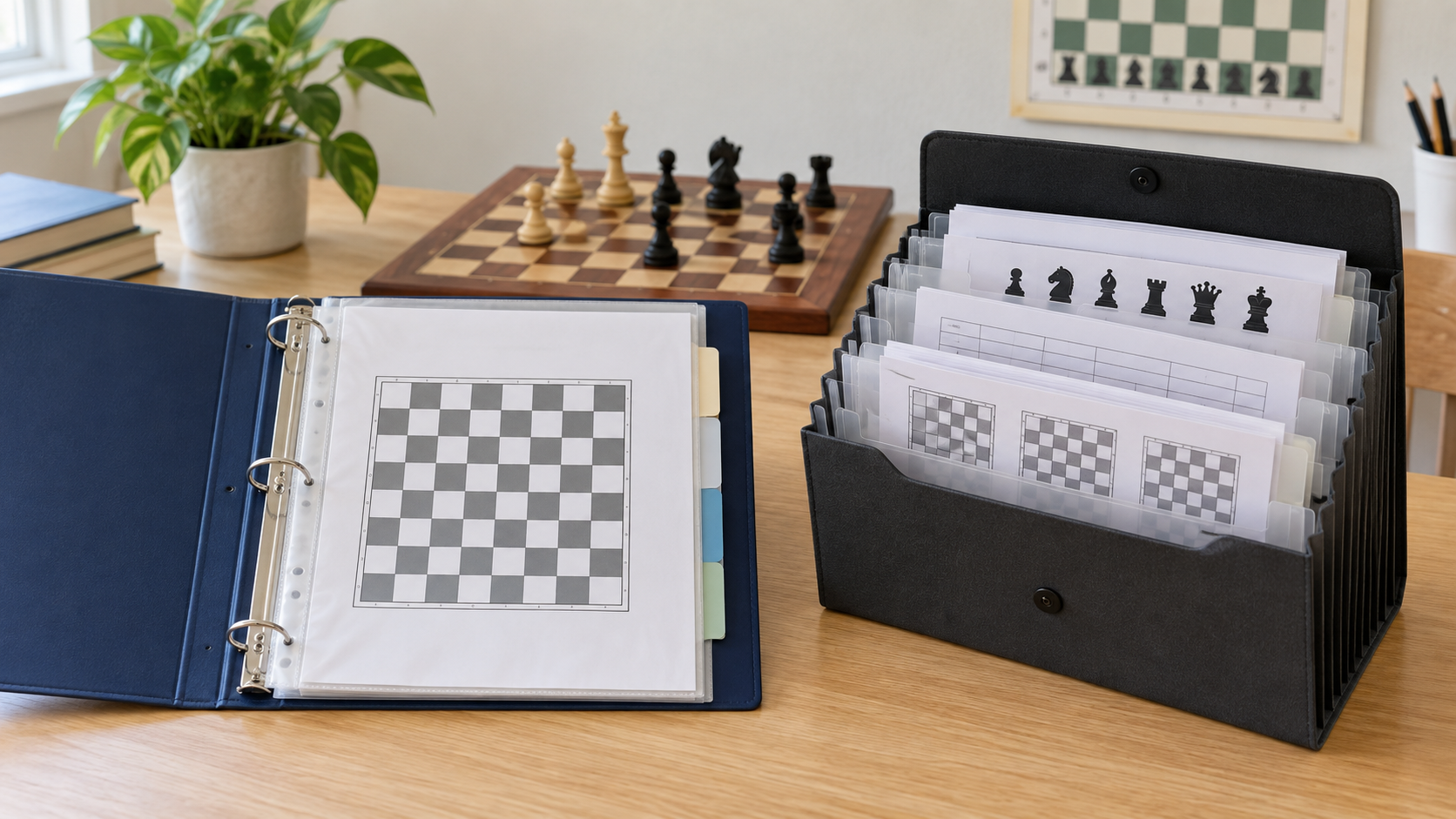
Sequence or categories?
Match the organizer to the teaching workflow
Choose a binder when page order matters and an accordion file when several loose-paper categories move in and out during each session. Measure the filled organizer, not only its empty profile.
Quick Decision
- Choose a ring binder for a stable curriculum, instructor notes beside each activity, and pages that should stay in a deliberate order.
- Choose an accordion file for loose worksheets, score forms, rules sheets, completed work, and categories that change quantity from week to week.
- Use both when the instructor needs one master lesson sequence plus a portable supply of student copies.
- Skip both when one slim folder or a carefully maintained digital library handles the small paper set.
The Core Difference: Browse a Sequence or Reach Into a Category
Binder rings turn separate sheets into a book. With dividers and sheet protectors, an instructor can move from movement rules to coordinates, simple tactics, and recording practice without shuffling a loose stack. Pages can remain visible during the lesson and notes can sit beside the activity they explain.
An accordion file behaves more like a portable filing drawer. Each pocket can hold a changing quantity of copies: today's pawn worksheet, blank score sheets, take-home puzzles, papers to return, and checkers references for another group. The teacher retrieves a category rather than following a fixed page order.
| Criterion | Ring binder | Accordion file |
|---|---|---|
| Best task | Browsing a planned lesson sequence | Sorting and distributing loose copies |
| Changing quantity | Pages must be opened at the rings or moved between pockets | Loose sheets drop into a labeled section |
| Page protection | Sheet protectors can isolate frequently handled masters | Outer case contains papers, but individual sheets remain loose |
| Table use | Opens flat only if format, fill, and rings allow it | Needs an open footprint for pockets and access |
| Carrying | Check cover closure and whether pages sag around rings | Check closure, handle, pocket height, and filled balance |
| Low-cost trial | Ordinary folder with pages arranged in lesson order | Several labeled folders inside one tote |
When a Ring Binder Fits Better
A binder suits the instructor's master copy. Put one lesson per section, keep answer notes behind the prompt, and use consistent chessboard orientation and notation. Clear protectors can preserve a reusable worksheet master, but confirm the protector fits the paper and that glare will not make diagrams hard to see at the teaching table.
Ring size alone does not establish useful capacity. Thick protectors and dividers consume space, and overfilling can make pages catch or tear near the holes. Test whether the chosen binder stays open at the page you need and whether the cover fits the shelf or teaching bag.
Skip the binder if helpers constantly remove piles of student copies, if category quantities change every session, or if punching and refiling papers becomes the slowest part of cleanup.
When an Accordion File Fits Better
An accordion file is useful when the paper library behaves like inventory. Label pockets by action—“teach today,” “blank score sheets,” “take home,” “completed,” and “refile”—or by a small number of active topics. Keep labels short enough that another helper can reset the file without guessing.
Verify that dividers are tall enough to prevent neighboring sheets from mixing and that tabs remain readable when pockets are filled. Compare the expanded depth with the available table and shelf. A file that opens into the playing area or no longer closes at working capacity has not solved the storage problem.
Skip the accordion file if the curriculum is already bound in a dependable order, if only a few sheets travel, or if loose pages routinely need to remain visible while teaching.
A Practical Hybrid Without Duplicate Copies
Keep one binder as the maintained teaching master. Store only verified lesson pages, answer notes, and the sequence you intend to teach. Use a smaller accordion file for expendable student copies and papers moving between states. This prevents the master from becoming a supply cabinet and prevents the portable file from becoming an archive.
- Select the next lesson from the binder.
- Count the student copies needed and put them in one labeled file pocket.
- Give returned work its own pocket instead of mixing it with unused copies.
- After the session, record missing or revised pages before refilling supplies.
- Return master pages to the binder and remove outdated duplicates from the file.
Run a Two-Lesson Trial Before Buying
Arrange the current material in lesson order inside one ordinary folder. Put loose copies into several labeled folders inside the bag you already carry. Teach two representative sessions and note how often you browse, remove a stack, add returns, refill copies, carry the organizer, and open it beside a board.
If browsing and page display dominate, a binder is likely the better purchase. If distribution and category changes dominate, favor the accordion file. If both trials feel easy, keep the no-spend setup until a recurring problem justifies more gear.
What to Verify Before Ordering
- Paper fit: usable internal size for the actual worksheets, protectors, tabs, and any oversize diagrams.
- Working capacity: capacity with dividers or protectors installed, not an unsupported page-count assumption.
- Access: rings that open as intended or pockets that remain reachable and separated when filled.
- Filled footprint: closed, open, and expanded dimensions against the shelf, tote, teaching table, and board area.
- Carry routine: closure, handle if present, weight distribution, and whether papers stay supported in the maker's intended orientation.
- Lesson accuracy: consistent board orientation, legal positions, readable diagrams, and clear rules context. An organizer cannot correct a flawed worksheet.
Bottom Line
Choose a ring binder when the value lies in a stable, browsable chess lesson sequence. Choose an accordion file when loose categories must be distributed, collected, and replenished quickly. A master binder plus a modest copy file can serve a larger program, but start with labeled folders and buy only after the real lesson workflow reveals which friction repeats.