
Loose rule sheets, board diagrams, puzzles, and score forms become hard to teach from when they travel as one unsorted stack. An accordion file can help a teacher or tutor carry categories in one container, but only when its paper size, pocket layout, closure, and expanded footprint match the real lesson routine.
This is a product-category comparison, not a ranking of named files or a claim of hands-on testing. Listings can change, so verify paper compatibility, pocket count, capacity, materials, handle, closure, and exterior dimensions before buying.
As an Amazon Associate, The Good Chess & Checkers may earn from qualifying purchases.
Quick decision aid
Start with paper fit and usable pockets
Count the categories you actually carry, measure the sheets, and check the file at its filled size. Extra pockets are not useful if tabs disappear, papers bend, or the expanded case no longer fits the shelf or bag.
Choose Pockets From a Real Lesson Plan
Write down the materials used during one month before choosing a pocket count. A simple mixed-game file might separate chess rules, chess positions, checkers rules, checkers positions, blank score sheets, completed work to return, and teacher notes. Leave one pocket for papers that need filing after the session.
A file with many narrow sections can be harder to browse than one with fewer well-labeled sections. Check whether pocket dividers reach high enough to keep neighboring sheets separate and whether the tabs remain visible when the file is full.
Best Overall: Letter-Size File With a Secure Closure
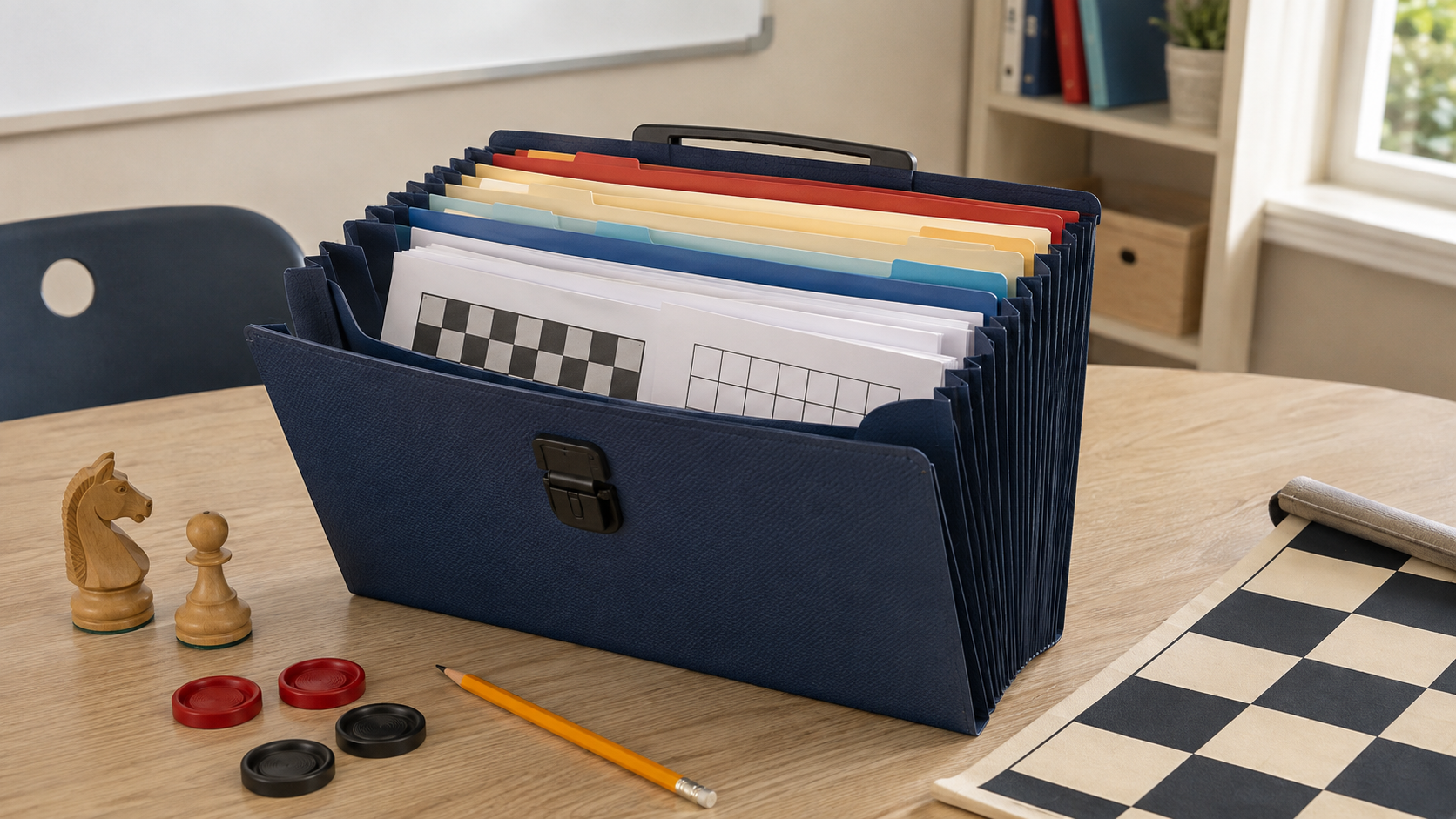
For ordinary printed lesson sheets, start with a file whose listing explicitly supports the paper size you use. A flap, buckle, or zipper should close without pressing hard against filled pockets. Compare the stated expanded depth with the shelf, tote, and teaching table—not just the slim empty profile shown in a product photo.
Best for: tutors and program helpers who carry several reusable categories between locations.
Skip it if: most materials are bound books, laminated boards, or oversize sheets that would bend inside.
Best for Frequent Travel: File With a Built-In Handle
A handle can keep one hand free for boards or piece bags, but it does not prove the case suits a heavy load. Verify how the handle attaches, whether the file closes while carried, and whether packed paper stays upright. Keep chess pieces, checkers, clocks, and markers in their own containers rather than adding loose hard objects to paper pockets.
Best for: instructors moving a modest paper library between rooms.
Skip it if: the handle increases bulk without replacing a separate tote, or the route exposes papers to conditions outside the maker's stated use.
Best for Desk and Shelf Use: Low-Profile Expanding File
A handle-free file can be easier to slide onto a shelf and open beside a board. Look for a stable base and tabs readable from the direction the file will face. Measure the open footprint too: an expanding file that fans across the board edge, captured-piece area, or player's writing space creates a new problem.
Best for: one regular classroom or tutoring table with nearby storage.
Skip it if: the file must be carried frequently or stored upright without a dependable closure.
Best for Small Reusable Sets: Compact Coupon-Style File
A compact expanding file may suit index cards, mini rule references, or a small set of folded prompts. It is not a substitute for a letter-size file unless the listing's internal dimensions fit the material without folding diagrams at important squares or covering notation fields.
Best for: a deliberately small card library used for short lessons.
Skip it if: full-page worksheets are part of the routine.
Label by What Happens Next
Use short labels a helper can understand: “Chess rules,” “Chess practice,” “Checkers rules,” “Checkers practice,” “Blank forms,” and “Return.” Put beginner and advanced materials in different pockets only if both are actively used. A dated archive belongs elsewhere; the teaching file should hold the current working set.
Checkers materials should state which rules they teach when forced captures, backward captures, board size, or king movement may vary. Chess sheets should use a consistent board orientation and notation convention. The file organizes paper; it does not resolve conflicting lesson content.
Run a No-Spend Trial First
- Collect the papers used in four typical lessons.
- Sort them into temporary labeled folders by teaching action.
- Remove categories that were never opened and combine tiny groups.
- Measure the largest sheet and the stacked thickness.
- Place the temporary system beside the actual board to test reach and table space.
- Only then compare pocket count, internal paper fit, closure, handle, expanded size, and shelf fit.
Who Should Skip an Accordion File?
Skip one when the teaching library is only a few sheets, when lessons are already sequenced in a binder, or when materials are reliably stored and displayed digitally. A ring binder is often better for a fixed page-by-page course; use the ring binder versus accordion file comparison to match that choice to the real lesson workflow. A simple folder may be enough for one learner. Do not buy a large file merely to create categories the program does not use.
Fit It Into the Whole Classroom Routine
Keep the paper file near the instructor rather than inside student set bins. Match each complete game kit with a clear identifier using the guide to classroom inventory labels, and keep teaching references concise enough that learners still spend time moving pieces. The broader station guide explains how readable boards, separate piece storage, and quick references work together.
Bottom Line
For most traveling chess and checkers instructors, a letter-size accordion file with clearly visible tabs and a closure that works at the filled capacity is the practical starting point. Add a handle only when it improves the real carry route. Choose the pocket count from actual lesson categories, measure the expanded case, and use a binder, small folder, or digital library when sequential pages or a tiny paper set make accordion storage unnecessary.