
A numbered checkers board can turn “move that piece over there” into a position both learner and teacher can find again. The useful board is not automatically the one with the most labels: it is the one whose numbering matches the lessons you follow, stays readable under the pieces, and still works comfortably for an ordinary game.
This is a category comparison, not a hands-on ranking. Numbering systems differ by checkers variant and publisher, and we have not verified every current listing. Compare the listing photos, stated board size, included pieces, and numbering diagram with your book, app, course, or teacher before buying.
As an Amazon Associate, The Good Chess & Checkers may earn from qualifying purchases.
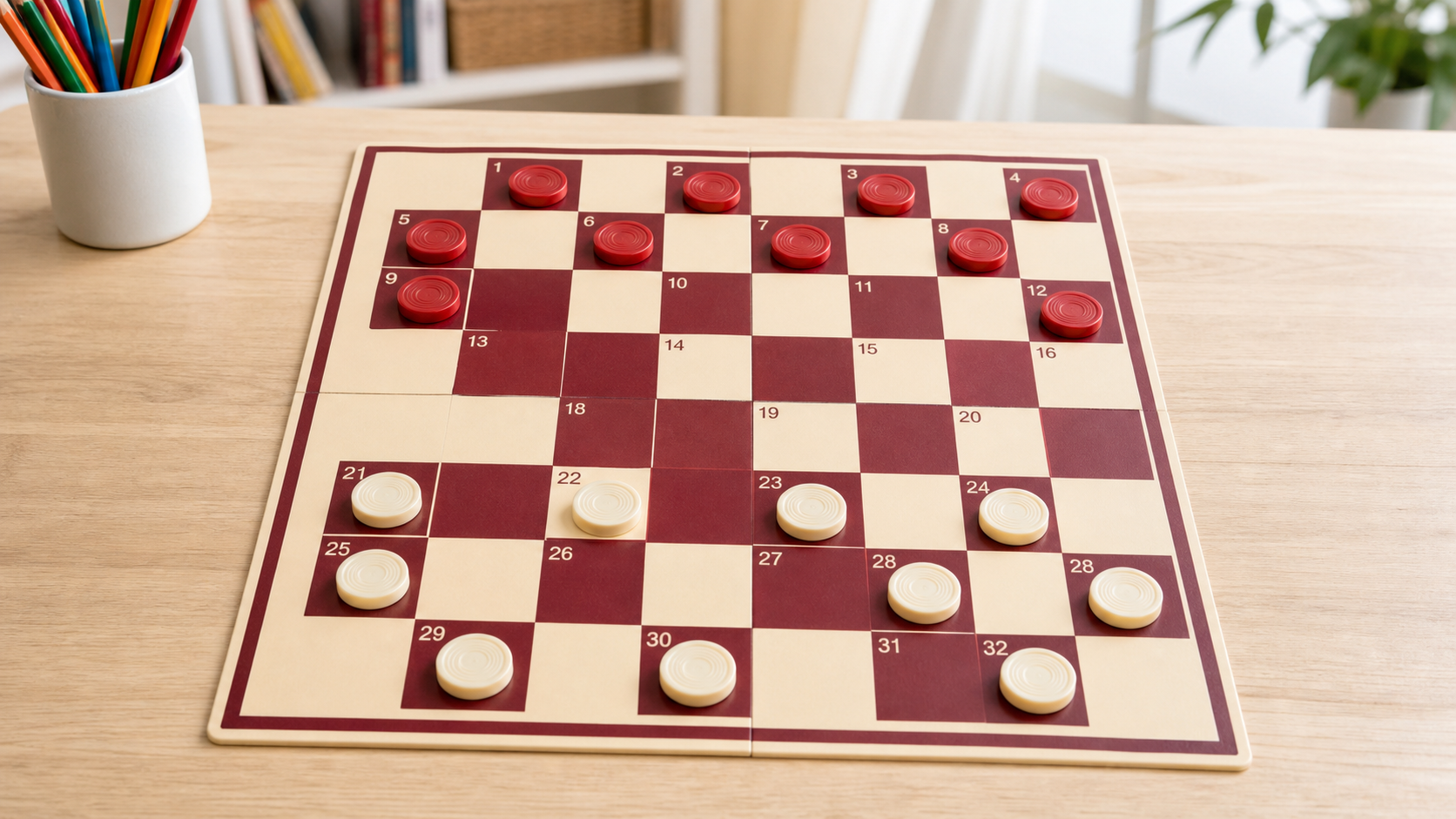
Match the notation before the material
Shop numbered checkers board formats
Start with the system used by your learning material. Then compare label placement, square contrast, checker diameter, board footprint, and storage.
The Short Answer
For most learners using American or English checkers material, the best fit is an 8-by-8 board that numbers only the 32 playable dark squares, uses small high-contrast labels, and includes stackable pieces that leave those labels visible. That is a fit recommendation, not a universal rule: international draughts commonly uses a 10-by-10 board and a different 1–50 scheme, while some teaching resources use row-and-column coordinates or their own diagrams.
How We Compare Numbered Checkers Boards
- Notation match: the printed system must correspond to the book, app, lesson sheet, or variant the learner uses.
- Label clarity: numbers should be easy to find without overpowering the square pattern or disappearing beneath every piece.
- Board and piece fit: checkers need room to sit inside a square and stack for kings without obscuring nearby labels.
- Contrast: playable squares, non-playable squares, labels, and both piece colors should remain distinct in normal room light.
- Portability: a folding, roll-up, or rigid board should suit where lessons happen and how the pieces are stored.
- Ordinary-play value: the labels should assist learning without making casual games awkward once notation is no longer needed.
Best for Most 8-by-8 Lessons: A 1–32 Playable-Square Board
A board numbered 1 through 32 on the dark squares gives each legal landing square one compact reference. This can make it easier to copy a position, record a move, or ask why a jump from one square to another is required. Look for a clear sample diagram in the listing rather than trusting the words “numbered board.”
Best for: learners whose American or English checkers material explicitly uses a matching 1–32 map.
Skip it if: the lesson uses a different orientation, coordinates around the board edge, a 10-by-10 board, or pictures without numbers.
Best for Shared Teaching: Numbers Printed in the Playable Squares
Numbers inside the dark squares are visible from several sides of a table and connect each label directly with a legal piece location. Smaller labels near a corner usually interfere less with the checker. Confirm in photos that the digits contrast with the square and do not sit exactly where every piece will cover them.
Best for: a parent, tutor, or small group talking through positions together.
Skip it if: several learners will view the board upside down and the typeface is hard to distinguish from that angle.
Best for Books with Grid References: Edge-Labeled Coordinates
Some learning materials identify rows and columns rather than numbering only playable squares. Edge labels keep the playing surface visually cleaner, but locating a square takes two references and may be slower for a new learner. The coordinates are valuable only when the accompanying material uses the same system.
Best for: lessons built around matching row-and-column references.
Skip it if: the learner's diagrams use 1–32 notation; converting every exercise adds avoidable friction.
Best Portable Option: A Roll-Up Numbered Board with Separate Pieces
A roll-up board can fit beside books and lesson sheets without a bulky box. Check whether the board is sold alone, whether the printed labels remain clear when the material lies flat, and whether the chosen checkers fit its square size. A separate pouch keeps pieces together but does not stop them moving during a game.
Best for: learners who carry the same notation board between home, a club, or lessons.
Skip it if: the board will stay on one table, needs to store pieces inside itself, or the surface tends to curl in the available space.
Best All-in-One Option: A Folding Learning Set
A folding set can store the checkers inside the board and reduce the number of loose parts. Inspect the listing for a complete numbering diagram, interior storage, checker count, and the open playing dimensions. A center fold is acceptable when the board lies flat enough that stacked kings do not wobble beside it.
Best for: families who want one contained set for lessons and casual play.
Skip it if: the pieces hide the numbers, the hinge interrupts several squares, or the listing does not show the full numbering scheme.
Quick Comparison Framework
- Choose 1–32 playable-square numbering when the learner's 8-by-8 lessons use the same map.
- Choose edge coordinates only when the learning material refers to rows and columns.
- Choose a roll-up board for easy carrying and separate piece selection.
- Choose a folding set when contained storage matters more than minimum bulk.
- Choose an unnumbered board when the learner plays visually and the labels are not used in any lesson.
Check Compatibility Before Buying
- Identify the game variant and board size used by the learner's main resource.
- Find that resource's board map and note which corner starts the numbering and which color is playable.
- Compare the map square by square with a full, unobstructed product image.
- Confirm whether the listing includes checkers and how many; do not infer included pieces from staged photos.
- Check the open board dimensions and square size against the checker diameter.
- Choose a storage format that fits the learner's actual table, shelf, and travel routine.
If the listing does not show the entire board clearly, ask the seller or choose a better-documented option. A mislabeled or incompatible board can make notation harder rather than easier.
Who Should Skip a Numbered Board?
Skip it when the learner is still focused only on legal movement and simple jumps, when the teaching resource never names squares, or when a familiar unnumbered board already works well. Labels can add visual noise for young or easily distracted learners, and they do not replace practice recognizing forced jumps, kings, and safe landing squares.
Also skip a specialized 8-by-8 board when the intended variant uses a different board. For ordinary family play, clear contrast and comfortable pieces may matter more than notation; the beginner checkers set guide compares those broader fit criteria. If kinging visibility is the problem, see the guide to stackable checkers pieces.
Bottom Line
The best numbered checkers board is the one that matches the learner's exact notation system and remains pleasant to play on. For many 8-by-8 lessons, that means clear 1–32 labels on the playable squares, readable contrast, properly sized stackable pieces, and a board format that fits the learning routine. Verify the full map before buying, because numbered does not mean universally compatible.