
If your checker pieces are complete but the board is torn, warped, or missing, a board-only replacement can save space and avoid buying pieces you do not need. The useful choice starts with compatibility: the correct grid, squares that fit your discs, clear contrast, and a material suited to where you play.
This is a product-category comparison, not a named-product ranking or hands-on test. Board listings change, so verify the grid, square measurements, material, and included contents before ordering.
As an Amazon Associate, The Good Chess & Checkers may earn from qualifying purchases.
Product-category guide
Measure your pieces before choosing a board
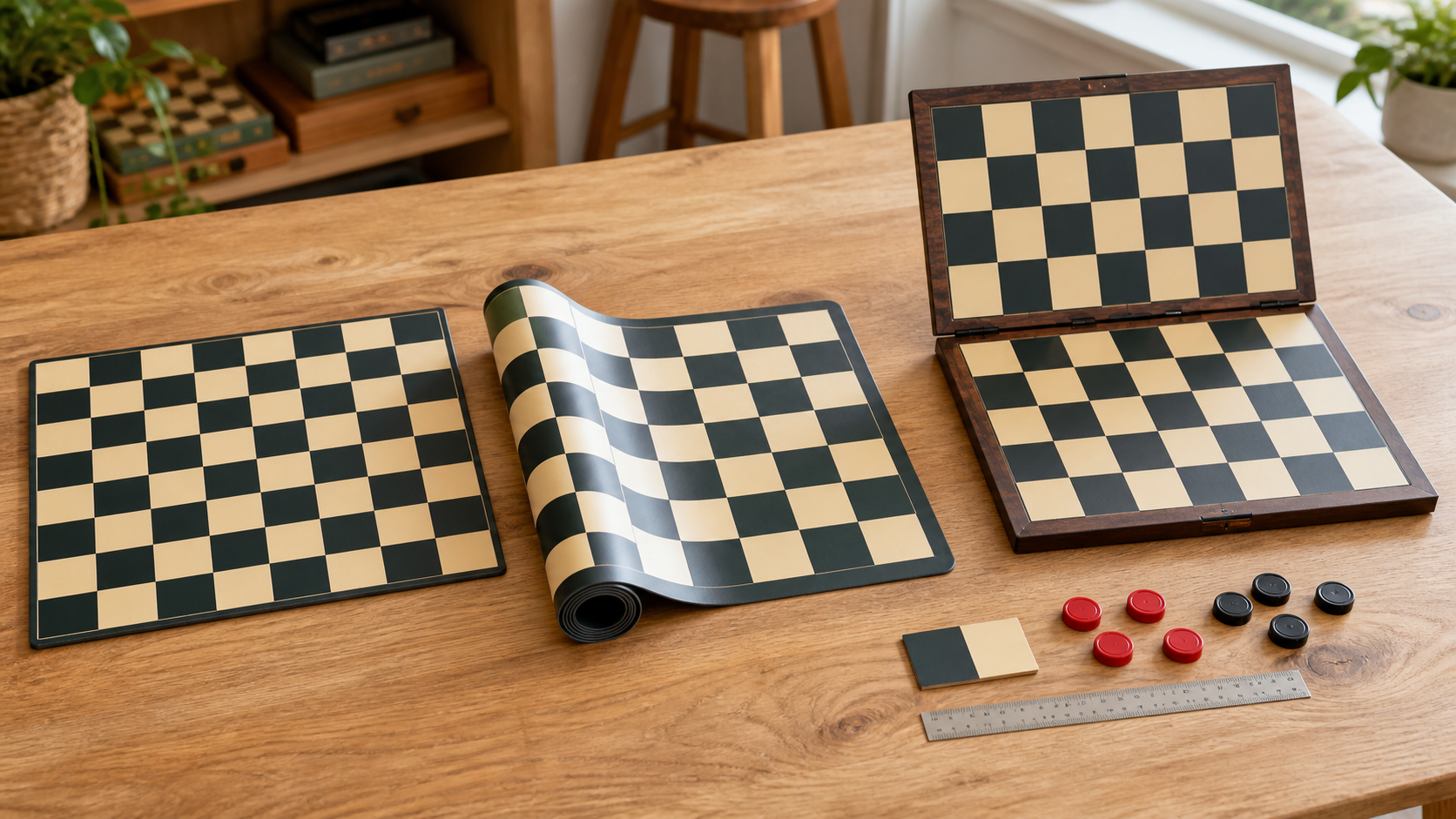
Confirm the playable grid, measure checker diameter, and choose squares with enough clearance to move and stack kings without crowding nearby pieces.
What to verify before buying a board without pieces
- Playable grid: standard American checkers is commonly played on an 8-by-8 grid. Other draughts variants can use different board sizes, so match the board to the rules you actually use.
- Square size: measure one checker across its widest point. It should sit inside a square with visible clearance rather than touching the lines.
- King fit: place two pieces in a stable stack and check that the stack can move without brushing adjacent pieces.
- Contrast: playable dark squares and non-playable light squares should be easy to distinguish under your normal room lighting.
- Surface: checkers should slide or lift cleanly without snagging on texture, deep seams, or raised printing.
- Included contents: confirm that the listing is truly board-only if avoiding duplicate pieces is part of the goal.
Best simple home replacement: flat rigid boards
A rigid board gives the most familiar tabletop feel and needs no flattening before play. Look for a smooth, readable surface and a backing that sits evenly. Record the full footprint as well as square size so the board fits the table and its storage location.
Best for: a game table, shared shelf, or drawer where the board can remain flat.
Skip it if: storage is narrow, the board must travel regularly, or the listing does not show how the edges and surface are finished.
Best for compact storage: roll-up flexible boards
Vinyl, silicone, and other flexible boards can store in a tube or loose roll. The real tradeoff is between compact storage and setup: a board should unroll flat enough that pieces do not tilt or drift. Store it rolled rather than sharply folded unless its maker specifically supports folding.
Best for: clubs, classrooms, travel bags, or homes without flat-board storage.
Skip it if: you want a decorative board left on display or dislike waiting for a tightly rolled surface to relax.
Best self-contained format: folding boards
A folding board reduces the stored footprint without requiring a separate tube. Inspect the center seam, hinge direction, closure, and whether the playing surface is likely to rest flat. Interior storage compartments add little value on a board-only purchase unless they fit the pieces you already own.
Best for: shelves and cabinets where a full rigid board is too wide.
Skip it if: a raised center seam would interfere with play or your existing pieces will not fit any interior tray.
Best for teaching positions: coordinate or numbered boards
Edge coordinates or numbered playable squares can help a learner follow a workbook, replay a position, or discuss a forced jump. The notation must match the lesson system; labels that conflict with a book are more confusing than an unlabeled board.
Best for: learners who actively use compatible numbered diagrams or position notation.
Skip it if: your family plays casually without notation, or different lesson resources label squares in different ways. See the numbered checkers board guide for that narrower decision.
Quick comparison framework
- Choose a flat rigid board for immediate home play and flat storage.
- Choose a roll-up board for the smallest practical packed format.
- Choose a folding board when shelf width matters more than avoiding a center seam.
- Choose a numbered or coordinate board only when its notation matches how the learner is taught.
- Buy a complete set instead when the existing pieces are incomplete, difficult to stack, or poorly matched in color and size.
A five-minute compatibility check
- Confirm the checkers or draughts variant you plan to play and its required grid.
- Measure one checker across its widest point in millimeters or inches.
- Stack two pieces as a king and check both stability and clearance.
- Measure the table and the place where the board will be stored.
- On the listing, verify square size, total dimensions, material, and included contents in text rather than estimating from photos.
Who should skip a board-only replacement?
Skip it if several pieces are missing, the two sides are hard to distinguish, or your discs cannot stack clearly for kings. In those cases, a complete beginner checkers set may solve the whole problem more cleanly. Also skip a standard 8-by-8 replacement when your group plays a variant that requires a different grid.
For a family buying its first board rather than reusing pieces, the family checkers board guide covers complete setup, handling, storage, and mixed-age needs.
Bottom line
The best replacement checkers board is the one that matches your rules and pieces before material or appearance enters the decision. Verify the grid, measure checker-to-square fit, then choose rigid, roll-up, folding, or labeled construction based on setup and storage. A board-only purchase is sensible when the pieces are genuinely complete and usable; otherwise replace the complete set.