
The best checkers demonstration board is the one every learner can read: a complete 8-by-8 grid, high-contrast round pieces, and a kinging method that remains obvious from the farthest seat. Before buying, measure the room, decide where the board will hang or stand, and verify that the included pieces can show ordinary checkers moves and doubled kings clearly.
This is a product-category guide, not a ranking of named products or a claim of hands-on testing. Many large display boards are designed primarily for chess, so do not assume that checker pieces are included or compatible.
As an Amazon Associate, The Good Chess & Checkers may earn from qualifying purchases.
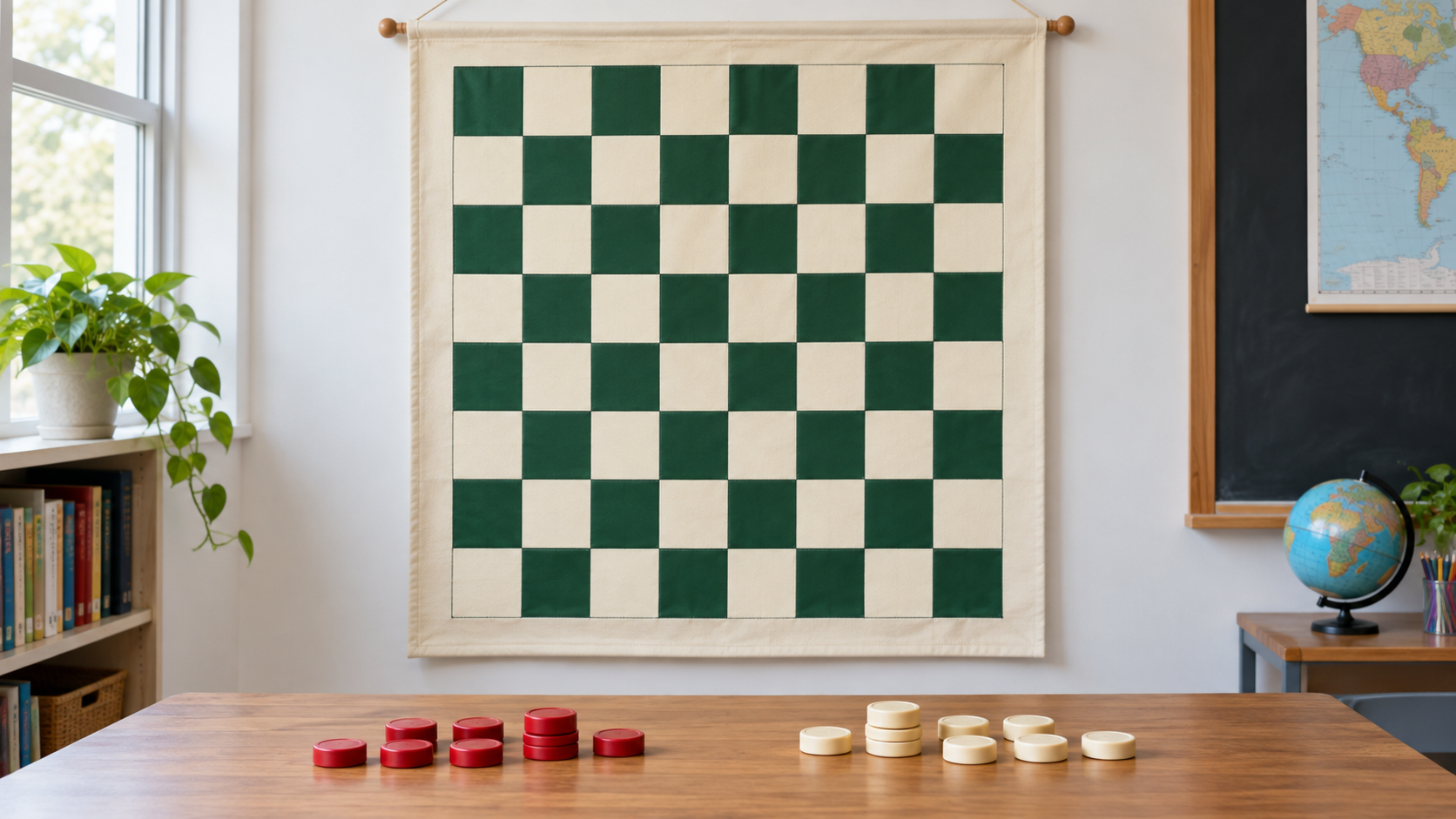
Verify the checkers components
Compare large checkers display formats
Look for stated board and square dimensions, round checker diameter, color contrast, a clear kinging method, mounting hardware, folded or rolled size, and replacement-piece availability.
Quick choices
- Choose a purpose-built magnetic checkers board when its listing confirms round pieces, board dimensions, and a workable way to show kings.
- Choose a hanging pocket-style board only when the checker pieces fit its pockets and doubled kings remain visible instead of disappearing behind an edge.
- Adapt a large chess demonstration board only after confirming compatible checker diameter, attachment method, quantity, and contrast.
- Skip the purchase when a document camera and existing tabletop board already produce a clearer view in the room.
Start with the farthest learner, not the product label
Mark the proposed display location and sit in the farthest normal learner seat. Estimate the board's real outline from the seller's stated dimensions. The group should be able to distinguish adjacent squares, piece colors, empty landing squares, and a king marker without moving closer.
“Large,” “classroom,” and “demonstration” are not measurements. Compare overall board width and height, individual square size, checker diameter, and the viewing distance in your room. A board that works for four people around one table may still be too small for a full group.
Compare the criteria that matter
| Criterion | What to verify | Why it matters for checkers |
|---|---|---|
| Complete board | Exactly 8 rows and 8 columns with clear alternating squares | Learners need to trace diagonal moves and multi-jump routes |
| Piece contrast | Round pieces visibly differ from each other and the playable squares | Color ownership should remain clear from the back of the room |
| Kinging method | Doubled pieces, crown markers, reverse-side symbols, or another visible supplied method | A king's status changes its movement options |
| Attachment | Magnets, pockets, hook-and-loop, or another maker-described system | Pieces should stay in place while the teacher points and moves nearby pieces |
| Setup and storage | Mounting method, rolled or folded dimensions, piece container, and complete carried size | A weekly group needs a repeatable setup and count-back routine |
Magnetic demonstration boards
Magnetic boards make it easy to lift a checker and place it on a new square without opening a pocket. Verify that the listing actually includes round checkers rather than chess pieces alone. If checkers are sold separately, confirm their diameter, polarity or attachment method, quantity by color, and compatibility with the board surface.
Skip this format when the pieces are too small to read, the maker does not confirm compatibility, or magnets slide on the board's intended hanging angle.
Pocket-style hanging boards
A pocket board can hold lightweight pieces without magnets and may roll for storage. Check whether pocket seams cover too much of a round checker and whether a second piece can visibly mark a king. Moving through a long forced-jump sequence should not require awkwardly opening each pocket.
Skip this format when the pocket depth hides piece color or king markers, or when the listing shows chess-piece cards but provides no compatible checkers component.
How should the board show kings?
Traditional double stacking is easy to explain, but a vertical display needs two pieces to stay visibly paired. A crown ring or a marked reverse side may be clearer, provided the product explicitly includes it and the class agrees on the signal. Do not assume a marker fits because a listing calls the pieces “standard.”
Test the method from every seat. A king should look different from an ordinary checker without hiding its color. For a closer look at the equipment tradeoff, compare crowning rings with stackable checkers.
Run a no-buy visibility trial
- Use removable tape or paper to mark the proposed display size on the wall.
- Draw or print several round checkers at the seller's stated diameter.
- Place ordinary pieces, a doubled king, and a possible multi-jump route on the mock board.
- Ask learners in the nearest and farthest seats to identify colors, kings, and landing squares.
- Check glare at the actual lesson time and from both sides of the room.
- Practice setup, piece counting, and storage with the person who will run the lesson.
If the mock display is not readable, choose a larger format or compare a physical demonstration board with a document-camera workflow. The same sightline test applies even though that guide uses chess examples.
What to verify before ordering
- Overall board size, square size, and whether all 64 squares remain visible when mounted.
- Included checker quantity, diameter, colors, and attachment system.
- Exactly how the supplied components represent kings.
- Mounting or stand hardware and the maker's setup instructions.
- Rolled, folded, or packed dimensions and a closed container for loose pieces.
- Whether compatible replacement checkers can be obtained without replacing the entire board.
- Return terms when room visibility or piece compatibility cannot be confirmed in advance.
Who should skip a demonstration board?
Skip it for one family table, a very small tutoring group, or a room that already has a reliable document camera and display. Also skip any listing that cannot establish board dimensions, checker compatibility, or a visible kinging method. A tabletop set plus learners' own boards may be more useful than an undersized wall display.
Bottom line
Choose a checkers demonstration board by visible checkers features, not by a generic chess-and-games label. Confirm the 8-by-8 grid, piece contrast, kinging method, attachment, mounting, and packed storage against the real room. If the farthest learner cannot follow a diagonal move or recognize a king in a paper mockup, the board is not large or clear enough.