
Choose stackable pieces when your set already has enough matching spares and two pieces sit together securely. Consider crowning rings when the pieces are flat, extra checkers are scarce, or a separate marker makes kings easier for the whole table to recognize. Rings are not a universal retrofit: their inside diameter must fit the exact checkers you own.
This is a product-category comparison, not a ranking of named products or a claim of hands-on testing. Measure first, inspect current listing details, and agree how kings will be marked before play.
As an Amazon Associate, The Good Chess & Checkers may earn from qualifying purchases.
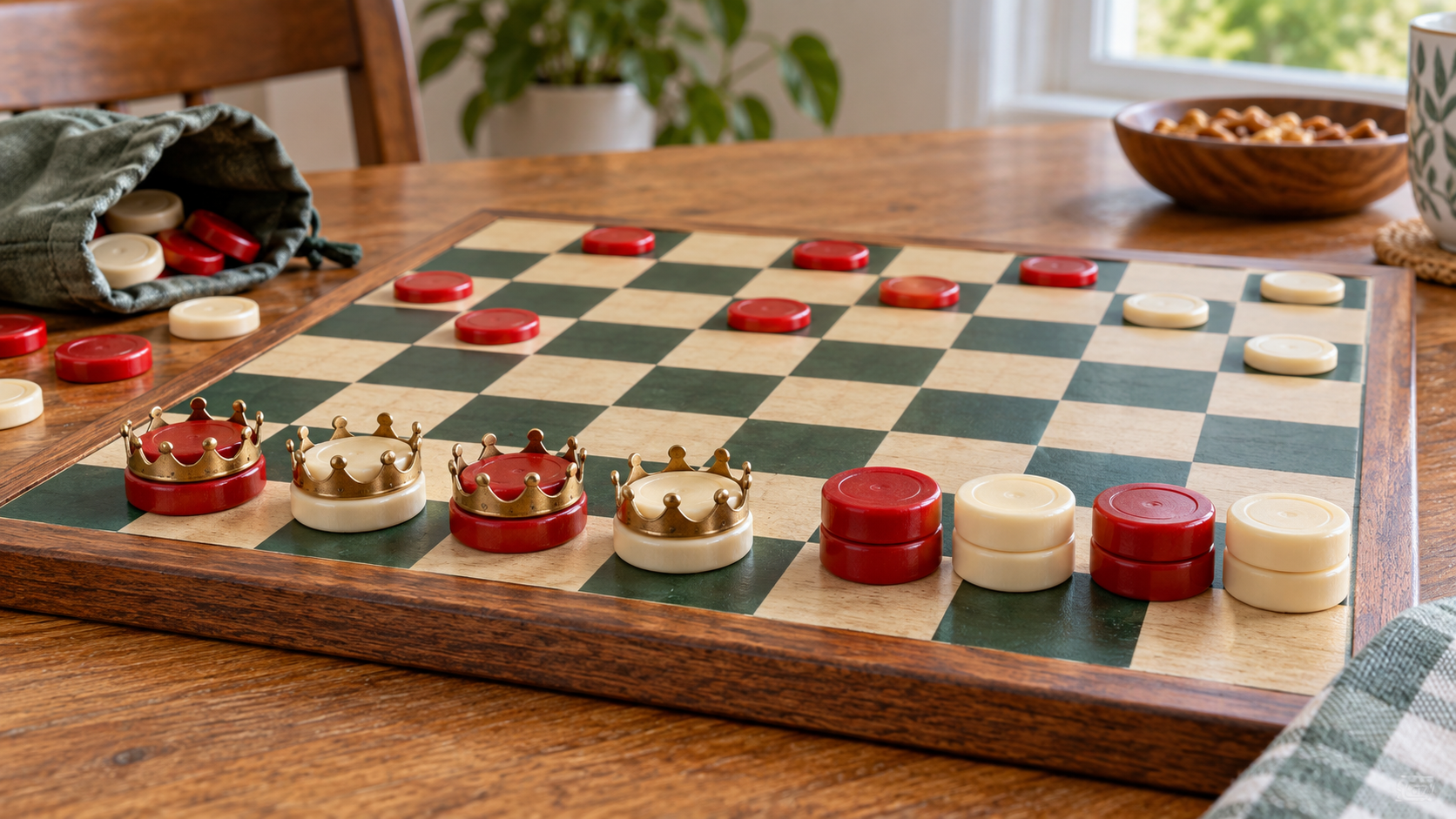
Measure the existing set first
Compare king markers and stackable replacements
For rings, verify inside diameter, quantity, visibility, and storage. For replacement pieces, match diameter, thickness, color, top-and-bottom shape, and the number needed for complete play.
Quick decision
- Use stackable pieces when the set was designed to stack, matching extras are available, and the taller king remains clear and steady.
- Try crowning rings when flat pieces will not stack well, a lower marker is easier to read, and a verified ring size fits without forcing or wobbling.
- Skip both purchases if your set already has a clear, complete kinging method.
- Replace the full piece set when colors, sizes, or quantities are inconsistent enough that another small accessory would add confusion.
The core difference: a separate marker or a second checker
A crowning ring adds a distinct part around or on top of the promoted checker. It can make a flat piece look different without requiring another full checker, but it creates a new fit measurement and a new group of small parts to count.
Stacking uses a second checker of the same side. It is simple when the pieces have compatible faces or molded rims and the set includes enough pieces. It is less useful when the checkers slide, tilt, or become too wide or tall for comfortable play.
Rules and terminology vary among checkers and draughts traditions. This page addresses the equipment decision only. Use the marker that your players recognize, and agree on it before the first move rather than presenting one accessory as an official universal standard.
Compare the practical criteria
| Criterion | Crowning rings | Stackable pieces |
|---|---|---|
| Compatibility | Inside profile must fit the checker diameter and shape | Top and bottom surfaces must nest or rest securely |
| King visibility | Different outline or color can stand out at low height | Extra height is usually the main visual signal |
| Inventory | One separate marker for each king that may appear | Enough same-color spare checkers to form king pairs |
| Reset | Remove, count, and return rings to their container | Separate doubled pieces and count all checkers by color |
| Storage | Needs a labeled pocket or compartment | Uses the set's existing piece storage if capacity allows |
| No-buy trial | Use a clearly agreed temporary marker that does not obscure the piece | Test two existing checkers on several board squares |
Measure rings instead of trusting “standard size”
Measure the checker across its widest point in the orientation where the ring will sit. Compare that number with the listing's stated inside diameter or fit range. Also inspect whether the ring rests around the side, on the top, or in a molded groove; those designs are not interchangeable.
Do not force a tight ring onto a checker. A loose ring that shifts or hides the piece color is also a poor fit. If the seller does not provide usable dimensions or imagery that clearly shows the fitting method, skip that route. The opportunity to buy a small accessory is not worth guessing about compatibility.
Test stackability with the board in use
Place two same-color checkers together on the center and edge squares. Move the king diagonally, make a representative jump, and reach past it to another piece. The pair should remain recognizable without repeatedly separating during ordinary handling.
Then count the pieces. A normal starting arrangement in American checkers uses 12 pieces per side, but the way a physical set supplies or reuses pieces for kings varies. Do not assume a replacement pack includes enough pieces of each color merely because the total quantity looks large.
Visibility matters from every seat
Look at each marker from the usual player seats, not only from directly above. A ring may have a strong silhouette but little color contrast; a double stack may be obvious from the side but blend into a busy board from above. Mixed-age groups may prefer the method that stays legible without a reminder.
A marker should also leave the square and checker color readable. Decorative crown points can photograph well while crowding neighboring pieces. Favor a plain, repeatable signal over ornament.
Plan the reset and storage routine
Rings need their own counted location: a small labeled compartment, closed pouch, or slot in the set box. Record the expected quantity so the person packing up knows when one remains on the table. Stackable pieces require a color count and enough storage height when the set is closed.
For classrooms or several family sets, avoid mixing rings and checkers with slightly different diameters. Keep each marker kit with the measured set it fits. If replacement inventory is the larger problem, use the replacement checkers guide for classroom sets.
Who should skip crowning rings?
Skip rings when dimensions are missing, your pieces already stack clearly, the set travels in a shallow case, or another group of loose parts would make cleanup harder. Also skip them when the ring obscures which side owns the checker or requires explanation every game.
Who should skip buying stackable replacements?
Skip a piece-only replacement when its diameter, thickness, color, and shape cannot be matched to the board and existing checkers. If most of the set needs replacement—or the board squares are already crowded—a complete readable set may be the simpler path. Compare flat and stackable checkers pieces for beginners before changing the whole format.
Bottom line
Stackable pieces are the simpler choice when the existing set supports a stable, obvious double stack and has enough matching spares. Crowning rings are useful only when a verified fit gives flat pieces a clearer king marker without complicating storage and reset. Measure one checker, test visibility from both seats, count the complete kit, and keep the current method if it already works.