
A room can feel bright while the far side of a chessboard, the coordinates, or a study book remains hard to read. A useful board light spreads illumination across the complete playing area and notes without occupying the space needed for pieces, captured material, or a book stand.
This is a category comparison, not a ranking of named lamps or a claim of hands-on testing. No approved current named-product feed is configured, so compare the observable formats below and verify every listing's dimensions, controls, power method, and placement instructions.
The Good Chess & Checkers may earn commissions from qualifying purchases.
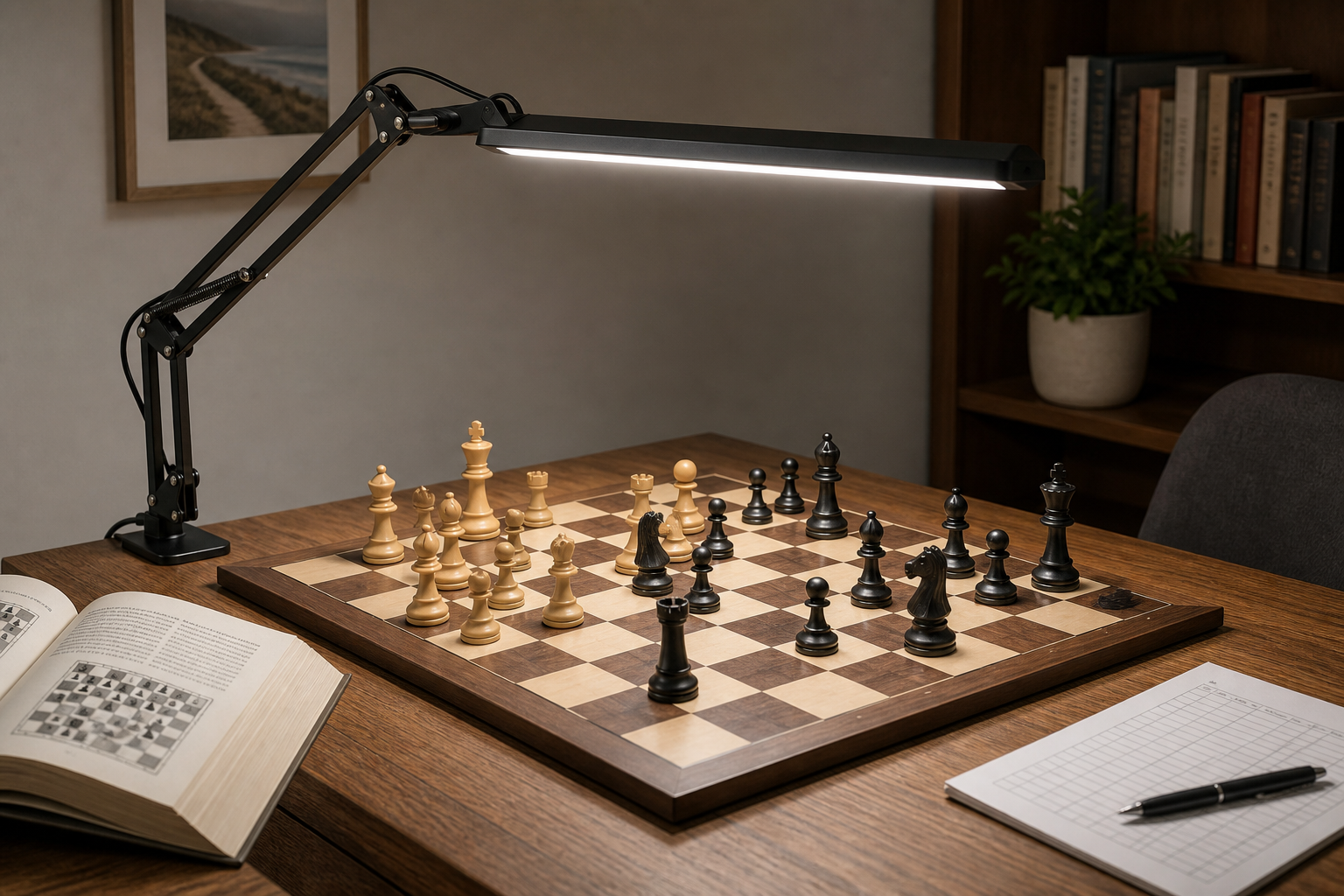
Quick decision aid
Start with coverage and placement
Measure the board, reading area, and available mounting space. A wide adjustable task light is useful only if its arm reaches the board without putting the base, clamp, cable, or lamp head in the players' way.
Selection criteria that matter
- Board-wide coverage: the lit area should reach all four corners plus the book or score sheet you actually use.
- Adjustable reach: compare arm length, pivot points, and head rotation with the distance from the base or clamp to the board center.
- Glare control: a diffused light bar and a position above eye level can reduce bright reflections on glossy boards and pieces.
- Shadow direction: place the head high enough and near the board centerline so tall pieces do not hide neighboring squares.
- Base or clamp fit: measure the base footprint, clamp opening, table thickness, edge shape, and clearance below the tabletop.
- Controls and memory: brightness or color settings matter only if controls remain reachable and the current listing clearly explains how they work.
- Power and cable route: confirm plug type, cable length, adapter placement, and a route that stays away from hands and chairs.
Comparison framework: which lighting format fits?
If those are your final two choices, use the focused clip-on light versus desk lamp comparison to map the clamp, base, reach, cable, and storage tradeoffs onto a small measured desk.
Wide-bar clamp lamps
Choose one when: the desk has a compatible exposed edge and you want broad coverage without giving up tabletop space. A long head can illuminate a board and open book from one mounting point.
Skip it when: the table has a thick apron, rounded edge, delicate finish, or no safe cable route. Follow the lamp maker's mounting instructions rather than assuming every clamp suits every table.
Adjustable lamps with weighted bases
Choose one when: clamping is not possible and the table or nearby side surface has room for a stable base. It is easier to reposition between study and ordinary desk use.
Skip it when: the base crowds captured pieces, books, clocks, or players' arms, or the arm cannot reach the center without becoming unstable.
Double-head task lights
Choose one when: two independently angled light sections can cover the board and reading area more evenly than one narrow beam. Check the total spread at your mounting distance.
Skip it when: the extra joints add bulk without reaching both work zones, or separate bright strips appear as distracting reflections on the board.
Portable rechargeable lamps
Choose one when: the study table changes frequently or a cable cannot safely reach it. Compare operating instructions, charging method, packed size, and whether useful brightness is available for a complete session.
Skip it when: charging becomes another setup barrier or the compact head lights only part of a full-size board.
How to test the setup without medical claims
- Set out the actual board, tallest pieces, book stand, clock, and writing materials.
- Measure from the possible base or clamp position to the board center and far corners.
- Check the board at normal seated eye level for bright reflections and squares hidden by piece shadows.
- Move a piece on every edge to confirm the head, arm, base, and cable remain outside the play path.
- Read coordinates and diagrams from both seats; reposition the lamp before relying on a higher brightness setting.
- Verify current manufacturer instructions for mounting, power, adjustment, and placement.
These checks address visibility and table organization, not eyesight, headaches, sleep, or other health outcomes. If a personal visual need affects play, choose guidance appropriate to that need rather than treating a lamp listing as a medical solution.
Fit the lamp into a complete study station
A lamp cannot fix a board with weak square contrast, pieces that blend into the squares, or a cramped table. Start with a readable coordinate chessboard if notation is the main challenge. Use a book stand to keep diagrams upright without covering the board, and choose an analysis set when the current set consumes the whole desk.
The named beginner-chess pillar is not built yet, so this guide links to the closest published study and board-selection paths rather than inventing a missing hub.
Who should skip a dedicated board light?
Skip one if an existing ceiling or room light already makes every square, piece, diagram, and note clear from both seats. A dedicated lamp is also a poor fit when the table changes constantly, no base or clamp can be positioned safely, or the cable would cross a walkway. In those cases, moving the board, using a smaller study set, or improving general room lighting may be the simpler decision.
Bottom line
For a permanent home-study desk with an exposed edge, a wide adjustable clamp light usually preserves the most playing space. A weighted-base lamp suits tables that cannot accept a clamp, while rechargeable formats trade coverage and charging upkeep for portability. Choose by measured reach, even board coverage, glare control, mounting fit, and cable placement—not by maximum brightness alone.