
When a chessboard, open book, and notebook must share one small desk, the lamp is part of the layout. A clip-on light saves surface area but needs a suitable edge and enough reach. A freestanding desk lamp is easier to reposition but uses space that might otherwise hold the board or book.
This is a category comparison, not a test of named lamps. Check the exact product dimensions and instructions before buying, and try your existing room lighting first.
As an Amazon Associate, The Good Chess & Checkers may earn from qualifying purchases.
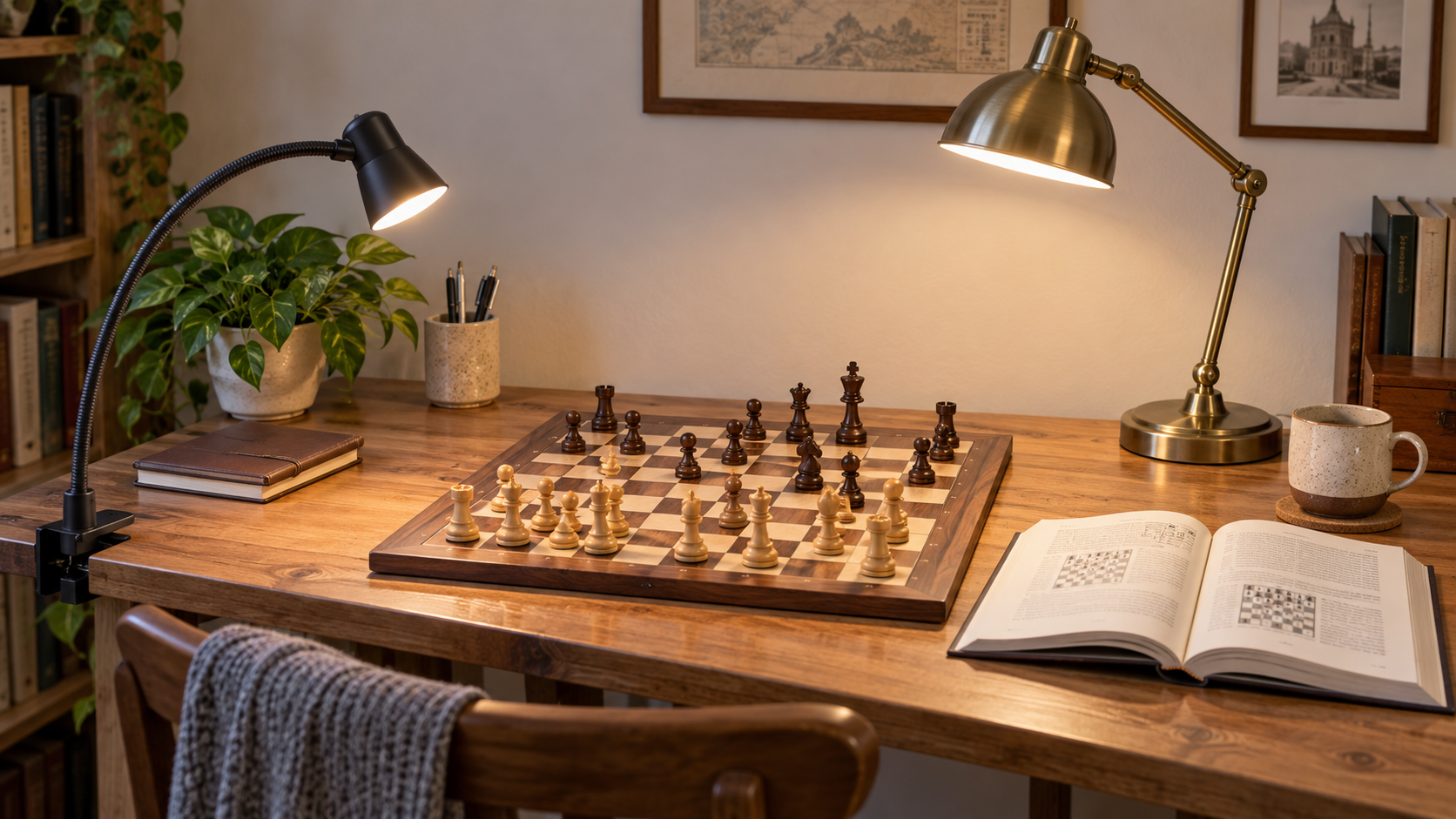
Compare the two formats
Measure the attachment and footprint before shopping
A clamp light suits a sturdy, accessible desk edge and a layout that rarely moves. A weighted-base lamp suits a desk with no usable edge or a study setup that must be rearranged often.
Quick Verdict
Choose a clip-on light when desk surface is the tightest constraint, the edge accepts the clamp without blocking a drawer or your knees, and the arm can reach the board without sitting in the move path.
Choose a desk lamp when you need easy repositioning, lack a compatible edge, or want the lamp to serve other reading and household tasks.
Skip both for now when moving the desk, rotating the board, or repositioning an existing lamp produces even, comfortable visibility for the entire study area.
Clip-On Light vs Desk Lamp at a Glance
| Decision | Clip-on light | Freestanding desk lamp |
|---|---|---|
| Desk surface | Uses little or no top surface | Needs a clear base footprint |
| Required support | Needs an edge within the stated clamp range | Needs a flat, stable area for the base |
| Repositioning | May require unclamping and checking the edge again | Usually moves with the base, within cord reach |
| Reach | Measured from the clamp point to the board center and far edge | Measured from the base location to the same points |
| Storage | Compact base, but the clamp and arm still need room | Base and arm can take more shelf or cabinet space |
Start With the Complete Study Rectangle
Set out the board, book, notebook, and any clock exactly as you use them. Mark the remaining surface area and the desk edges you can reach. The lamp must cover the far ranks, the near ranks, and the book without forcing its arm or base into your playing space.
Do not compare lamp reach from a product photo alone. Check the maker's stated arm dimensions, base dimensions, or clamp range, then compare them with your measured layout. An articulated arm may not extend in every direction shown by its total length.
When a Clip-On Light Fits Better
A clip-on format is useful when every patch of desktop matters. It can attach behind or beside the board and leave the book area free. It also keeps its mounting point fixed, which can make a repeated study setup easier to recreate.
The edge is the deciding constraint. Measure its thickness and depth, look underneath for drawer fronts or support rails, and follow the lamp maker's attachment instructions. Skip the clamp if its pads cannot sit fully on the intended surface or if the arm would be bumped during ordinary moves.
When a Desk Lamp Fits Better
A freestanding lamp works on desks without an accessible edge and moves more easily between the board, a reading chair, and other tasks. The base can also provide a predictable support point without depending on the desk's edge shape.
Measure the whole base rather than its apparent width in a photograph. Place a paper outline of that footprint on the desk and make several moves on the board. If your forearm, book, or captured pieces repeatedly enter the outline, the base is too intrusive for that position.
Check Coverage Without Chasing Brightness Claims
The practical goal is to distinguish pieces and squares across the entire board while reading the book beside it. Place the light above and to one side, then view the board from the chair you actually use. Glossy boards and pieces can show reflections at some angles, so adjustable position matters as much as a marketing brightness number.
If a listing states adjustable output or color controls, treat those as controls to verify—not a promise of better study. Avoid medical or eye-comfort conclusions. Your room light, board finish, lamp shade, distance, and viewing angle all affect the result.
Power and Cable Placement
- Outlet-powered: confirm that the cable reaches without crossing the board, chair path, or desk drawer.
- USB-powered: identify the required power source and whether an adapter is included in the exact listing.
- Rechargeable: check the maker's charging instructions and decide where the lamp will recharge between sessions; do not assume a runtime that is not documented.
- Controls: make sure switches remain reachable after the clamp or base is placed.
A No-Buy Setup Test
- Arrange the complete study setup and photograph it from your seated position.
- Use a book or paper rectangle to reserve the dimensions of a candidate lamp base.
- Mark a proposed clamp point and measure from it to the board's center and far corners.
- Move every piece type from both sides and turn several book pages.
- Reposition an existing household lamp and the desk before deciding the problem requires new equipment.
Who Should Skip Each Format?
Skip a clip-on light when the desk edge is too thick, rounded, fragile, obstructed underneath, or outside the maker's clamp instructions. Skip a desk lamp when its base displaces the book or board, when storage is scarce, or when the only workable position creates distracting reflections. Readers with ample room and good existing overhead light may need neither.
Bottom Line
For a genuinely cramped chess desk, a clip-on light is usually the space-saving choice—but only when the clamp fits and the arm reaches the full work area. A freestanding lamp is the more flexible choice when the desk edge is unsuitable or the setup changes often. Measure first, test the no-buy layout, and choose by physical fit rather than by category name.
The planned beginner chess rules and strategy pillar is not yet built. For now, continue with the book-stand guide or analysis-set guide to finish a practical board-study workspace.