
Replaying a position from a book already asks a small desk to hold the book, a board, pieces, and sometimes a notebook. A compact page holder can stop a paperback from closing without adding the depth and height of a full book stand—but only if it fits the binding and leaves the diagram visible.
This is a category comparison, not a hands-on ranking. We have not tested every current listing. Measure your open book and working space, inspect the holder's contact points, and confirm the seller's current dimensions and supported thickness before buying.
As an Amazon Associate, The Good Chess & Checkers may earn from qualifying purchases.
Control pages, not the whole book
Shop compact page-holder formats
Compare clip-on holders, clear page restraints, and small page weights. Check the book thickness each format can accept and how much of the page it covers.
What Matters Most on a Small Study Desk
- Book fit: verify the closed thickness, open page span, binding type, and whether the holder must grip one cover or the complete book.
- Diagram clearance: map every clip, arm, and weight against the diagrams, notation, and page numbers you actually use.
- Working footprint: include any projecting handle or clip, not only the part touching the page.
- Page turning: decide whether you will move one holder, release a clip, or lift a weight every time you advance.
- Contact surfaces: look for smooth edges and enough holding force without assuming a holder is suitable for delicate or collectible books.
- Portability: a compact device should store safely without bending, snagging, or becoming easy to lose.
Best Simple Choice: A Slim Clip-On Page Holder
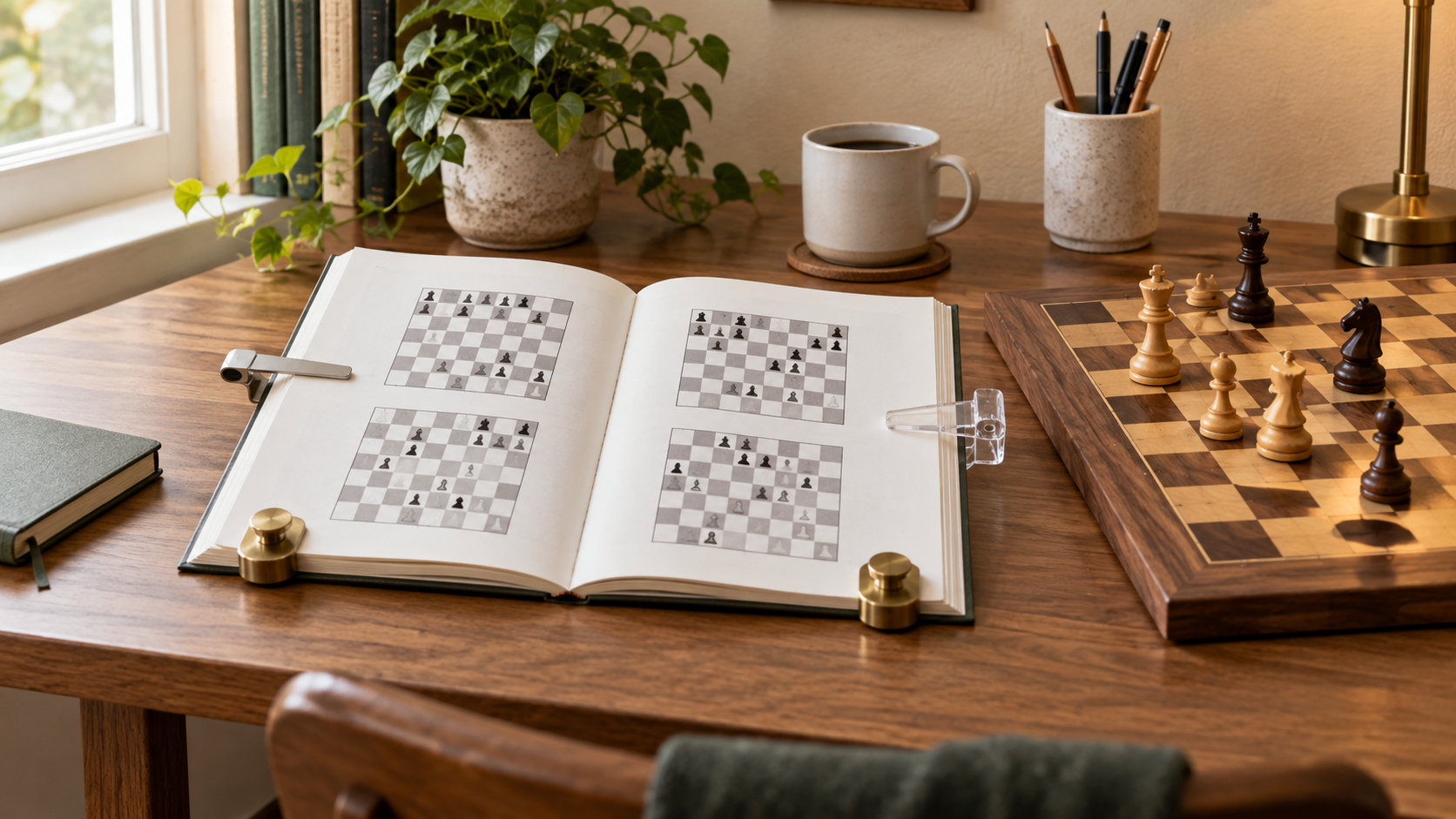
A narrow clip can hold one side or the lower edge of an open book while leaving most of the desk free. It suits ordinary paperbacks when the clamp opens far enough and the arm reaches the page without covering the current diagram. A swiveling or sliding arm can make placement easier, but every moving part also adds a measurement to check.
Best for: paperback study books with a clear outer margin and readers who stay on one spread for several minutes.
Skip it if: the clamp cannot accept the cover and page stack, the pressure point lands on a diagram, or frequent page turns make repeated clipping annoying.
Best for Seeing Through the Holder: A Clear Page Restraint
A transparent restraint can keep more of the printed area visible than an opaque bar. Transparency does not guarantee readability: thick edges, glare, scratches, and distortion can still hide small coordinates or notation. Look at the full shape and contact area, then plan to place it over blank margins whenever possible.
Best for: books with narrow margins where an opaque arm would cover useful content.
Skip it if: your study light reflects strongly from clear plastic or the restraint crosses the center of the diagram.
Best for Flexible Placement: Two Small Page Weights
Separate weights can sit at the lower corners without clamping the cover or binding. They adapt to different book thicknesses and move quickly when a diagram occupies one corner. Their tradeoff is loose-object management: they need clear landing spots, take a little desk area, and must be stored between sessions.
Best for: mixed book sizes, flatter-opening books, and readers who want to choose a new contact point on each spread.
Skip it if: the desk is tilted, bumped often, or too narrow to keep the weights away from the board and pieces.
Best No-Clip Option: A Weighted Reading Bar
A slim weighted bar spans part of one page and avoids attaching anything to the book. It works best when its length, weight, and surface align with an empty margin. On a chess book, a long bar can easily cover ranks, files, captions, or move text, so measure the available blank band rather than assuming the page width is enough.
Best for: large pages with a consistent blank lower or outer margin.
Skip it if: diagrams fill the page, the book springs closed strongly, or the bar would roll or slide during use.
Quick Comparison Framework
- Choose a slim clip when the book has a usable gripping edge and you want the smallest loose footprint.
- Choose a clear restraint when placement may overlap printed content and glare is manageable.
- Choose separate weights when book sizes vary and flexible corner placement matters most.
- Choose a reading bar only when the page has a measured blank band wide enough to hold it.
- Choose a full book stand instead when you also need the book raised, angled, or supported upright.
Measure the Whole Study Layout
- Place the board where it will sit during study, including room for captured or spare pieces.
- Open the thickest chess book you expect to use and measure its width, thickness at the chosen spread, and available blank margins.
- Mark the diagrams and notation that cannot be covered.
- Measure the remaining desk area, including the space needed to turn a page without moving the board.
- Compare those measurements with the holder's complete footprint, clamp opening, reach, and contact area.
Try the layout before buying by using clean household objects as temporary page weights. The trial will show whether page closure is the real problem or whether the open book itself simply needs more desk space.
Who Should Skip a Dedicated Page Holder?
Skip one if a spiral-bound book already lies flat, a borrowed digital edition solves the space problem, or two clean temporary weights work reliably. A chess book stand is the more useful category when viewing angle and upright support matter. Also skip any holder whose listing omits its opening, contact area, or overall dimensions; a generic “fits most books” claim does not establish fit.
Bottom Line
For most small-desk chess study, start with the least intrusive format that fits the actual book: a slim clip for a usable edge, a clear restraint when visibility matters, or two small weights for flexible placement. Measure the open spread, protect every diagram, and include the holder's complete footprint before deciding that compact means compatible.