
Choose a book stand when you need the book raised at a readable angle and fully supported. Choose a compact page holder when the book already sits well on the desk and your only problem is keeping springy pages open. The smaller tool is often enough; the stand earns its extra footprint when viewing angle and book support matter during long replay sessions.
This is a product-category comparison, not a named-product ranking or hands-on test. Start with the chess book, board, and desk you already use, then verify dimensions and mechanisms on the current listing.
The Good Chess & Checkers may earn commissions from qualifying purchases.
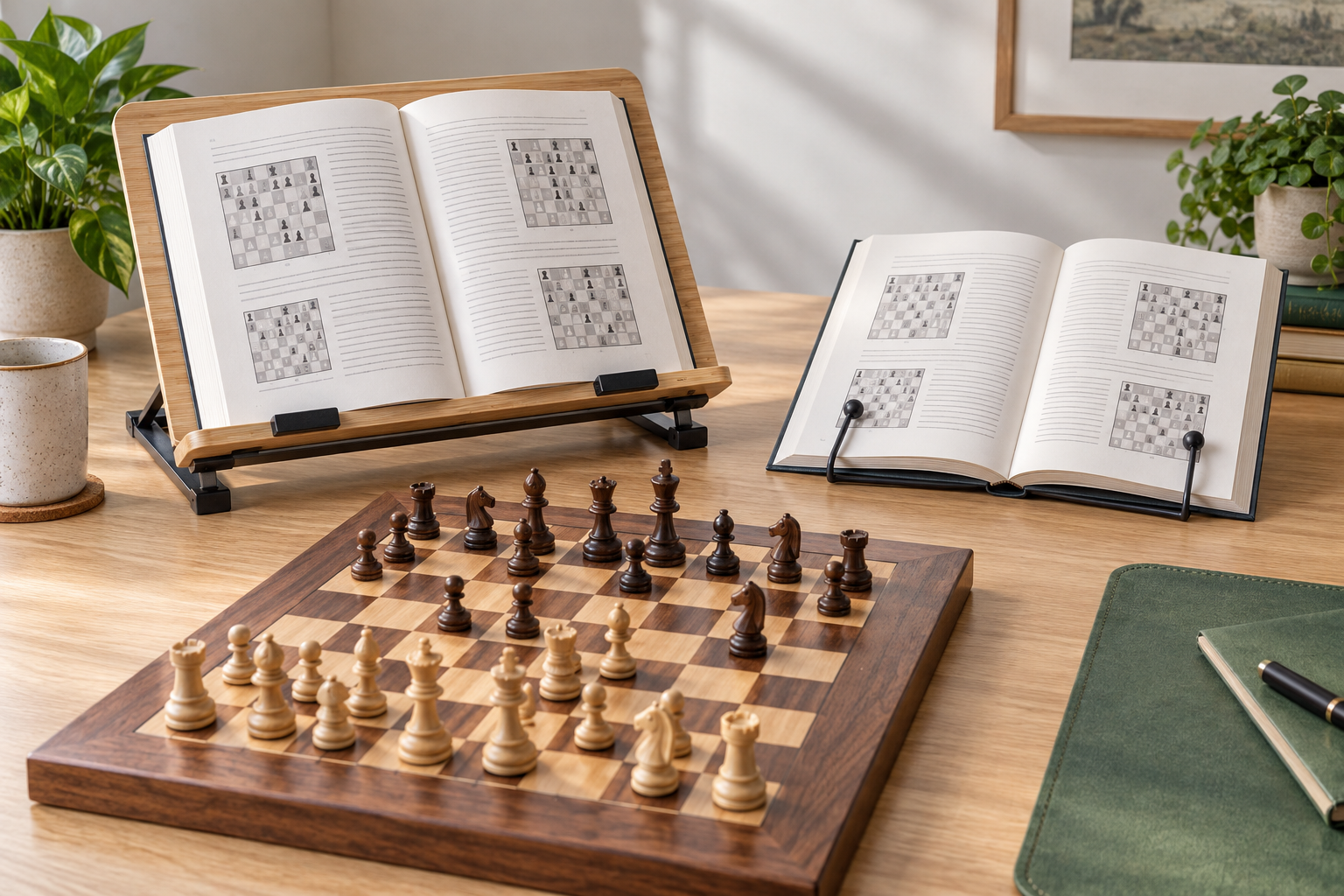
Quick decision aid
Compare both accessory formats
For a stand, check the support panel, ledge depth, stable angles, clips, and complete base footprint. For a page holder, check the book thickness it spans, where it touches the pages, how much text it covers, and whether it stays clear of diagrams.
Quick decision
- Choose an angled book stand for a heavy book, a book that needs full cover support, or a setup where raising the diagrams makes replay easier.
- Choose a compact page holder when desk depth is scarce, the book is comfortable to read while flat, and pages simply will not stay open.
- Use a stand with built-in page clips when both support and page control are necessary, but verify that the clips do not cover notation or diagrams.
- Skip both purchases when the book lies open on its own or a light, non-damaging household object already controls the page without hiding content.
The practical difference
A tabletop stand supports the covers and page block on an angled panel. It can lift the book behind the chessboard, reduce the distance between diagram and pieces, and free the desk area directly under the book. In exchange, it adds a base, hinges, a ledge, and another object to store.
A compact page holder does less. Some span the lower edges of an open book; others use small arms or clips. The book remains on the desk at roughly the same height and angle, but the accessory may fit in a drawer or book bag. That simplicity is useful when page closure is the only obstacle.
Choose by the way you study
You replay moves on a full-size board
A stand can put the book behind the board, keeping diagrams visible above the pieces. Measure the entire arrangement: board depth, stand base depth at the intended angle, open book width, and the reach needed to turn a page. A product's folded size does not reveal how much desk it uses while open.
A page holder is the better fit when the open book can sit beside the board without crowding captured pieces or your writing hand. It will not improve the viewing angle, so test the flat-book position before buying.
You use a small analysis set or shallow desk
Start with a page holder. It avoids the backward depth an angled stand often needs and can travel inside the book or a small accessory pouch. Check whether the holder extends beyond the page edges or blocks the bottom ranks of chess diagrams.
A compact stand may still work when vertical space is available and the base fits behind the board. Make paper rectangles matching the published base and open-book dimensions, then place them on the actual desk before ordering.
You study from thick hardbacks or stiff paperbacks
Thick books need verified support. Compare the book's closed thickness and open width with the stand's ledge depth, support-panel width, and stated capacity. With a separate page holder, verify the maximum span or book thickness and inspect how the contact points sit on curved pages.
Do not assume a holder that works on a thin novel will span a thick chess reference book. Likewise, a stand shown with a tablet may have a ledge too shallow for a large page block.
You change pages often
Look at the release-and-reset action. A useful stand clip can be moved with one hand while the other hand remains near the board. A separate holder should lift or slide without bending a corner or forcing the book closed. Product photos can show the mechanism, but the real test is whether its contact points overlap the page areas you need.
What to verify before buying
- Open book size: measure width, height, thickness, and approximate weight using the largest book you expect to study.
- Visible page area: compare arms, clips, and ledges with the location of diagrams, notation, page numbers, and answer text.
- Stand footprint: use dimensions for the chosen working angle, not only the folded product.
- Support and adjustment: verify the maker's stated size or load guidance and how the angle locks.
- Page-holder span: confirm the supported book thickness or width rather than trusting a generic “books” label.
- Storage: check folded thickness, loose parts, and whether the accessory fits with the book and board you carry.
- Materials and contact points: inspect the surfaces that touch covers and pages; follow the book and accessory makers' care guidance.
Try the layout without buying anything
- Set up the board, open book, notebook, and captured-piece space exactly as you use them.
- Prop the book at a modest angle with a stable object placed well away from the board, then compare that view with the book lying flat.
- Use two clean, light objects near the page edges for one short session, taking care not to cover diagrams or stress the binding.
- Notice the actual problem: poor viewing angle, inadequate book support, pages closing, lost board space, or slow page turns.
- Buy only the format that fixes that repeated problem, using measured dimensions from the trial.
Who should skip each option?
Skip a stand if your desk cannot accommodate its working footprint, the book is already easy to read flat, or your study materials are mostly loose sheets. A stand can solve the wrong problem while taking space from the board.
Skip a separate page holder if the book needs rigid back support, a higher viewing angle, or a span beyond the holder's documented fit. Also skip one whose arms obscure the diagrams you replay most often. If you study mainly from a screen, neither book accessory is likely to earn its storage space.
Bottom line
A chess book stand is the fuller solution: it supports the book and changes the viewing angle, but it costs more desk and storage space. A page holder is the focused solution: it keeps pages open while leaving the book flat and the setup portable. Measure the open book and complete study layout, identify the one recurring frustration, and choose the smallest accessory that removes it.
If binding is the root of the problem, compare a spiral-bound chess book with a hardcover book for board study before adding a separate support accessory.