
The best chess and checkers set for a coffee table is attractive enough to leave nearby but practical enough that people actually play it. A set can look great in a living room and still fail if the pieces are hard to identify, the board crowds the table, or there is no easy place to put everything away.
This guide compares useful coffee-table set categories rather than ranking specific products. It does not claim hands-on testing, current prices, ratings, or live availability. If the real issue is a tight apartment or small shelf, compare this with chess and checkers sets for small spaces. If the set is mainly a family gift, use best chess and checkers gift sets for families before choosing a display-first board.
As an Amazon Associate, The Good Chess & Checkers may earn from qualifying purchases.

Quick decision aid
Choose the products in this guide
Compare these affiliate product routes first, then use the guide criteria to choose the board, pieces, storage, clock, or learning aid that fits the player.
Helpful product path
How to Judge a Coffee-Table Set
A coffee-table set has a harder job than a set that lives in a closet. It has to share space with drinks, books, remotes, snacks, and guests while still being clear enough for beginners. Before choosing one, judge the set by these fit points:
- Readable pieces: chess pieces should have familiar shapes, and checkers should contrast clearly with the board.
- Table footprint: the open board should leave room for players' hands and normal living-room clutter.
- Stable board surface: the board should sit flat and resist sliding when people lean over a low table.
- Storage plan: drawers, lids, trays, or pouches should keep pieces from becoming decor scattered around the room.
- Dust control: a set left out needs a realistic way to stay clean enough for regular play.
- Beginner friendliness: decorative details should not make the bishop, pawn, king, queen, or checker colors harder to tell apart.
Best Overall: A Medium Wooden Combo Set with Built-In Storage
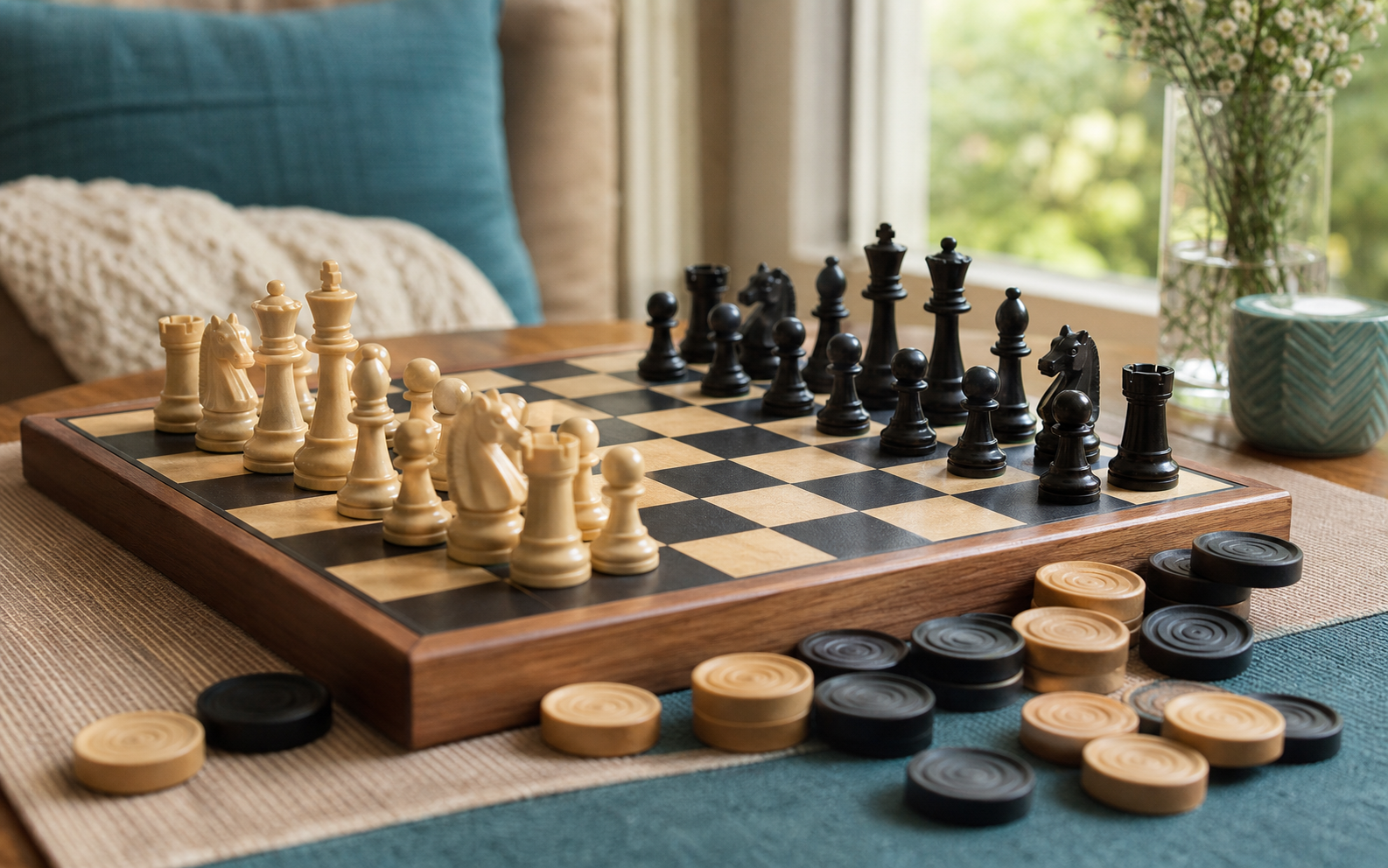
A medium wooden or wood-look chess and checkers combo set is the safest coffee-table category for many homes. It feels presentable in a living room, usually offers enough board space for casual games, and can store both chess pieces and checkers in the same case.
Look for a board that opens flat or sits as one stable surface, pieces that are easy to recognize, and interior storage that keeps chess pieces separate from checkers. The best version feels like a normal household game, not a fragile display object that nobody wants to touch.
Best for: casual living rooms, family rooms, grandparents' houses, and buyers who want one set that can stay nearby without looking temporary.
Skip it if: the hinge raises the middle of the board, the interior storage dumps pieces together, or the board is too wide for the table where people actually sit.
Best for Display: A Readable Wood or Stone-Look Set
Display value is fine as long as it does not outrank playability. A set with warm wood tones, a stone-look board, or a more polished case can work well on a coffee table when the squares still contrast and the pieces remain obvious.
Be especially careful with novelty shapes, low-contrast boards, glossy finishes, and sculptural chess pieces. If a beginner has to ask which piece is the bishop or whether a checker is on a dark square, the set is better decoration than equipment.
Best for: rooms where the set will sit visible between games and presentation matters almost as much as regular play.
Skip it if: the set uses themed or abstract pieces that slow down beginners, or if the board pattern competes with the pieces.
Best for Small Coffee Tables: A Compact Folding Combo Set
A compact folding set can make sense when the coffee table is narrow, round, or already crowded. The key is choosing compact without going tiny. Players still need enough room to pick up pieces, crown checkers, and see the board from a sofa angle.
Compact coffee-table sets work best when they close securely and have an obvious home beside the couch or on a shelf below the table. If portability matters too, compare the category with best folding chess and checkers sets before choosing a small format.
Best for: apartments, dens, small living rooms, side tables, and homes where the board needs to disappear quickly after play.
Skip it if: the pieces are so small that adults pinch them awkwardly or children lose track of which chess piece is which.
Best for Fast Reset: A Set with a Drawer or Divided Tray
Coffee-table sets get used more often when cleanup is obvious. A drawer, divided tray, or lidded insert gives every piece a home and keeps checkers from mixing with chess pieces after a short game.
Drawers should open smoothly without tipping the board or scraping the table. Trays should be shallow enough that people can see missing pieces before the set goes away. If the family already owns a board but loses pieces often, use best chess and checkers storage ideas for families for storage-only fixes.
Best for: families, shared apartments, homes with guests, and anyone who wants a visible game without visible clutter.
Skip it if: the storage looks clever but is too tight for the pieces, too fragile for regular use, or hidden enough that missing pieces go unnoticed.
Best for Mixed Ages: A High-Contrast Large-Piece Set
If children, grandparents, or guests will play from a low sofa or armchair, choose clarity over drama. Larger pieces and high-contrast squares can make a coffee-table game feel calmer because players do not have to lean in or squint.
The board still has to fit the table. Large pieces on a crowded board are frustrating, and a very large board can take over a living room surface. For more detail on size and handling, compare this with best large-piece chess and checkers sets.
Best for: mixed-age family rooms, grandparents and kids, relaxed teaching games, and homes where readability matters more than a tiny storage footprint.
Skip it if: the large board blocks normal table use or the pieces crowd the squares when the game reaches the middle.
Best Low-Clutter Option: A Board That Lives Nearby, Not Always Out
The best coffee-table choice is not always a permanent display set. Some homes do better with a handsome folding board, a nearby shelf, and storage that makes setup take less than a minute. That keeps the table useful while still making the game easy to start.
This approach is especially useful when drinks, pets, younger children, or frequent guests make a permanently open board impractical. The set can still feel living-room friendly without being exposed all day.
Best for: busy living rooms, shared coffee tables, households that host often, and buyers who want a game close at hand without committing table space.
Skip it if: the set will be put so far away that nobody reaches for it casually.
Quick Comparison Framework
- Choose a medium wooden combo set when you want the safest balance of display, storage, and everyday play.
- Choose a readable display set when presentation matters but the pieces and board remain beginner-friendly.
- Choose a compact folding set when the table is small and the board still stays comfortable to use.
- Choose drawer or tray storage when cleanup and missing pieces are the biggest risks.
- Choose a high-contrast large-piece set when mixed ages or sofa-distance viewing make clarity more important.
- Choose nearby storage instead of permanent display when the table needs to stay open for daily life.
Who Should Skip a Coffee-Table Set?
Skip a coffee-table set if the main player needs club-style chess equipment, several duplicate boards, or a travel set that can survive bags and cars. A coffee-table set is usually a home-use compromise, not the best tool for every setting.
Also skip display-first boards if beginners will be learning on them. Unusual pieces, shiny squares, and low-contrast colors can make the first games harder than they need to be. A plain readable set that gets played is better than a beautiful board everyone avoids.
Bottom Line
For most coffee tables, start with a medium wooden or wood-look chess and checkers combo set with readable pieces and real storage. Go more decorative only when the board stays clear, compact only when the pieces remain usable, larger only when the table can handle it, and off-table when daily clutter would make a permanent display frustrating.
The right set should invite a casual game, not just fill a surface. If it looks good, stores cleanly, and remains easy for beginners to read, it has earned its place in the living room.