
Club storage guide
Best Chess Clock Drawer Organizers for Club Storage
Separate, label, count, and retrieve several clocks without turning a secure drawer into a loose equipment pile.
A drawer organizer makes sense when a club already has secure fixed storage but its clocks slide together, hide behind one another, or take too long to count. Start with the clocks and drawer you actually own. Measure both, test the retrieval motion, then choose a divider format. “Adjustable” is useful only when the listed compartment range fits the equipment.
As an Amazon Associate, The Good Chess & Checkers may earn from qualifying purchases.
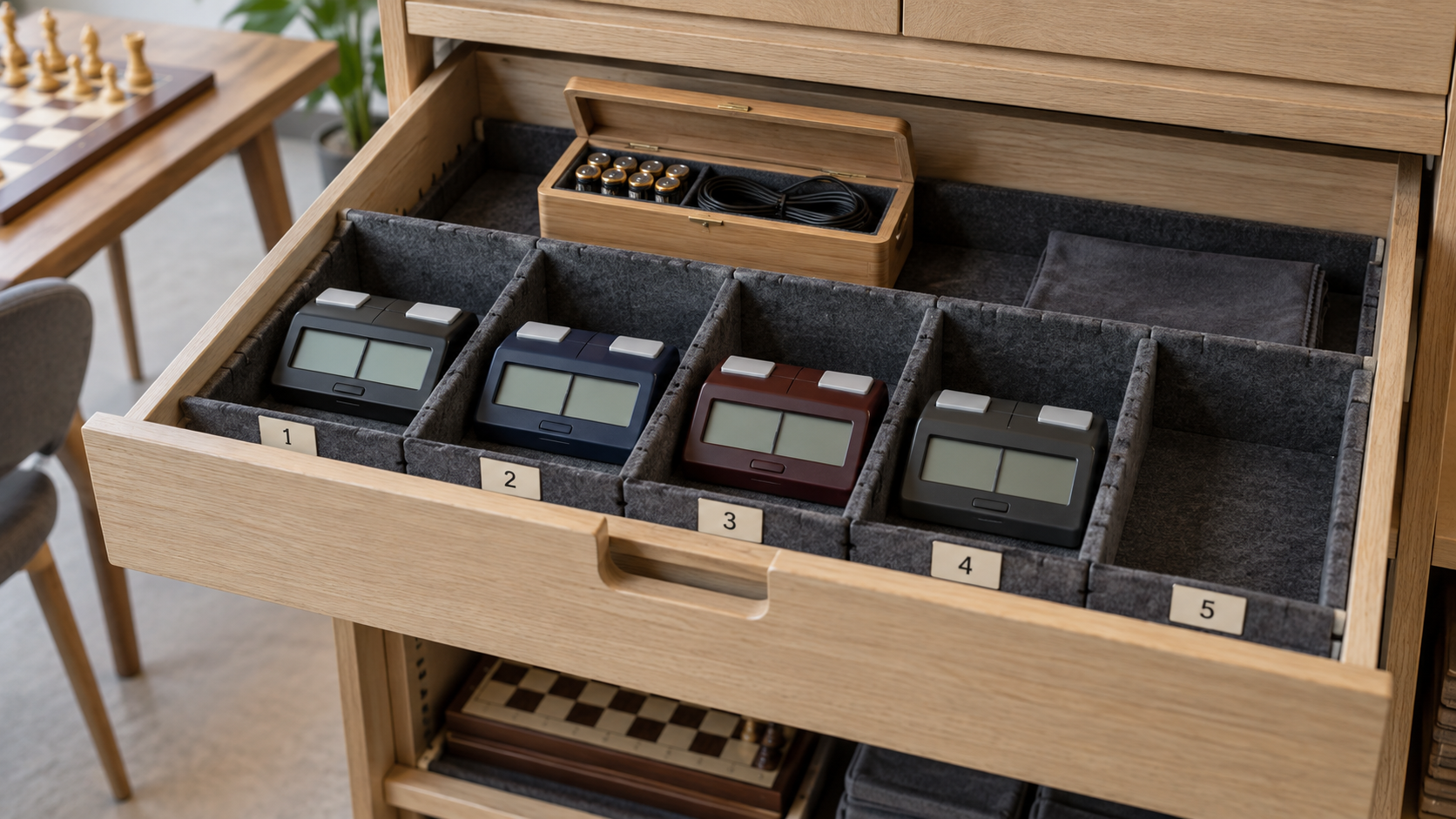
Measure the equipment before the insert
Browse adjustable padded drawer organizers
Compare the listed interior and exterior dimensions, divider range, base material, height, and attachment method. Confirm that the complete insert fits the drawer and that each clock clears the drawer above it.
Quick comparison framework
- Adjustable padded dividers: best starting point for mixed clock shapes when the stated adjustment range and drawer fit are verifiable.
- Fixed compartment tray: simplest for matching clocks when every opening has enough button, display, and finger clearance.
- Separate soft pouches in a drawer: useful when individual separation matters more than an instant visual count, but slower to issue and inspect.
- No new organizer: sensible when a labeled cardboard mock-up or existing small bins already keep a short clock inventory orderly.
Measure four different clearances
Record each clock's widest point, full depth, and height, including feet and player buttons. Then measure the drawer's usable interior width, depth, and height—not the outside of the cabinet. Check the drawer opening too: a clock may fit inside yet strike the frame as it is lifted out.
Allow room for fingers beside the clock. A compartment that matches the device exactly can force helpers to pull on buttons or tip the clock against a divider. Make one cardboard compartment at the proposed size and ask two helpers to remove and replace the largest clock.
Choose dividers for separation, not promised protection
Soft lining can reduce direct contact between clocks, but a generic organizer is not a tested protective case. Inspect the maker's stated materials and attachment method. Avoid exposed fasteners or rough edges near displays, controls, feet, and battery covers.
Adjustable dividers suit a changing inventory only if they remain in the chosen position during ordinary opening and closing. Fixed cells are easier to count but can become unusable when the club replaces one clock with a wider model. Verify claims from the current listing rather than assuming every organizer works the same way.
Keep accessories out of clock compartments
Give manuals, spare batteries, and maker-supported cables their own lidded, labeled container. Loose batteries should be stored according to their maker's guidance; do not let metal objects or mixed loose cells roll beside clocks. Follow each clock manual for switching off, charging, battery removal, and longer-term storage.
If a clock needs to remain connected to power, a drawer may be the wrong location. Do not improvise in-drawer charging or route cables through furniture unless the equipment and cabinet makers explicitly support that use and the room manager approves it.
Build a count-and-return system
- Assign a short identifier to each clock and its compartment.
- Store clocks facing the same direction so displays and controls are easy to scan.
- At issue, record the clock number with its board or table.
- At return, switch off and inspect the clock as its manual directs.
- Leave an empty compartment visible until the log explains where that clock is.
Labels should remain readable with the drawer open and the clocks in place. Test removable labels on an inconspicuous area and rely on the label maker's surface guidance; furniture finishes and adhesives vary.
Run a no-spend drawer trial
Before buying, make temporary dividers from clean corrugated board and place a folded cloth beneath the clocks without blocking vents or controls. Use the layout for one session. Time the count, issue two clocks, return them, and note where hands collide or labels disappear. This trial defines the compartment size and workflow; it is not a permanent protective solution.
Who should skip a drawer organizer?
Skip this category if the drawer does not have enough vertical clearance, the clocks regularly leave the building, the club needs an open visual count from across the room, or only one or two clocks already sit securely in a labeled cabinet. A wall shelf fits an approved fixed room where visibility matters, while a padded carrying case fits mobile equipment.
Bottom line
The best chess clock drawer organizer is the one proven against the club's largest clock, actual drawer opening, hand clearance, and return routine. Favor verifiable dimensions, adaptable separation, visible labels, and a dedicated accessory container. Skip the purchase when a temporary measured layout shows the existing drawer already works.