
A school chess cupboard can hold ten boards and only eight playable armies after a few missing queens, knights, and pawns. The right replacement set restores several tables at once, but only if its pieces fit the boards, remain easy for beginners to identify, and can be sorted reliably during a fast cleanup.
This is a product-category comparison, not a named-product ranking or hands-on test. Listings and pack contents change, so count the missing pieces and confirm current dimensions, colors, construction, quantities, and included storage before ordering.
As an Amazon Associate, The Good Chess & Checkers may earn from qualifying purchases.
Product-category guide
Standardize before buying a spare pool
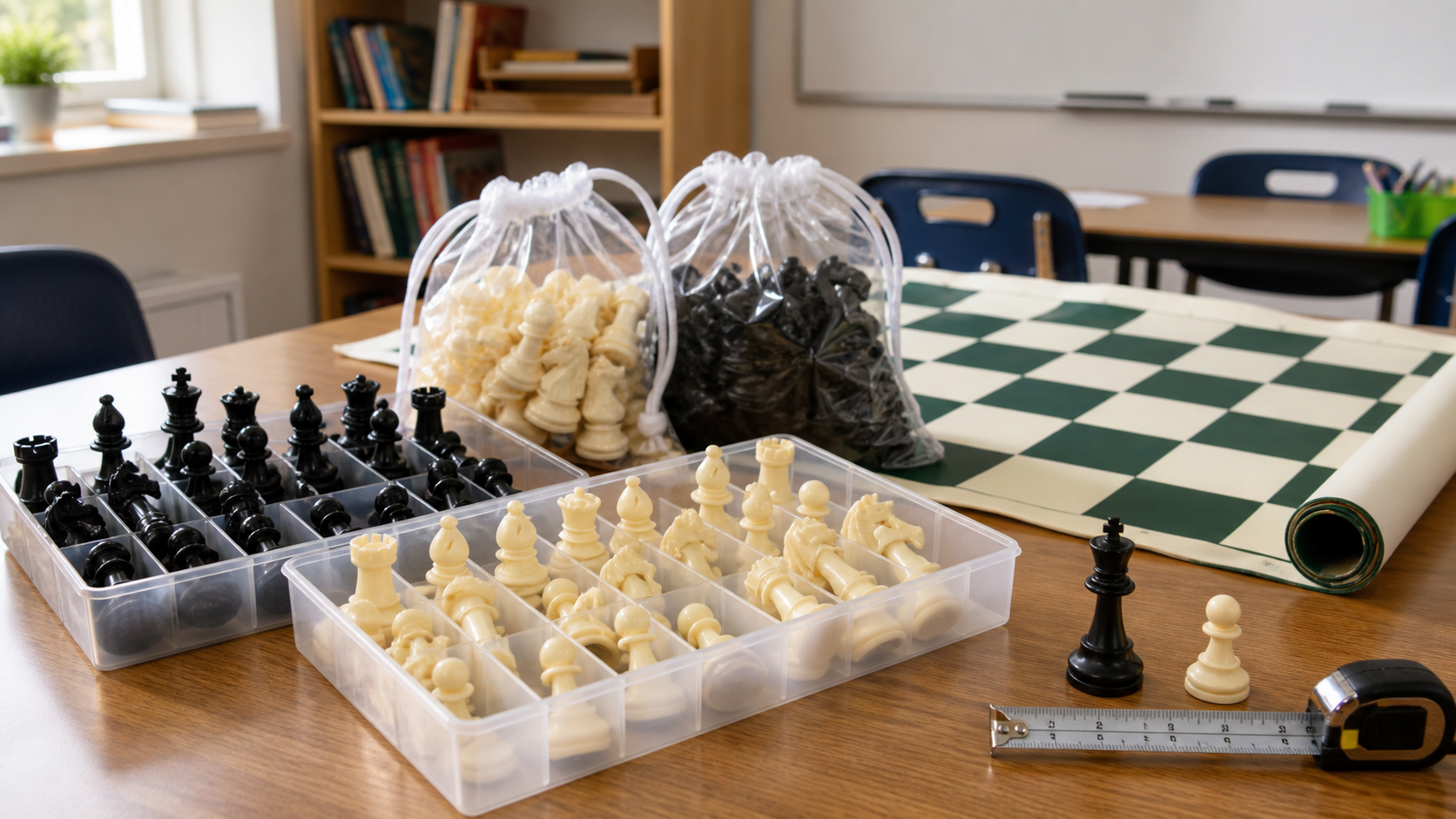
Measure a surviving king, pawn, and board square; inventory every missing piece by color; then compare full armies, half armies, and mixed bulk packs by compatible size and piece count.
Audit the cupboard before shopping
- Give each board or set a simple number, then count every light and dark piece by type.
- Separate sets that use different scales, magnetic pieces, pegs, unusual shapes, or molded storage inserts.
- Measure the height and base diameter of one surviving king and pawn, plus the width of one board square.
- Record whether pieces are hollow, solid, weighted, felted, or magnetic and whether light pieces are white, cream, or ivory.
- Total the missing pieces by compatible group, then add only a modest reserve rather than an untracked mixed bin.
Selection criteria for a school replacement set
- Complete piece mix: confirm the count of kings, queens, rooks, bishops, knights, and pawns for each color. A high total count can still omit the piece your program needs.
- King and pawn dimensions: these measurements are useful anchors for overall scale. Product labels such as “standard” are not enough on their own.
- Base-to-square fit: pieces should leave visible space within a square so students can read crowded positions and move without knocking neighbors over.
- Recognizable shapes: familiar Staunton-style silhouettes make queens, bishops, and kings easier for beginners to distinguish across matching tables.
- Color contrast: the two armies must be unmistakable under classroom lighting. A perfect shade match matters less than clear sides and consistent scale.
- Construction: do not mix ordinary loose pieces into a magnetic or peg set. Compare weighting and base treatment when consistent handling matters.
- Storage: decide where active armies and reserve pieces will live. A large bulk pack without labeled compartments can make cleanup worse.
Best broad fix: complete two-color plastic armies
One or more complete light-and-dark armies are the clearest category when school boards are sound but several piece types have vanished. Plain, recognizable plastic pieces are easier to redistribute than decorative sets, provided their dimensions suit the existing squares.
Best for: restoring one or more common roll-up or flat-board school sets while keeping a small compatible reserve.
Skip it if: only pawns are missing, the boards use several incompatible scales, or replacing the full low-quality set would cost less work than sorting mixed armies.
Best for one depleted side: single-color armies
A light-only or dark-only army can repair sets whose losses are concentrated on one side. Verify that the pack is a full army rather than a group of pawns or an incomplete assortment. A slight finish difference is usually manageable if the scale and silhouettes remain consistent.
Best for: standardized sets with one intact side and a clearly depleted opposing side.
Skip it if: the listing does not state every piece count or the surviving side is already a mixture of sizes.
Best for many standardized boards: mixed bulk replacement packs
A mixed bulk pack can support a school club when every board uses the same compatible piece scale. Compare the count by piece type and color—not just the headline total—because extra pawns do not solve missing queens or knights. Store the reserve separately and record what leaves it.
Best for: programs maintaining several matching classroom or club sets through a term.
Skip it if: the boards came from unrelated sets or nobody can own the counting and labeling routine.
Best for recurring pawn losses: pawn-only packs
Pawns are numerous and easy to misplace, so a compatible pawn pack can be more efficient than another full army when the audit shows that all major pieces are present. Match height, base diameter, construction, and color count to surviving pawns.
Best for: otherwise complete standardized sets that repeatedly lose the same small pieces.
Skip it if: rooks, bishops, knights, queens, or kings are also missing. Use a complete or mixed replacement category instead.
Best near-match: same-line replacement pieces
When the original maker, line, and size are known, same-line spares may provide the closest proportions and finish. Confirm the actual measurements because a familiar style name can be sold in several scales. Do not rely on photographs alone.
Best for: newer school sets with identifiable specifications and fitted storage that rewards a close match.
Skip it if: compatibility is inferred only from a color name, generic “tournament” wording, or an image without dimensions.
Quick comparison framework
- Choose complete two-color armies when several kinds of pieces are missing across ordinary boards.
- Choose a single-color army when one side is intact and the other needs a full reset.
- Choose mixed bulk packs only for a genuinely standardized board fleet with labeled storage.
- Choose pawn-only packs when the inventory proves pawns are the only recurring gap.
- Choose same-line spares when the exact size and construction can be verified.
Who should skip replacement pieces?
Skip piecemeal repair when boards are warped, unreadable, or split across too many sizes; when pieces are already difficult for beginners to recognize; or when fitted boxes, magnets, pegs, sensors, or unusual themed designs require proprietary compatibility. A standardized classroom set refresh may be easier to teach, count, and maintain.
Also skip an unplanned bulk purchase if nobody will label the reserve and check boards after sessions. For a broader repair decision that includes checkers, use the replacement pieces guide for both games.
Make the replacements last
Assign each playable set a number, store its two armies together, and keep only compatible spares in a separate labeled tray or bag. Put king height, pawn height, base diameter, square size, and color on the reserve label. Count boards at cleanup before students leave rather than borrowing silently from the next box.
Bottom line
The best chess piece replacement set for a school is the one that matches a measured board fleet and a counted shortage. Start with a cupboard audit, group compatible boards, and compare piece type, color, scale, construction, and storage. Complete armies solve broad gaps; single-color, bulk, pawn-only, and same-line options work only when the inventory supports them.