
A useful chess score-sheet pad gives several club boards the same readable form without assigning every player a bound book. Choose the pad only after checking its actual writing fields, paper size, backing, sheet count, and what happens to each page after the game. The best format is the one your volunteers can distribute, collect, identify, and file without slowing the session.
This is a product-category guide, not a ranking of named pads. We have not tested every result in the shopping route and make no claims about current prices, ratings, availability, paper quality, or event acceptance. Casual clubs can set their own record routine; any organized event should follow its own published requirements.
As an Amazon Associate, The Good Chess & Checkers may earn from qualifying purchases.
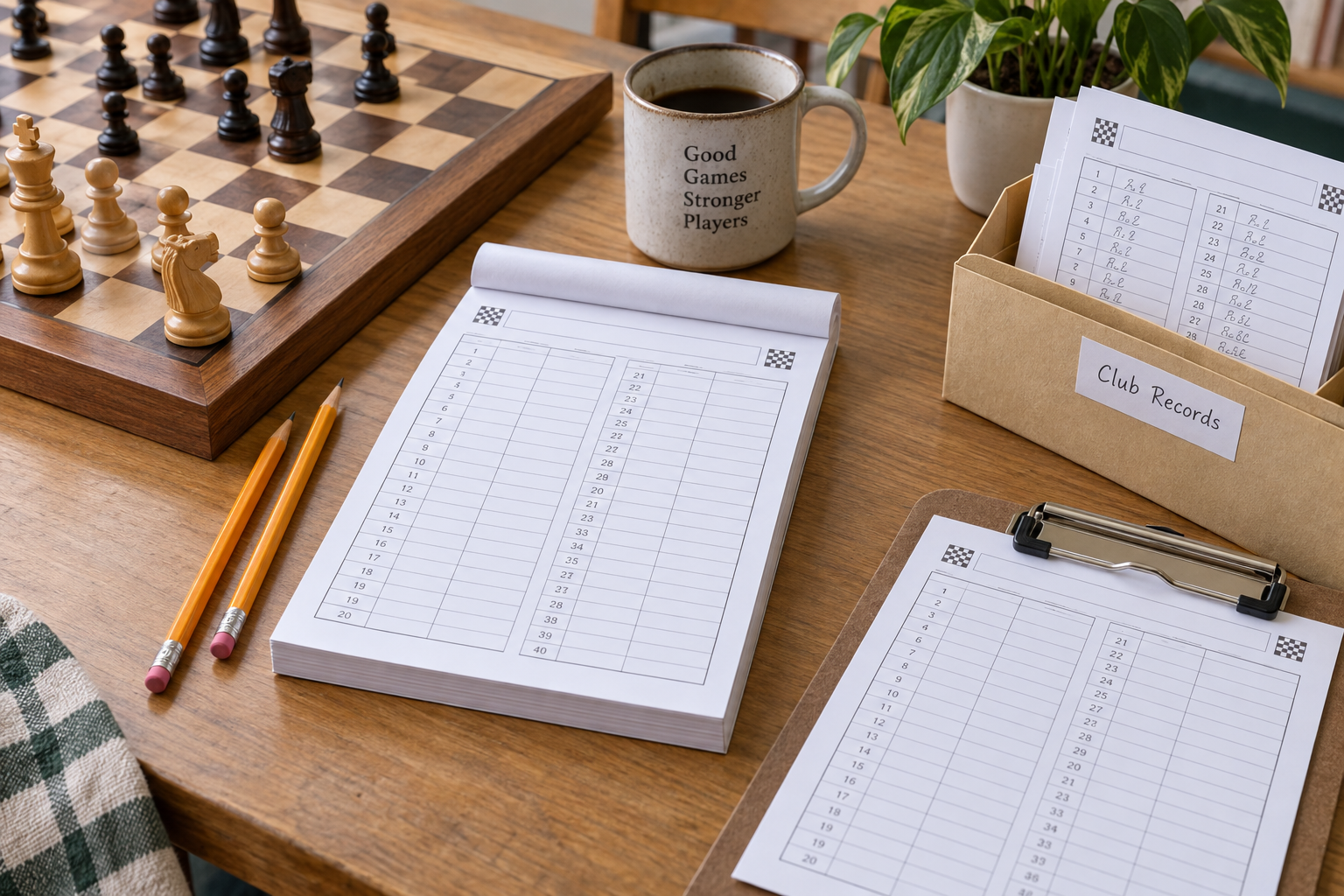
Club record-supply guide
Inspect a sample page before ordering a stack
Verify the notation columns, player and event fields, paper dimensions, sheets per pad, backing, and whether one page records one player or both. Then decide who labels, collects, and stores each sheet.
Quick decision
- Choose a club pad when organizers supply identical disposable sheets at several boards and collect them afterward.
- Choose a one-player layout when each player records both sides' moves and keeps or submits a separate copy.
- Choose a two-player or carbonless format only after verifying its instructions when the club needs one shared record or duplicate copies.
- Choose a bound scorebook when records belong to individual players and should stay together.
- Skip a purchase when a clear printable sheet and ordinary paper already serve the small group.
Compare the page layout first
Look for enough move rows for the club's normal games, clearly paired White and Black columns, and room for player names and the date. Round, board, result, and opening fields can help an archive, but unused boxes also consume writing space. A sample page matters more than a product title.
Beginners need room to write legibly and correct a mark. Dense forms with tiny cells can be frustrating even when they fit many moves. If coordinates and algebraic notation are still new, use a short practice sheet before asking players to preserve full games.
Measure the complete writing setup
Record the sheet's width and height, not just the pad label. Check whether it fits the table beside the board and clock without entering either player's playing area. If the table surface is uneven or shared with snacks and bags, a correctly sized clipboard may matter more than a stiffer pad backing.
Also check how cleanly sheets detach. A glued top edge is convenient only when volunteers can remove a page without tearing the player name or last move rows. Do not assume a pictured cardboard back is rigid enough for lap writing.
Estimate supply by sessions, not by pad count
For a one-player form, a recorded game may use two sheets. A shared form may use one, while a duplicate-copy format follows its own instructions. Multiply the real per-game use by the number of boards and recorded rounds, then add a modest allowance for restarts and damaged pages.
Write the opened date on each pad and count remaining sheets periodically. Reorder from observed use rather than an optimistic sheet count in a listing. Keep one small reserve separate so the final active pad does not disappear halfway through a session.
Choose a distribution workflow
- Store active pads, pencils, and erasers together near check-in.
- Give each recording board the required number of sheets before play.
- Have players add names, date, and a simple board or session identifier before the first move.
- Collect club-owned records at one clearly marked point after the game.
- Count unused sheets back into the supply and note when the reserve is opened.
A loose-paper system needs an owner. If nobody is responsible for collection and filing, a bound club log or player-owned scorebook will usually create fewer orphaned pages.
Plan the archive before the first sheet is used
Decide whether records are returned to players, reviewed briefly, or retained by the club. For club files, use a consistent identifier and sort sheets by session, board, or player. A labeled folder, ring binder, or accordion file should match the page size without folding the notation columns.
Set a simple retention routine appropriate to the club and avoid collecting personal details the group does not need. If the real goal is post-game replay, check that handwriting remains readable and that the sheet records the complete move sequence.
Run a no-spend trial
Print ten copies of one clear sample layout. Use them across a normal club session, then ask the organizer to distribute, collect, sort, and store the pages. Note cramped fields, missing identifiers, table-space conflicts, and how many sheets were actually consumed. Those observations become the purchase criteria.
Who should skip score-sheet pads?
Skip this category when players do not yet know notation, nobody intends to review or retain the games, or only one player wants a personal record. A plain notebook or beginner chess scorebook may suit individual ownership better. For repeated instruction where permanent records are unnecessary, compare reusable dry-erase and paper sheets.
Bottom line
The best chess score-sheet pad for a casual club is not the pad with the biggest headline count. It is the format with a verified, readable page; a table-friendly footprint; predictable per-game consumption; and a distribution and archive routine the club will actually maintain. Trial the workflow on printed pages before buying in quantity.