
Choose a dry-erase score sheet when the main goal is to practise notation, correct mistakes, erase the record, and begin again. Choose paper when the completed game needs to be kept, collected, replayed, or annotated later. The important difference is not simply reusable versus disposable: it is temporary practice record versus durable session record.
This is a comparison of generic score-sheet formats, not named products we tested. Before buying, inspect the actual notation fields, sheet dimensions, writing area, marker or pencil requirements, cleaning directions, quantity, and storage plan.
As an Amazon Associate, The Good Chess & Checkers may earn from qualifying purchases.
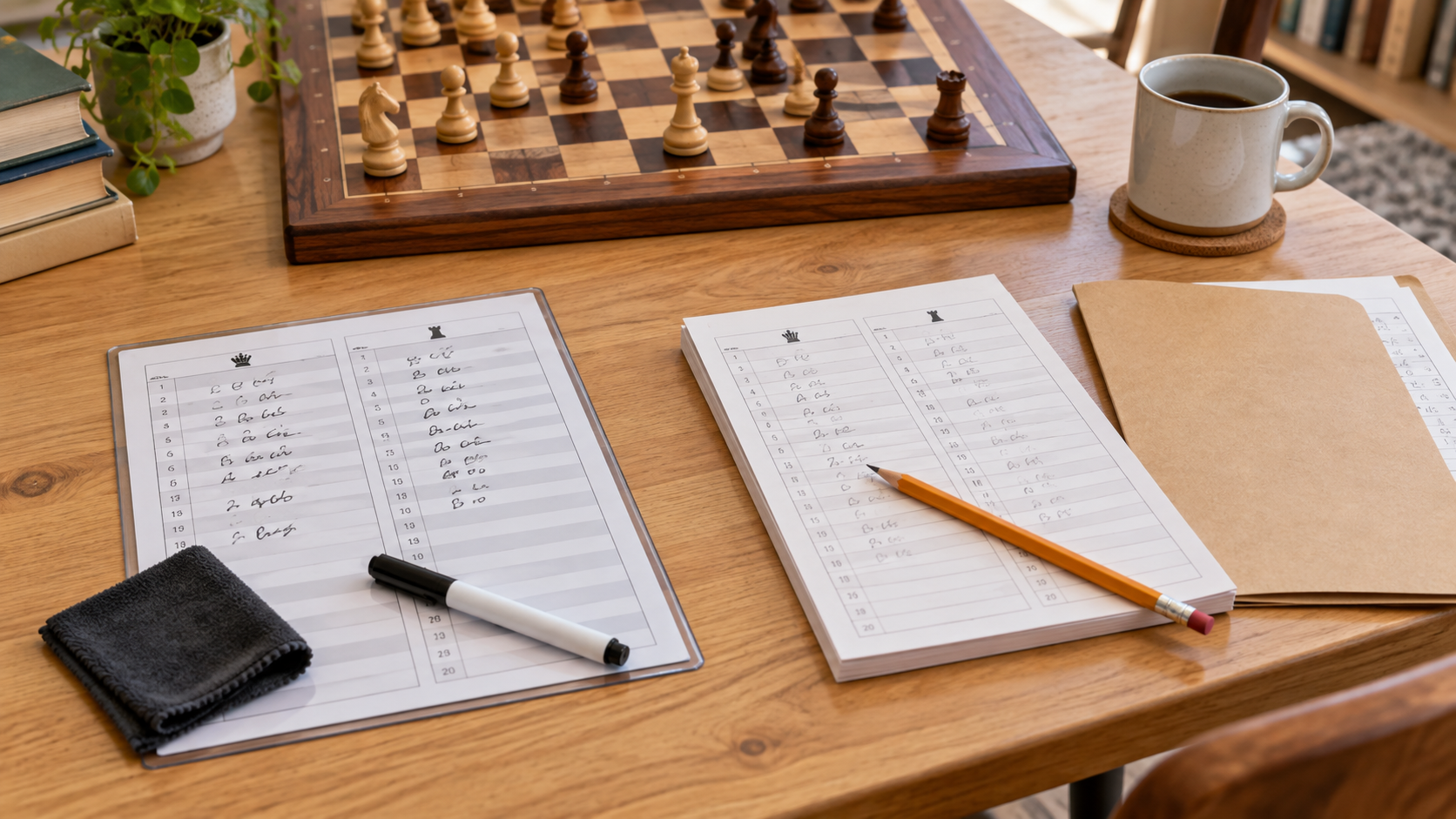
Choose the record you need after practice
Compare reusable and retainable notation formats
For a reusable sheet, verify the visible move columns, writing area, approved marker type, cleaning method, and sleeve or lamination construction. For paper, verify the same fields plus sheet count, paper size, backing, and how completed records will be filed.
Quick decision
- Choose dry-erase for short notation drills, correction practice, demonstrations, and repeated use by the same learner or pair.
- Choose paper for complete games that a player, tutor, family, or club wants to retain and review.
- Use both deliberately when dry-erase handles drills and paper begins only after the learner can record a full casual game without constant interruption.
- Skip specialized sheets for now when the learner is still learning coordinates or an ordinary printed template already answers the need.
The core choice: practise the process or preserve the game
A reusable sheet lowers the cost and clutter of repeating a short exercise. A tutor can dictate a few moves, let the learner correct a crowded or ambiguous entry, erase the surface, and run the exercise again. That makes the format useful before full-game recording becomes comfortable.
Paper changes the purpose of the activity. The finished sheet can stay with the game, travel home with a learner, or enter a dated folder for later replay. Corrections remain visible, which may look untidy but can also show where notation broke down. Paper is the better fit when the record matters after the board is reset.
Compare the practical tradeoffs
| Criterion | Dry-erase score sheet | Paper score sheet |
|---|---|---|
| Best use | Repeated drills and temporary records | Complete records kept for replay or filing |
| Correction | Erase and rewrite if the approved marker cleans properly | Cross out or rewrite while preserving the original mark |
| Archive | Must be copied or photographed before erasing | Can be labeled and filed directly |
| Supplies | Compatible marker, cloth, and cleaning routine | Pencil or pen plus replacement sheets |
| Distribution | Collect, erase, inspect, and return | Hand out, collect if needed, then retain |
| Low-cost trial | Printed template in a compatible clear sleeve | One printed template on ordinary paper |
When a dry-erase score sheet fits
Use dry-erase when a beginner needs repetitions more than an archive. Useful exercises include entering a starting position header, recording five legal moves, correcting captures, or practising move numbers and the two player columns. Erasing reduces the temptation to save every incomplete attempt.
Verify the actual surface and the maker's marker and cleaning instructions. “Laminated,” “wipe-clean,” and “dry-erase” are not interchangeable guarantees. Check that the move rows and headings remain visible under the sleeve or coating and that the sheet stays flat enough to write on beside the board.
Skip dry-erase when the game record must be submitted, signed, filed, or reviewed later; when the approved marker routine is unclear; or when glare and a flexible sleeve make entries harder to read. Copying every temporary record onto paper afterward also removes much of the convenience.
When paper score sheets fit
Use paper when each completed game should remain available. A loose sheet can be dated, paired with a short lesson note, and filed by player or session. A backed pad can also provide a writing surface when the table is uneven, though the actual backing and paper dimensions should be checked rather than assumed.
Paper quantity is not the same as usefulness. Inspect a clear interior preview for move numbers, separate white and black columns, player and event fields you will actually use, and enough writing room for the learner's handwriting. Avoid sheets crowded with unexplained fields when the goal is simple beginner practice.
Skip a bulk paper supply when sessions rarely produce complete records, storage is already disorganized, or a freely printable template works better. Loose sheets without a naming and filing routine quickly become anonymous paper.
A simple two-stage notation practice routine
- Make sure the learner can identify files, ranks, and piece letters before asking for a full record.
- Use a reusable sheet to record a short, untimed sequence of five to ten legal moves.
- Pause at the first confusing entry, rebuild the position, and correct the notation rather than guessing.
- Erase and repeat with a different short sequence until the form itself no longer needs explanation.
- Move to paper for one casual game, then replay it on a physical board while the position is still familiar.
- File only records that can support a future review; recycle practice sheets according to local rules and keep private identifying details out of shared folders.
If notation is still the main obstacle, start with the chess notation workbook decision guide. A score sheet records moves; it does not necessarily teach the notation system.
Measure the full tabletop setup
Place a sample sheet beside the board where the learner will actually sit. Check whether the board, clock if used, captured pieces, pencil or marker, and record all fit without covering one another. A compact sheet saves space only if its rows are still readable and writable.
- Sheet fit: exact width and height, orientation, margins, and number of usable move rows.
- Writing fit: row height, column width, contrast, and room for corrections.
- Reusable setup: marker length, cap routine, cloth, cleaning supplies, drying time, and flat storage.
- Paper setup: pencil or pen, writing support, sheet quantity, folder dimensions, labels, and completed-record storage.
Try both before buying a group quantity
Print the same score-sheet template twice. Put one copy in a compatible reusable sleeve and leave the other on paper. Run one short drill on each, then compare legibility, correction speed, board-space use, cleanup, and whether anyone needs the record afterward. This trial tests the workflow without implying that one supply format is universally better.
For a club, also time distribution and reset. Reusable sheets must return, erase cleanly, dry, and be counted with their markers. Paper sheets need a reliable supply and a clear destination after play. Buy for the repeated bottleneck you observed, not for an imagined future routine.
Bottom line
A dry-erase chess score sheet is the better practice tool when entries will be corrected, erased, and repeated. A paper score sheet is the better record when a completed game needs to survive the session. Test both with the same beginner, board, and notation task; then choose based on what must happen after the final move.
The planned beginner-chess pillar is not built yet. Continue through the beginner piece-movement guide if legal moves are still unfamiliar, or compare a score-sheet clipboard with a bound scorebook when writing support and record ownership are the next decision.