
Use clipboards with loose score sheets when the club supplies, collects, and files game records. Use bound scorebooks when individual players own their records and bring them back for later review. Both can record the same moves; the meaningful difference is who controls the paper before and after the game.
This is a workflow comparison, not a claim that one format improves play. Before buying either, decide whether the club or the player needs the lasting archive and confirm that recording is appropriate for the kind of games your group runs.
As an Amazon Associate, The Good Chess & Checkers may earn from qualifying purchases.
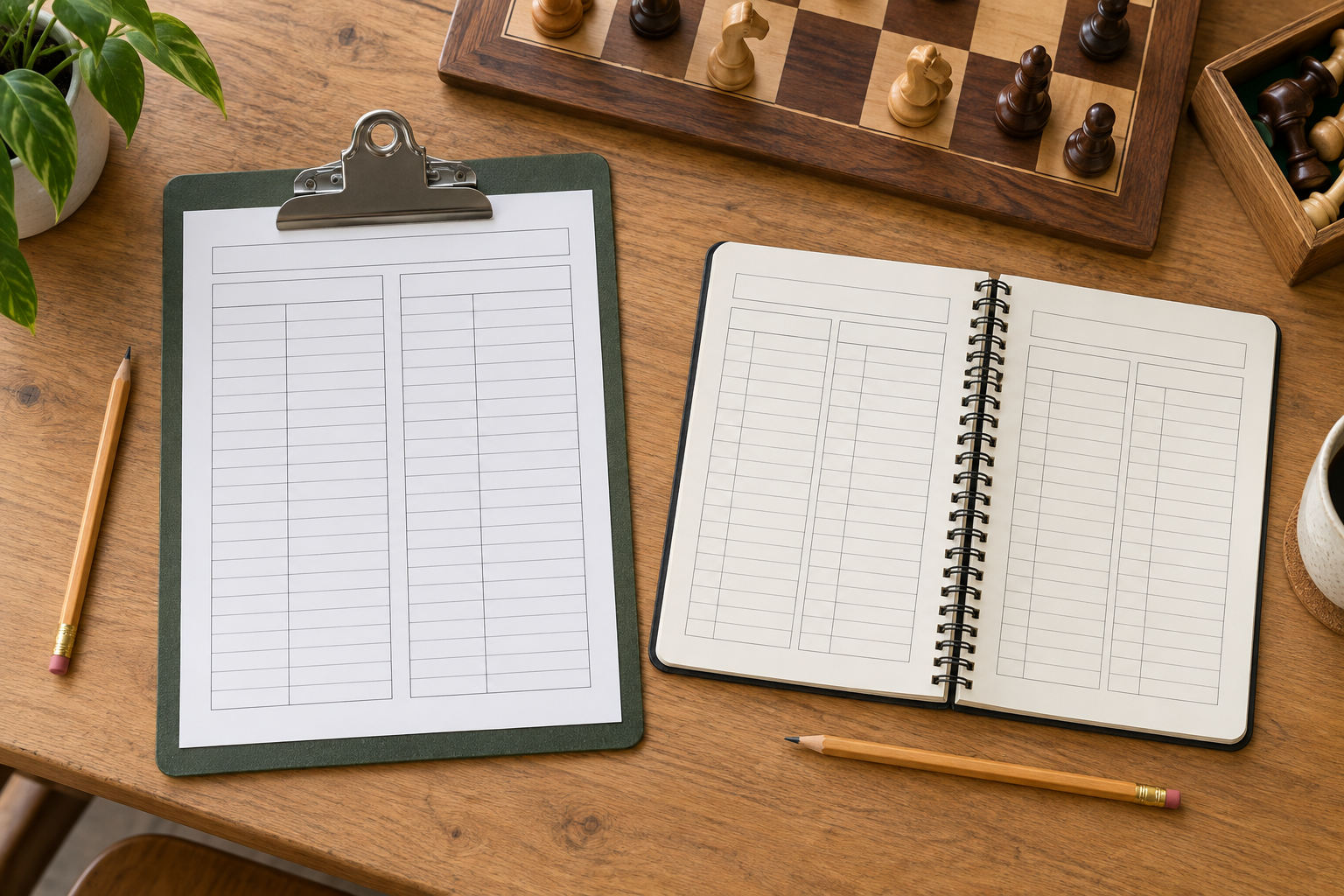
Compare the complete record workflow
Choose the owner of the archive first
Match a clipboard to the club's exact paper size and table space. For a scorebook, inspect current inside-page images for move columns, game headings, writing room, and binding behavior before choosing.
Quick decision
- Choose clipboards and loose sheets when the club prints one standard form, assigns equipment by table, and gathers records centrally.
- Choose bound scorebooks when each player keeps a chronological personal archive and is responsible for bringing it.
- Use a mixed system when the club collects selected games but players also want personal copies; define which record is authoritative before play.
- Skip a bulk purchase when few players record games or nobody has a plan to review or file the records.
Clipboard vs scorebook at a glance
| Decision | Clipboard with loose sheets | Bound scorebook |
|---|---|---|
| Usual owner | Club or event organizer | Individual player |
| Writing support | Firm backing; clip shape and clearance matter | Built in; binding must stay open enough to write |
| Archive | Flexible sorting, but pages need a filing routine | Games remain in sequence, but are harder to reorganize |
| Table space | Board footprint follows the chosen paper size | Open spread may be wider; compact books may offer less writing room |
| Replacement | Add fresh forms and replace one clipboard independently | A lost book can remove the player's whole physical archive |
| Best fit | Central collection and shared equipment | Personal study and long-term continuity |
Choose clipboards for a club-owned process
Loose forms make sense when an organizer controls the layout, prints the supply, and knows what happens to completed pages. A club can collect selected games for a lesson, file them by date or group, and replace the paper without asking every player to buy the same book.
The tradeoff is administration. Pages need clear fields for player names, date, color, result, and any board or session identifier the club actually uses. Blank and completed forms need separate storage, and someone must decide which records are kept. Without that handoff, loose paper becomes clutter rather than an archive.
Choose scorebooks for player-owned continuity
A bound scorebook suits a player who wants games in chronological order and will bring the book to later review sessions. There is no separate filing step, and neighboring games remain together. That continuity can be useful when a learner and helper revisit recurring notation errors or positions.
Check the exact page preview. A useful layout needs readable move rows, enough writing room for the notation the group uses, and headings for the context the player wants to remember. A binding that closes itself or consumes too much table width can make an otherwise suitable book awkward beside the board.
Measure the full playing table
- Set up the normal board, pieces, captured-piece area, and clock if the group uses one.
- Place a letter-size sheet where a clipboard would sit, then measure the remaining hand and elbow room.
- Open a similarly sized notebook to estimate a scorebook's full spread rather than measuring only its cover.
- Check whether the clipboard clip or book binding crowds the first writing rows.
- Repeat the layout on the smallest or most awkward table the club regularly uses.
Plan the record after the game
For loose sheets, name the collection point and filing format before distributing paper. A folder for completed forms is better than returning them to a stack of blanks. If selected games are used in lessons, record the date and player permission process appropriate to your group without assuming every member wants records shared.
For scorebooks, decide whether the player keeps the only copy or makes a separate copy for club analysis. Do not promise that a physical archive is searchable or backed up. If a durable searchable copy matters, the player can transcribe selected games later, but that is a separate step with its own accuracy and privacy choices.
Run a one-session trial before buying in quantity
Print the proposed club form and borrow one clipboard. Ask another player to use an ordinary bound notebook with a similar open size. After the game, carry both through the real review and storage routine. Note writing clearance, second-page handling, table crowding, who retained the record, and whether anyone reopened it. The result is more useful than choosing from product photos alone.
Who should skip each format?
Skip a clipboard system when tables already provide a firm writing surface, players keep their own books, or the club has no filing owner. Skip bound scorebooks when the organizer needs standardized detachable forms, players are unlikely to bring books consistently, or a wide open binding crowds the playing area. Beginners who cannot yet record moves without losing track of the board may benefit more from a short notation lesson or practice worksheet than either archive format.
Bottom line
Clipboards are better for replaceable forms and a central club archive. Scorebooks are better for personal continuity and player-owned review. Choose who owns the record, test the full table, and walk one sample game all the way from the first move to filing or review before buying multiple copies.
The planned beginner chess rules and strategy pillar is not yet built. Until it is, continue with the beginner movement guide, the notation-workbook decision guide, or the record-format guides linked above.