
The best flat portfolio is the smallest one that accepts the complete lesson board without bending it or straining the opening. Measure the board's full width, height, and thickest edge, then compare those numbers with the portfolio's stated usable interior—not its outside dimensions.
This is a category-fit guide, not a named-product ranking or a hands-on test. A portfolio can organize and carry a thin panel, but a soft case does not automatically provide rigid, waterproof, impact-resistant, or archival protection. Verify the current listing, maker guidance, and return terms before buying.
As an Amazon Associate, The Good Chess & Checkers may earn from qualifying purchases.
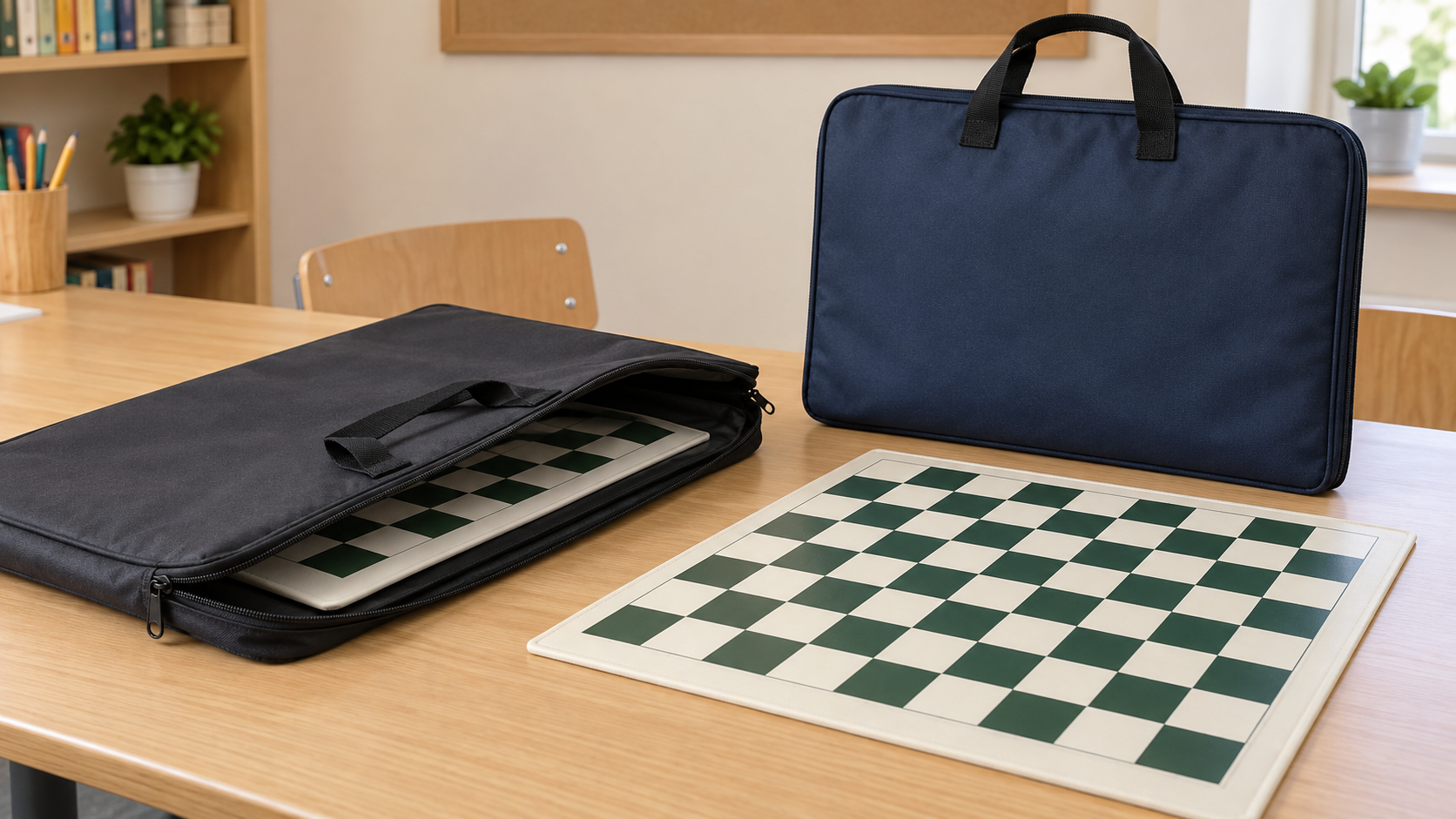
Measure the panel, opening, and route
Browse flat zippered art portfolios
Look for stated interior dimensions larger than the complete lesson panel, an opening that does not steal usable width, handles joined to the body, and a packed shape that fits the destination shelf. Treat pockets, shoulder straps, and rigid inserts as separate needs.
Quick choice framework
- Choose a soft zippered portfolio when a thin, already-rigid lesson panel mainly needs containment, handles, and a cleaner carrying routine.
- Choose a portfolio with a removable rigid insert only when its stated interior still fits the board and the added thickness remains practical.
- Choose a larger gusseted case when the same case must hold magnets, markers, reference cards, or several panels—but keep loose supplies from rubbing the board surface.
- Skip the portfolio when the board is designed to roll, fold, remain wall-mounted, or already has a fitted case.
Start with the lesson board, not the case label
Terms such as poster size, art portfolio, and presentation case do not guarantee a fit. Measure the board at its widest and tallest points, including frames, corner caps, hanging loops, clips, and any pieces that remain attached. Measure thickness at the deepest point rather than assuming the center panel tells the whole story.
Add only enough clearance for the board to enter without scraping or forcing the zipper. A dramatically oversized case may sag, let the panel shift, or become awkward in doorways and on shelves. If a listing gives only exterior dimensions, it does not provide enough information for a confident fit decision.
Selection criteria that matter
Usable interior and opening geometry
Compare the board with the stated internal width, height, and depth. Then inspect how the case opens. A zipper that stops short of a corner, a thick seam, or a rounded top can make the opening smaller than the nominal interior. A three-sided zipper usually gives a different loading path from a narrow top opening.
Structure and board support
Decide what provides rigidity. The lesson board may support itself, the portfolio may include a firm panel, or a separate smooth insert may be needed. Do not assume fabric described as heavy-duty prevents bending. If the panel must not flex, verify a documented rigid construction or keep it between suitable flat supports.
Handles and optional shoulder strap
Check how handles attach, whether they meet comfortably above the loaded case, and whether a shoulder strap is included or merely pictured. A strap can free one hand for a set box, but it also changes how a wide panel moves through doors and around people. Use the shortest real route as a trial before making a group purchase.
Closure and accessory separation
A full zipper contains a thin board more completely than an open sleeve, but closure type does not establish weather or impact protection. If the portfolio also carries magnets, clips, or markers, use a closed internal pouch and confirm that hard items cannot press into the board face.
Packed shelf and vehicle fit
Measure the loaded case rather than the empty product photo. Confirm that it can lie flat or stand in the orientation allowed by the board maker, and that handles do not block the shelf opening. A portfolio that fits the panel but not the cabinet, trunk, or borrowed-room storage point has not solved the full route.
Exposure limits and care
Follow the portfolio and board makers' cleaning and exposure guidance. A fabric case may reduce casual surface contact without being waterproof, moisture-proof, or suitable for long-term document storage. Keep the board away from damp floors and do not leave it in a vehicle merely because it is enclosed.
Run a no-spend fit test first
- Measure the complete board's width, height, and maximum thickness.
- Make a paper or cardboard rectangle matching the proposed portfolio's stated usable interior.
- Mark the advertised zipper or opening boundary, including rounded corners.
- Place the board on the mock-up and check loading clearance, handle position, and excess movement.
- Walk the actual route through doors, stairs, parking areas, and the teaching table with a similarly sized lightweight panel.
- Measure the destination shelf and decide where markers, magnets, and lesson sheets will travel.
- Buy one case first and test the complete pack, carry, unload, teach, repack, and store cycle.
Common setups
One thin board in a close-fitting portfolio
This is the simplest setup. The board supplies its own rigidity, while the case adds containment and handles. It suits a tutor or teacher who carries one panel and stores accessories elsewhere.
Board plus a separate accessory pouch
Use a smooth, closed pouch for loose magnets, clips, erasers, or markers. Place it where it cannot create a pressure point against the board. If that arrangement makes the portfolio bulge or prevents full closure, move the supplies to a separate teaching bag.
Several very thin panels
Multiple panels require verified depth plus a way to prevent face-to-face abrasion and snagging. Count the separators in the total thickness. A portfolio that technically closes may still be too crowded for quick classroom setup.
Who should skip a flat portfolio?
Skip this category when the panel is too thick or heavy for the documented case, the seller omits usable interior measurements, or the teaching route involves exposure the maker does not address. A fitted hard case may be more appropriate when rigid enclosure is a real requirement. A storage tube is usually the better category for a flexible board whose maker permits rolling, while a wall-mounted board may need no transport case at all.
For the rest of the teaching station, use the beginner-friendly chess and checkers classroom or club setup guide. It helps separate shared display, table sets, teaching supplies, and storage so one carrying case is not asked to do every job.
Bottom line
Choose a flat portfolio by verified usable interior dimensions, loading opening, structure, handle arrangement, accessory separation, and the full carrying-and-storage route. A close-fitting zippered format is the practical default for one thin, self-supporting chess lesson board. Buy one only after a paper fit check, then test one complete teaching cycle before standardizing it.