
A whole-table cover can keep a paused chess or checkers position out of direct view and reduce casual contact while a dedicated table is not in use. It is not a protective guarantee, a storage container, or permission to leave a game where the table must serve another job. The useful choice is a light, removable cover that fits the measured setup without pressing on the tallest pieces.
This guide compares cover categories and fit criteria, not named winners or products we have tested. Materials, dimensions, seams, care instructions, and stated uses vary. Check the listing and the table and game-set makers' care guidance before use.
The Good Chess & Checkers may earn commissions from qualifying purchases.
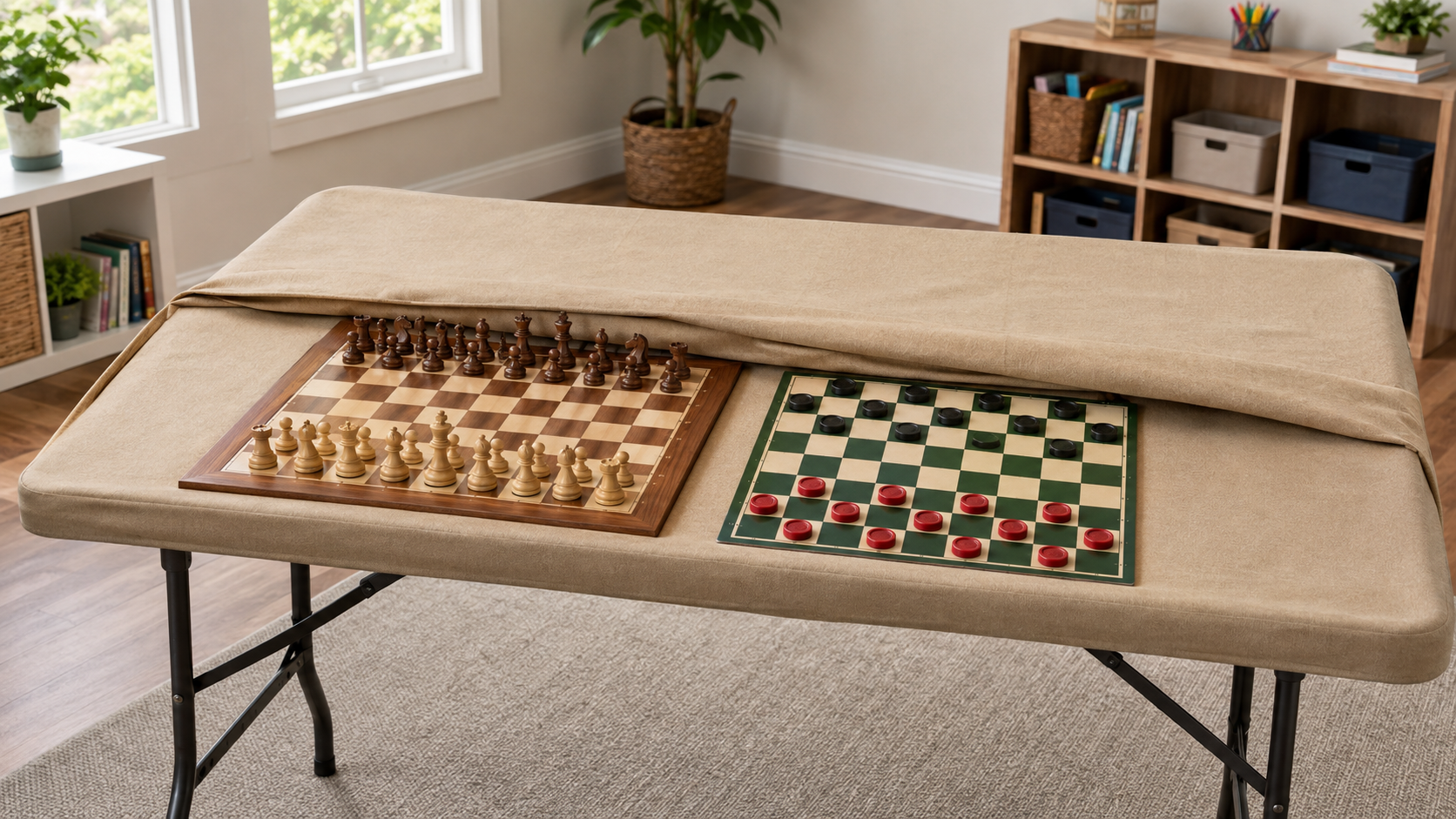
Quick decision aid
Compare lightweight indoor table covers by fit
Record tabletop length and width, edge thickness, the tallest standing piece, and the drop needed on each side. Favor published dimensions, a manageable fabric weight, simple care instructions, and a closure style that does not pull against the boards.
Quick answer
For a dedicated rectangular table in a calm indoor room, start with a lightweight fitted or softly draped fabric cover whose internal length, width, and height comfortably clear the entire setup. A fitted edge resists casual shifting; a simple rectangular cloth is easier to fold and repurpose. Clear and store the pieces instead when the table is shared, the position cannot tolerate disturbance, or the cover would rest on tall pieces.
Measure the covered volume
A tabletop measurement alone is incomplete. Measure the table at its widest and deepest points, then measure from the tabletop to the top of the tallest piece. Add the desired side drop without letting fabric collect near feet, chairs, vents, or anything that moves. If two boards share the table, include clocks, notation books, captured pieces, and the gap between boards in the footprint.
Compare those measurements with the cover's published finished dimensions. Product labels such as card-table, banquet, or game-table do not establish fit. A taut cover can press on pieces; an oversized one can drag or snag.
What to compare
| Feature | What to verify | Why it matters |
|---|---|---|
| Finished size | Published length, width, and side drop | The cover must clear every board, clock, and standing piece. |
| Shape | Rectangular, square, fitted edge, or plain cloth | The table shape determines where excess fabric gathers. |
| Material and weight | Fabric description and care instructions | Heavy or clingy material may disturb pieces during placement. |
| Edge treatment | Elastic, hem, ties, or no closure | A secure edge can reduce shifting but may complicate removal. |
| Opacity | Current photos and material description | An opaque cover hides visual clutter; a translucent one may not. |
| Storage | Folded size and a clean, labeled storage place | A cover helps only when it stays clean and easy to deploy. |
Best for a dedicated table: lightweight fitted cover
A fitted cover uses an elasticized or shaped edge to stay around the tabletop. It can make sense when a chess or checkers table remains set up between sessions and the cover has ample internal clearance. Put it on and remove it slowly from opposite corners rather than dragging it across the position.
Skip it when the elastic must stretch hard over the table, the corner seams align with tall pieces, or frequent access makes the fitted edge cumbersome.
Best flexible option: plain rectangular cloth
A hemmed rectangular cloth is easy to fold, wash according to its label, and use on different tables. It also lets you choose a shallow drop so less material hangs near chairs. The tradeoff is that it has no built-in grip and can shift more readily than a fitted shape.
Skip it if there is no measured placement routine, the fabric slides easily, or excess material would trail into a busy route.
Best for a display-only setup: structured dust cover
A purpose-sized fabric or clear cover can suit one display board when its internal measurements clear every piece. This is a board-cover decision rather than a whole-table solution, and rigid covers require their own storage space while the game is being used. See the separate guide to chess-set dust covers before choosing that format.
Skip it for two active boards, a crowded family table, or any setup wider than the verified internal dimensions.
A cover does not preserve a position by itself
Photograph or record the position before covering it if resuming accurately matters. For chess, a photo should show the whole board and orientation; a written score may help when moves are already being recorded. For checkers, variants can differ, so note the ruleset as well as whose turn it is. The cover may shift a piece during placement or removal, and it cannot replace a record.
Use and storage routine
- Confirm that the table can remain dedicated until the next session.
- Record the position and whose turn it is.
- Remove drinks, pencils, captured pieces, and loose accessories from the cover path.
- With another person if the table is wide, lower the cover without sliding it across the boards.
- Check that the fabric clears the tallest pieces and does not pull at any edge.
- To resume, lift from the edges and fold the cover away from the boards.
- Store it clean and dry according to the care label.
Who should skip a game-table cover?
- Families that need the dining or homework table should clear and store the set instead.
- Classrooms and clubs with frequent room changes usually benefit more from labeled board and piece storage.
- A breezy, damp, outdoor, or high-traffic location is a poor match for leaving a loose position under fabric.
- A valuable or delicate set needs its maker's storage guidance; a generic cover is not a substitute for a fitted case.
- Anyone who cannot verify clearance above the tallest piece should not place the cover over the position.
Bottom line
A lightweight fitted cover is the simplest category for a measured, dedicated indoor game table; a plain rectangular cloth is more flexible when careful placement is practical. Choose by full setup dimensions, material weight, edge behavior, access routine, care, and folded storage—not by a generic table-size label. If the table must return to everyday use, clear the board and follow the broader shared game-shelf setup guide instead.