
A dust cover makes sense when you regularly leave a chess position assembled and want a simple barrier against ordinary settling dust. The useful choice is not the most elaborate cover: it is the format that clears the complete board and tallest piece, is easy to remove without disturbing the position, and can be cleaned and stored as its maker directs.
This is a product-category comparison, not a ranking of named products or a hands-on test. A basic dust cover should not be treated as impact, moisture, pet, child, theft, or conservation protection.
The Good Chess & Checkers may earn commissions from qualifying purchases.
Quick decision aid
Measure the assembled position, not just the squares
Compare internal width, depth, and height first. Then check cover material, access, cleaning directions, visible seams, and where the empty cover will go while you play.
Measure these three internal dimensions
- Width: measure the full board or board-frame width, including coordinates, borders, handles, and decorative edges.
- Depth: measure front to back at the widest point. A cover that fits the playing grid but not the frame will not seat properly.
- Height: measure from the surface supporting the cover to the top of the tallest piece, usually a king. Add working clearance so the cover does not brush a piece during removal.
Use the listing's internal dimensions when they are provided. Outside measurements include the thickness of panels, seams, hems, or frames and can overstate usable room.
Best for visibility: clear rigid lift-off covers
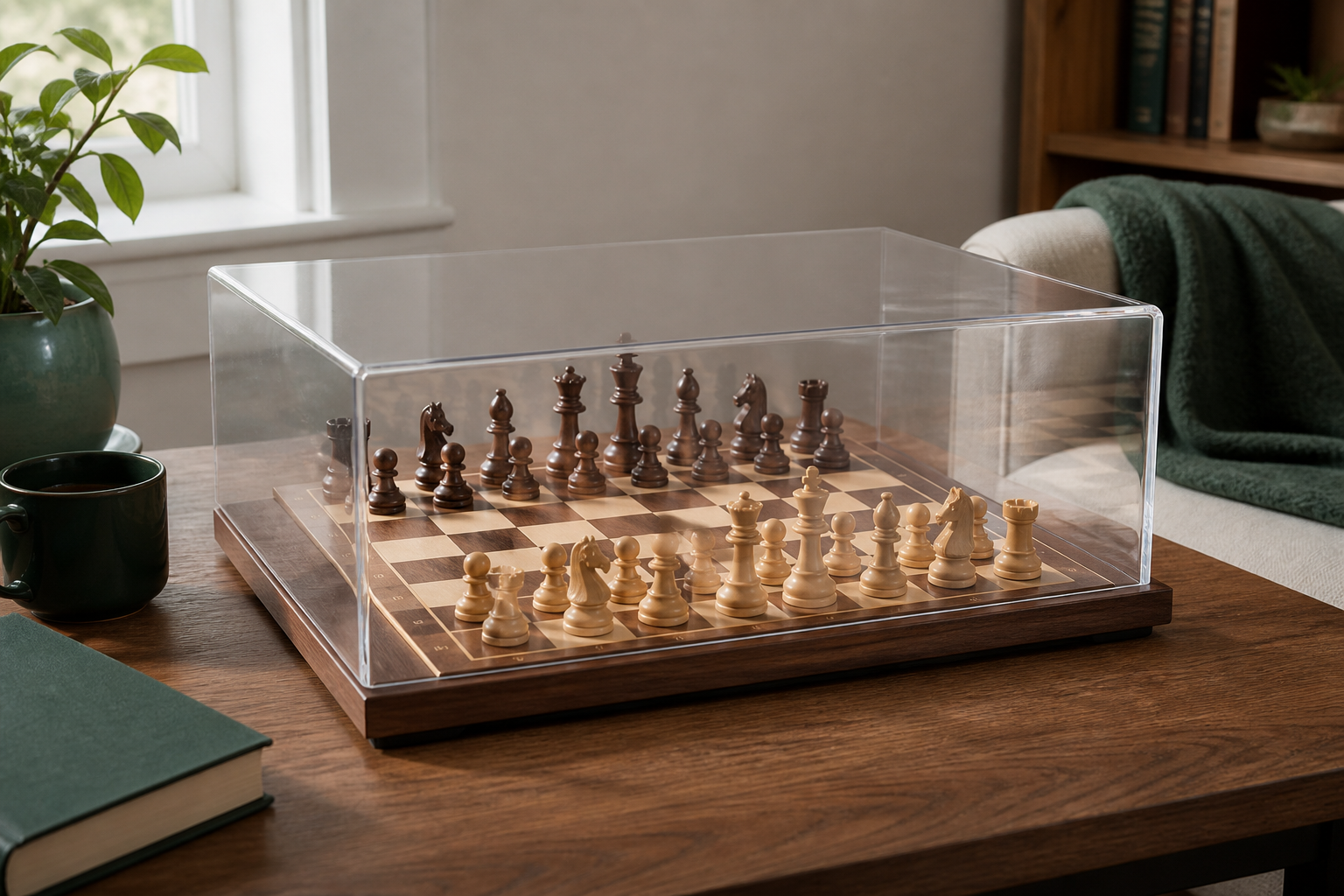
A clear acrylic or similar rigid shell keeps the board visible and holds its shape while being moved. The tradeoffs are bulk, reflections, fingerprints, and the need for a safe place to set the entire cover during play. Check whether it arrives assembled or flat-packed, how edges join, and which cleaning products the maker permits.
Best for: an attractive set that stays on a stable table and remains part of the room.
Skip it if: there is nowhere to put a large rigid cover during a game or frequent access would make lifting it awkward.
Best for compact storage: soft fitted covers
A fabric or flexible synthetic cover can fold into a drawer when not in use. Look for a defined rectangular shape, enough height over the kings, seams that will not snag pieces, and a hem or opening that clears the board frame. Opaque fabric hides the position; transparent flexible material may show wrinkles and can be harder to drape without touching pieces.
Best for: practical dust control where viewing the set between sessions is not important.
Skip it if: the material will rest on delicate or easily tipped pieces, or you want the displayed position continuously visible.
Best for unusual board sizes: made-to-measure covers
Custom sizing can help with oversized boards, deep frames, unusually tall themed pieces, or a chess table whose usable cover footprint differs from common retail sizes. Confirm whether the stated measurements are internal or external and who is responsible for allowance around the set. Check return and alteration terms before ordering because custom items may have different policies.
Best for: a stable long-term display whose dimensions do not match stock cover sizes.
Skip it if: the board may soon change, the set is frequently packed away, or a standard cover already provides safe working clearance.
Quick comparison framework
- Choose clear rigid when visibility and a self-supporting shape matter most.
- Choose soft fitted when folded storage and simple handling matter more than display visibility.
- Choose custom-sized only when verified dimensions make stock formats unsuitable.
- Choose a full display case when a supported base, more finished enclosure, or a different access design matters—not because a generic listing implies protection it cannot prove.
Pre-purchase checklist
- Record the complete board width, depth, frame thickness, and tallest assembled piece.
- Confirm usable internal dimensions and allow removal clearance on every side.
- Check material, seam or panel construction, opening direction, assembled weight, and where the cover rests during play.
- Read current cleaning instructions; avoid assuming any clear plastic tolerates household glass cleaner.
- Check whether the cover arrives assembled, requires tools, folds, or needs flat storage.
- Keep the set on a stable surface away from conditions the cover is not designed to address.
Who should skip a chess set dust cover?
Skip a cover if you pack the pieces away after every game, regularly move the board, or lack clear space to lift and store the cover. Compare a dust cover with a full storage case when the real choice is leaving a position ready versus clearing the complete set; use a complete-set carrying bag when transport is the main job.
Also skip a generic retail dust cover for fragile, signed, historically important, or unusually valuable pieces. Dust control alone is not conservation guidance, and an unsupported cover does not provide meaningful security against impacts or handling.
Bottom line
For a chess set that remains assembled on a display board, a clear rigid lift-off cover is the most visible category, while a soft fitted cover is easier to fold away. Measure the full frame and tallest piece, compare internal rather than external dimensions, plan how you will remove and store the cover, and treat every option as ordinary dust control—not broader protection.