
Giant checkers can give mixed-age gatherings an easy game to watch and join, but the biggest discs are not automatically the easiest to play. The useful format is one with an 8-by-8 board that fits the space, pieces that fit the squares, and a clear way to show kings without creating a storage problem.
This is a product-category comparison, not a ranking of named products or a hands-on test. Dimensions, included pieces, materials, and care instructions vary, so confirm the current listing before buying.
As an Amazon Associate, The Good Chess & Checkers may earn from qualifying purchases.
Product-category guide
Start with board and checker fit
Measure the complete board when open, then compare checker diameter with square width. Confirm how kings are marked, whether all 24 pieces are included, and how the board and discs pack away.
Selection criteria for giant checkers
- Correct board: standard American checkers uses an 8-by-8 board and 24 pieces, 12 per side. Other draughts variants can use different equipment, so match the set to the rules your group will play.
- Checker-to-square fit: a disc needs room to sit clearly inside one square. Compare its stated diameter with the square width instead of judging the overall set by board size alone.
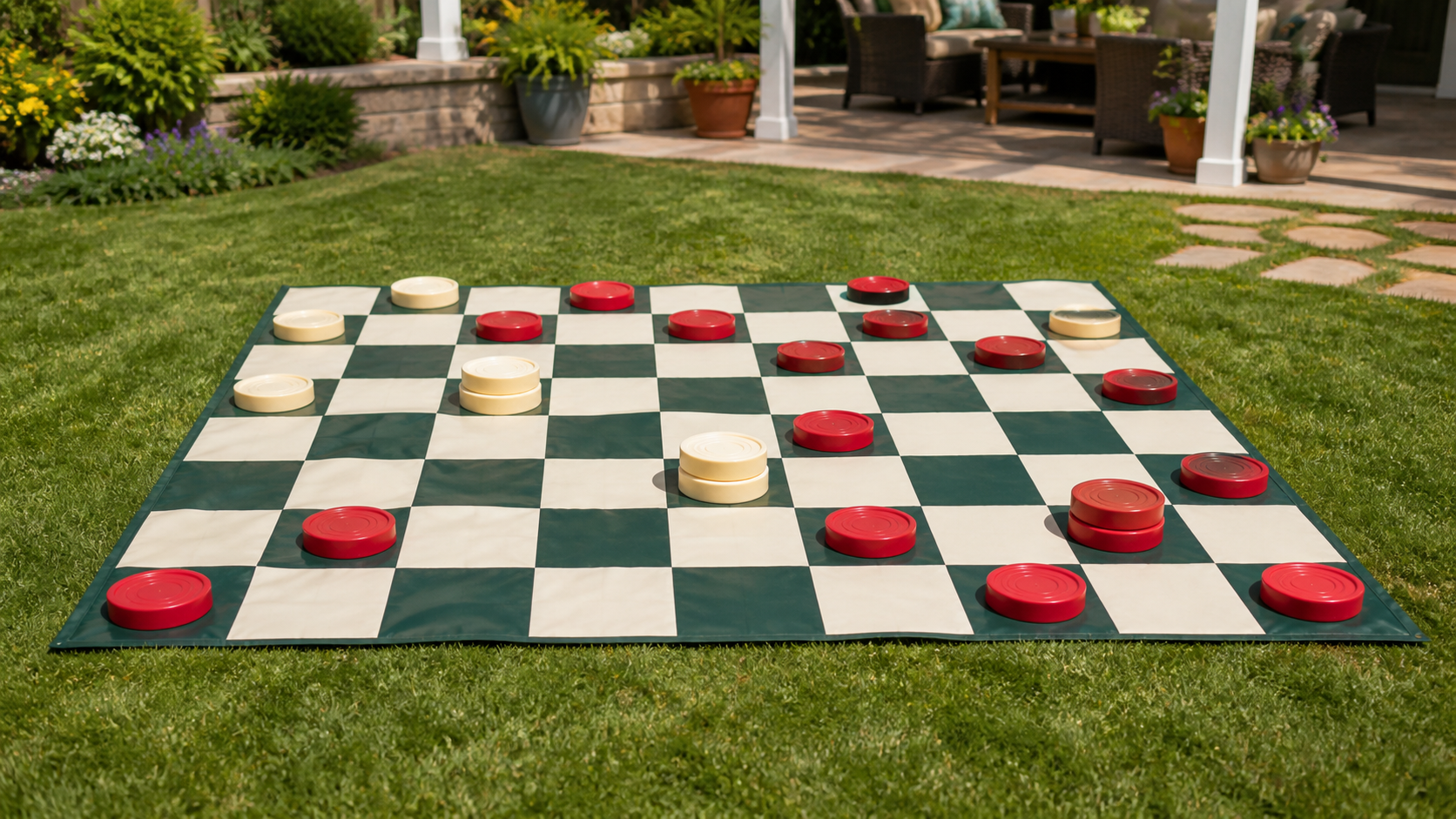
- Kinging: stackable pieces make a crowned checker visible without separate markers. If pieces do not stack securely, confirm the set includes another clear king marker.
- Contrast: the two piece colors and alternating board squares should remain easy to distinguish from several sides.
- Surface: mats need a reasonably flat area. Sectional tiles add seams and setup steps but can pack differently.
- Storage: measure the board or tile bundle plus all 24 oversized discs. Check whether a bag or container is included rather than assuming it is.
- Care: follow the maker's current directions for moisture, sunlight, cleaning, drying, and storage.
Best for most family gatherings: mat-and-disc sets
A large checkerboard mat with oversized discs is the simplest category to understand. It creates a clearly bounded game, can be removed after the gathering, and usually requires less storage than rigid board systems. A single-piece mat has fewer parts, while a foldable or sectional mat may pack more neatly.
Best for: occasional backyard, hall, or covered-patio play where the board must be put away afterward.
Skip it if: the available surface is too uneven for pieces to sit flat or there is no practical place to dry and store the mat.
Best for easy kinging: thick stackable discs
Stackable discs preserve the familiar way many families mark a king: place a second checker on top. Look for flat upper and lower surfaces or a stated nesting feature, and check whether a two-disc stack remains stable inside one square. A tall stack is not useful if it crowds nearby pieces.
Best for: groups that already know stacking as the clearest king marker and want spectators to read the game easily.
Skip it if: the pieces cannot be stacked securely or the set provides exactly 24 discs with no stated king-marking method.
Best for repeat use: interlocking board tiles
Interlocking squares or larger board sections create a more structured playing surface than a thin mat. Individual sections may be easier to replace or divide between storage containers, but the board takes longer to assemble and every connection should lie flat enough for play.
Best for: recurring reunions, community rooms, or family spaces with a predictable setup routine.
Skip it if: fast setup matters most, small components will be hard to count, or the assembled board would block normal use of the space.
Best for flexible indoor play: soft or lightweight formats
Lightweight discs and a foldable board are easier to carry between rooms than heavy rigid pieces. Indoors, they also avoid asking one person to move a bulky set across a long route. Compare visibility and board flatness carefully; compact packing should not make the playing position hard to read.
Best for: family halls, multipurpose rooms, and gatherings where the game moves between indoor and covered spaces.
Skip it if: the pieces shift too easily for the intended surface or the board cannot remain flat during a full game.
Quick comparison framework
- Choose a single-piece mat when the fewest setup steps matter most.
- Choose a folding or sectional mat when packed shape matters more than minimizing seams.
- Choose thick stackable discs when visible, familiar kinging is the priority.
- Choose interlocking board tiles for repeat use with a reliable setup and storage routine.
- Choose a large tabletop set instead when the group wants better visibility without using the floor or lawn.
Pre-purchase checklist
- Confirm the board is 8 by 8 if you plan to play American checkers.
- Confirm the set includes 12 pieces in each of two clearly different colors.
- Compare checker diameter with square width and allow space for a crowned stack.
- Verify the kinging method: stacking, reversible pieces, marked pieces, or included markers.
- Mark the full board dimensions on the actual lawn, patio, or room and leave walking space around it.
- Check every packed dimension, package count, carrying method, and route to storage.
- Read the current cleaning, drying, surface, and storage instructions.
Who should skip a giant checkers set?
Skip giant checkers if the gathering has limited floor space, storage is far from the playing area, or the group mainly wants seated two-player games. A large-piece tabletop checkers setup improves visibility and handling with a much smaller footprint.
Also skip a checkers-only purchase when the family wants one oversized activity for both games. Compare the outdoor chess and checkers guide, but verify that any shared board includes appropriate pieces and a clear setup for each game.
Bottom line
For most occasional family gatherings, start with an 8-by-8 mat-and-disc set whose checkers fit the squares and stack clearly for kings. Move to interlocking or more rigid formats only when the playing area, setup routine, and storage plan make those extra parts worthwhile.