
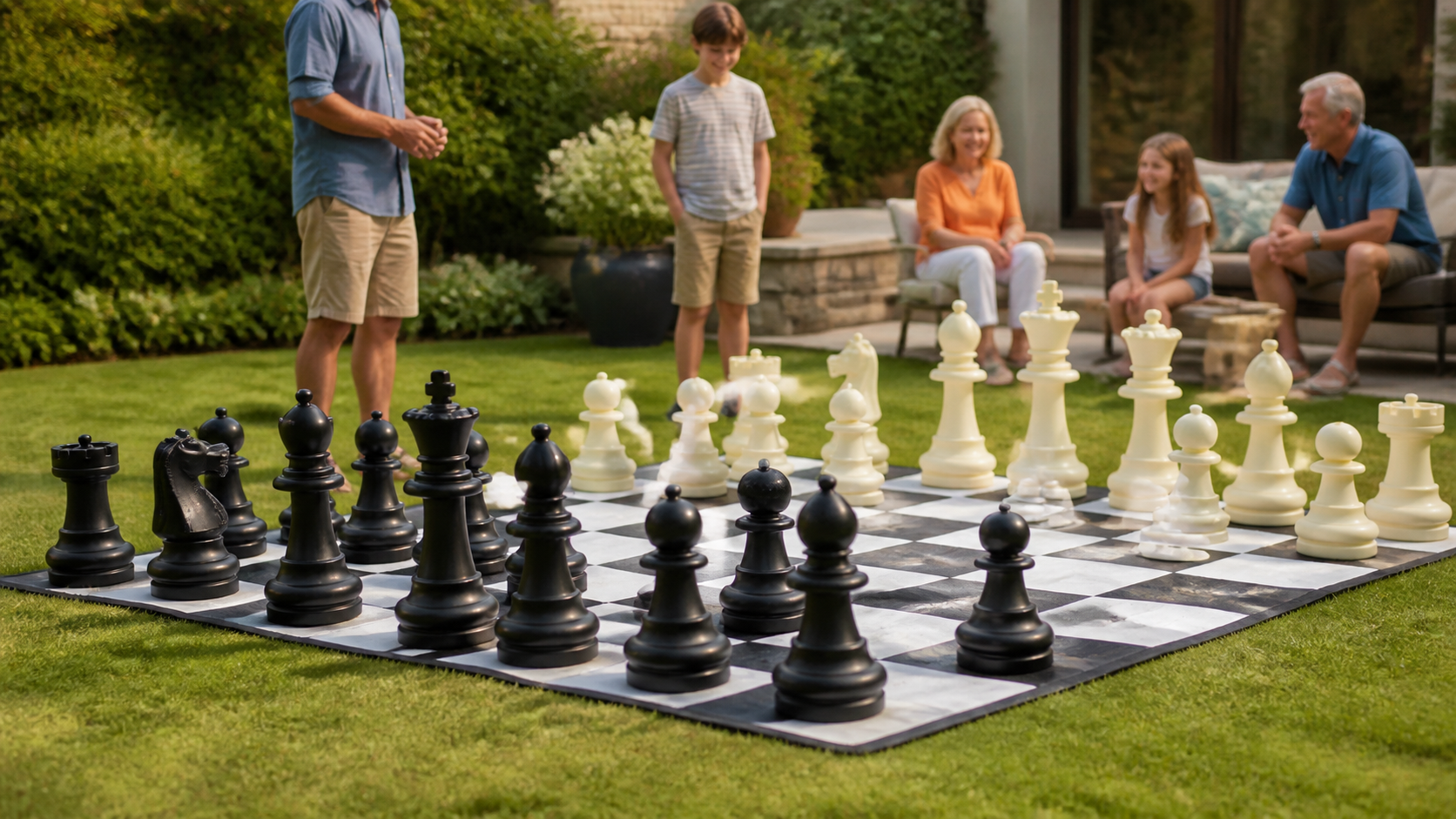
A giant chess set can give a family gathering a clear shared activity, but the tallest pieces are not automatically the most useful. The better fit is the format your space can hold, your group can see, and one or two people can set up and store without turning every game into a project.
This is a product-category comparison, not a ranking of named products or a hands-on test. Dimensions, included parts, materials, and care instructions vary, so verify the current listing before choosing a set.
As an Amazon Associate, The Good Chess & Checkers may earn from qualifying purchases.
Product-category guide
Start with the full playing footprint
Measure the board or mat when open, the route from storage, and the space people need to walk around it. Then compare piece height, base width, total packed volume, setup steps, and care instructions.
Selection criteria for a useful giant chess set
- Open footprint: measure the complete 8-by-8 board or mat, then leave comfortable room around all four sides.
- Piece scale: compare the tallest piece, pawn height, and base diameter with the square size. Large bases should fit without crowding neighboring squares.
- Visibility: recognizable shapes and strong contrast matter when several people are following the position from different sides.
- Stability: compare base width and the maker's stated filling or weighting method. Do not assume hollow pieces suit every surface or weather condition.
- Setup: count board sections, mat tiles, stakes, and pieces that must move from storage before play can begin.
- Storage: check the packed dimensions of all 32 chess pieces plus the board. A nearby shed or large bin changes what is practical.
- Care: follow current instructions for moisture, sunlight, cleaning, filling, emptying, and indoor or outdoor storage.
Best for most backyards: mid-size lawn chess
Mid-size lawn sets make the pieces clearly oversized while remaining easier to carry and store than the tallest display-scale formats. They can work well when adults and older children want to move pieces themselves and the gathering needs a game, not a permanent garden feature.
Best for: occasional backyard gatherings, patios with generous open space, and families that can store several bulky bags or bins nearby.
Skip it if: your only playing area is uneven, the pieces must travel far from storage, or the open board would block normal foot traffic.
Best for a flexible layout: mat-based giant sets
A one-piece or sectional mat creates a visible board without installing permanent squares. One-piece mats reduce assembly but may be awkward to fold or roll. Interlocking tiles pack into smaller sections and can replace a damaged square more easily, but they add setup time and seams.
Best for: multipurpose lawns, halls, covered patios, and gatherings where the playing area must disappear afterward.
Skip it if: the surface cannot support a flat board, loose edges will be a nuisance, or there is no practical way to clean and dry the mat according to its instructions.
Best for frequent use: sectional or fixed-board systems
Sectional squares or a dedicated built-in board can make the play area more defined. This format may suit a home, community room, or club that uses giant chess regularly, but it is less flexible than rolling out a mat for one afternoon. Confirm whether the board is included; some listings sell pieces separately.
Best for: repeat gatherings with a predictable playing area and an established storage routine.
Skip it if: the board needs to move between locations, the space serves many other purposes, or occasional play does not justify the setup.
Best for spectacle: extra-tall display-scale pieces
The tallest giant chess pieces are easy for a group to notice, but their storage, transport, and setup demands rise quickly. Treat this as a space-and-routine decision rather than assuming bigger creates a better game. Verify how pieces are stabilized and whether any fill must be added or removed.
Best for: a large, level area, nearby dedicated storage, and gatherings where the chess activity is meant to be a visual centerpiece.
Skip it if: one person must carry everything a long distance, younger players cannot comfortably move the pieces, or a mid-size set would be played more often.
Quick comparison framework
- Choose mid-size lawn chess for the most manageable balance of visibility, movement, and storage.
- Choose a one-piece mat when quick board setup matters more than compact packing.
- Choose interlocking tiles when sectional storage matters more than the fewest setup steps.
- Choose a fixed or sectional board system for frequent play in one predictable place.
- Choose extra-tall pieces only when the gathering space, storage, and setup routine support the added scale.
Pre-purchase checklist
- Mark the advertised open dimensions on the actual lawn, patio, or indoor floor.
- Measure the clear walking space around the board and keep the set out of normal access routes.
- Confirm that the listing includes 32 chess pieces and clearly states whether the board or mat is included.
- Compare piece bases with square dimensions and verify that the two sides are easy to distinguish.
- Check packed dimensions, package count, total weight, handles, bags, bins, and the route to storage.
- Read the current setup, filling, care, and storage instructions instead of inferring all-weather use.
- Decide who will set up, count, clean, dry, and put away every component after the gathering.
Who should skip a giant chess set?
Skip giant chess if your group mainly wants a quiet two-player game, has limited storage, or would need to transport the set for every use. A large-piece tabletop set can improve visibility and handling without taking over the yard.
Also skip a chess-only giant set if the family wants equal support for both games. The outdoor chess and checkers guide compares flexible tabletop and lawn formats, while family gift sets are easier to store and use year-round. If you already own oversized pieces, use the giant-piece storage-box guide to measure the full inventory and storage route.
Bottom line
For most occasional family gatherings, a mid-size giant chess set with a clear mat and nearby storage is the sensible starting category. Move up to extra-tall pieces only when the full playing footprint, transport route, setup work, and packed volume all fit the way the family will actually use it.