
A compact chess scorebook can make a new notation habit harder than it needs to be. Small move boxes, faint ruling, and a binding that closes itself all compete with the board for attention. A larger-format book can help, but “large print” is not a dependable size standard: the useful choice is the one whose current sample pages and dimensions match the writer.
This is a product-category comparison, not a ranking of named books or a claim of hands-on testing. It does not promise an accessibility outcome. Verify the current edition, trim size, notation-field dimensions, ruling contrast, binding, page layout, and game capacity before buying.
As an Amazon Associate, The Good Chess & Checkers may earn from qualifying purchases.
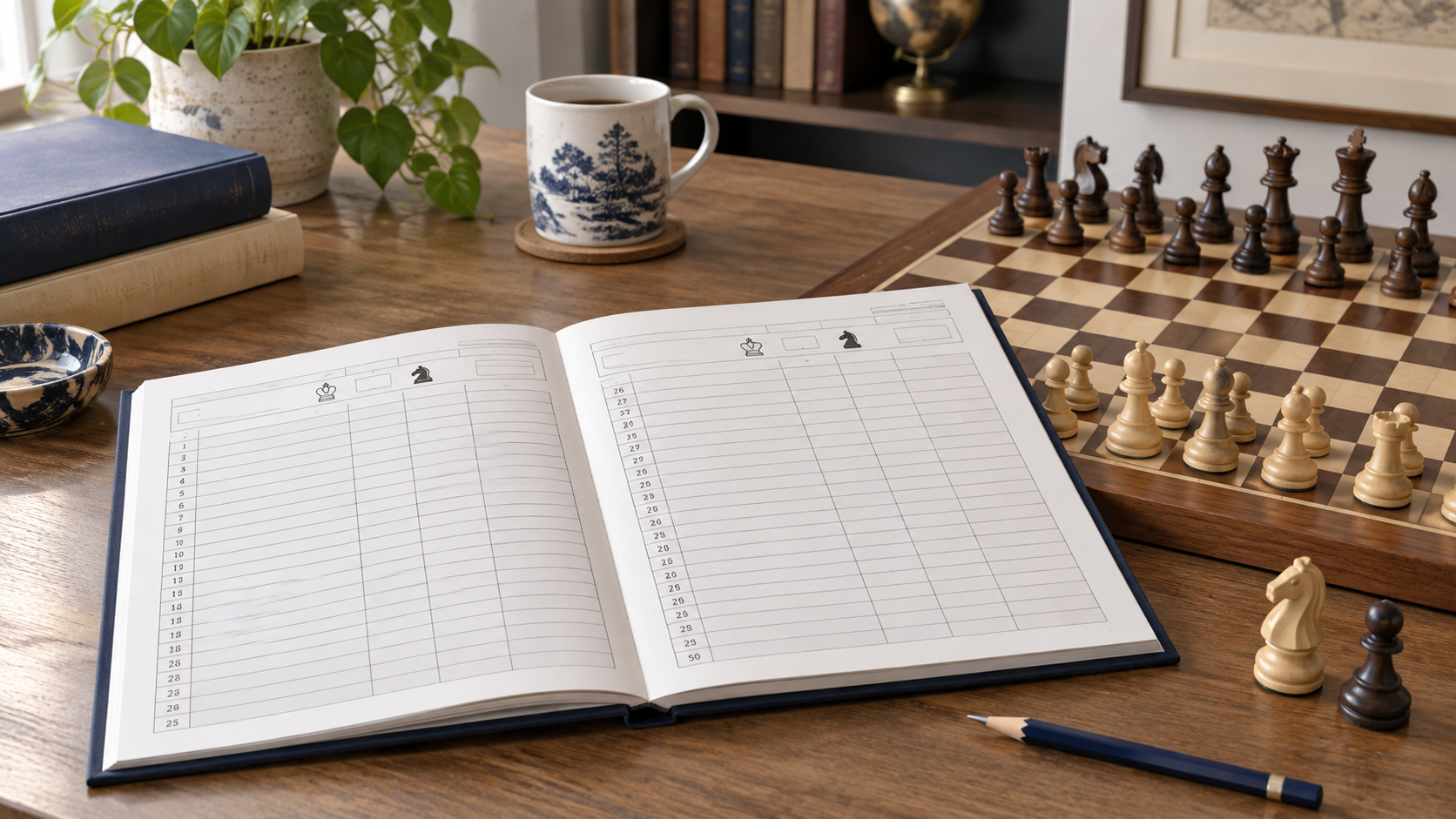
Measure the writing area
Compare page layouts, not the label
Look for an inspectable sample page, then compare the actual move-row height, column width, contrast, binding, and open footprint with the player’s writing and table setup.
Quick Answer
The best starting format for a beginner who wants more writing room is a lay-flat scorebook with a clearly pictured two-column score sheet, strong ruling, and enough space for full move numbers and both players’ moves. Do not rely on “large,” “easy read,” or an age label by itself. If the listing provides no sample interior and no useful page dimensions, skip it.
Define “Large Print” With Measurements
Trim size tells you the outside page dimensions, not the size of the writing fields. Use a listing image with a ruler or stated interior measurements when available. Compare the height of each move row, the width allotted to White and Black, and whether move numbers are visually separate from notation. A wide book with many cramped rows may offer less usable writing room than a smaller book with fewer rows per page.
Print a blank scoresheet at home first and test several row heights with the pencil or pen the player normally uses. This no-spend trial gives you a minimum useful field size to compare against current product information.
Comparison Framework
| Criterion | What to verify | Why it matters |
|---|---|---|
| Move fields | Row height, column width, and separation of move numbers | Determines whether notation fits without crowding. |
| Contrast | Dark text and ruling on a plain background in sample pages | Helps the page remain easy to scan beside the board. |
| Binding | Spiral, sewn, or another format shown open | A book that stays open uses less attention during play. |
| Prompts | Visible fields for players, date, result, event, and board | Useful prompts reduce forgotten game context. |
| Capacity | Number of complete score sheets, not total pages | Front matter and notes pages can change actual game capacity. |
| Open size | Full width and height when used | The book must share the table with the board and clock. |
Best Overall Format: Lay-Flat With Spacious Move Rows
A spiral-bound or otherwise lay-flat book is the most practical category when the writer needs to glance between board and page. Favor a simple score-sheet layout with bold move numbers and an obvious division between White and Black. Confirm whether the binding sits comfortably for the writer’s preferred hand and page orientation.
Best for: beginners recording complete casual or club games at a table with enough space.
Skip it if: the listing hides the interior, the ruling is faint, or the open book crowds the board.
Best for Learning the Routine: Scorebook With Concise Prompts
Some books reserve space for player names, date, result, color, event, or board number. Those fields can reinforce a repeatable record, but pages of opening advice or notation rules do not compensate for cramped score rows. Check that any instructional material uses the same algebraic notation the learner is practicing.
Best for: a beginner who knows legal moves and wants reminders about what to record.
Skip it if: the learner still needs guided notation exercises and answer support; a workbook is the better tool.
Best for Home Review: Fewer Games With Notes Space
A larger notes area can be more useful than maximum game capacity when the goal is to revisit turning points. Check whether notes sit beside each game or on clearly linked pages. Keep claims modest: a notes box creates room for reflection, but it does not provide analysis or coaching.
Best for: casual players who plan to replay games on a physical board.
Skip it if: the priority is compact storage of many club records rather than individual review.
Best for Carrying: A Moderate Large Format With a Firm Cover
The biggest page is not automatically the best travel choice. Compare the closed dimensions with the chess bag, and check whether the cover protects page corners without making the book awkwardly heavy or rigid. A clipboard and loose enlarged sheets may be easier when only a few games need recording.
Best for: players who want more room but regularly carry their own board and pieces.
Skip it if: a free enlarged score-sheet printout already fits the routine.
Who Should Skip a Large-Format Scorebook?
- A learner who does not yet understand algebraic notation should practice with guided exercises before recording a full game.
- A player whose device already captures games reliably may prefer a digital record, provided screen use and export fit the setting.
- A club collecting loose sheets may benefit more from enlarged printable forms and a consistent filing system.
- Anyone unable to verify the interior layout should avoid buying on a “large print” label alone.
A Five-Minute Prepurchase Check
- Write several sample chess moves at a comfortable size.
- Measure the row height and column width they require.
- Measure the free table area beside the board.
- Inspect the current listing for an interior sample and closed dimensions.
- Confirm the binding, score-sheet count, prompts, and return terms.
- Skip the book if any essential fit detail remains unclear.
Bottom Line
Choose a large-format chess scorebook by its measurable writing fields, contrast, lay-flat behavior, and open table footprint—not by age wording or a vague large-print claim. A simple roomy layout is the strongest general choice for an older beginner who already knows notation. Try an enlarged free sheet first, and buy only when current samples show that the bound book improves the real recording routine.