
A beginner club needs boards that new players can read quickly, helpers can carry in batches, and everyone can set up without treating the equipment as fragile. Vinyl roll-up boards often fit that job, but the lowest price is not the only decision. Square size, contrast, coordinates, piece fit, storage, and care determine whether a board remains useful after repeated meetings.
This guide compares vinyl board categories rather than naming winners or claiming hands-on tests. Product listings and included contents change, so verify current measurements, material wording, care directions, and what comes in the package before ordering.
As an Amazon Associate, The Good Chess & Checkers may earn from qualifying purchases.
Product-category guide
Start with a readable board that fits the club’s pieces
Compare the square measurement, overall footprint, contrast, coordinates, material, and included contents. A board-only listing needs compatible pieces and a separate storage plan.
Quick comparison framework
- Square and piece fit: compare the square width with the king’s base diameter. Pieces should have visible space around their bases.
- Contrast: choose two calm, clearly different square colors with a matte-looking finish that stays readable under ordinary room lights.
- Coordinates: border labels help beginners follow lessons and record moves, but cramped or tiny labels add clutter.
- Flatness: vinyl can retain curl or creases. Check storage guidance and avoid listings that arrive folded when the club plans to roll them.
- Cleaning: confirm the maker’s wiping and drying directions. Do not assume every printed vinyl surface tolerates the same cleaner.
- Standardization: matching board dimensions and colors make setup instructions, replacement buying, and table planning simpler.
Best overall club format: full-size board with coordinates
For a beginner club that teaches notation, a full-size vinyl board with clear edge coordinates is usually the most useful category. A consistent layout helps volunteers direct everyone to the same square, and a generous playing area keeps pieces from feeling crowded. Verify actual square size rather than relying on “club” or “tournament” wording, which sellers may use inconsistently.
Best for: clubs teaching setup, files and ranks, notation, or guided positions.
Skip it if: the club uses very small tables, compact pieces, or casual play where coordinates would only add visual noise.
Best for casual beginner play: high-contrast board without coordinates
A coordinate-free board keeps the border simple. It can work well for family clubs, drop-in library sessions, and players who are learning legal moves before notation. Look for a clear outer border so beginners can see where the board ends, especially when several boards share one table.
Best for: relaxed practice where board clarity matters more than notation lessons.
Skip it if: teachers regularly call out squares or learners use books and worksheets built around algebraic coordinates.
Best when starting from nothing: board, pieces, and bag bundle
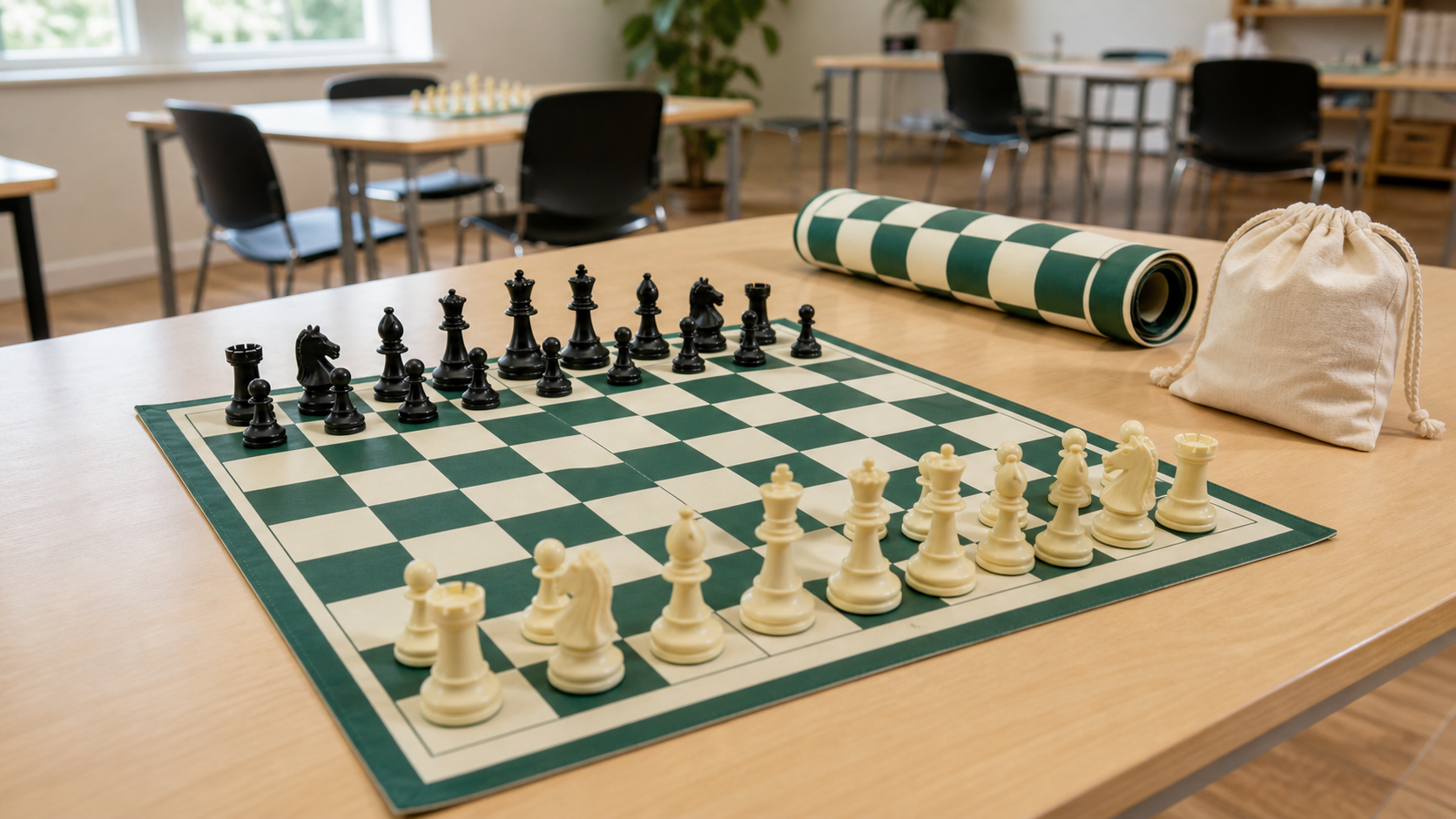
A bundle reduces the risk of buying pieces that crowd the squares, provided the listing gives useful measurements. Confirm that it includes all 32 chess pieces, that the light and dark pieces contrast with both board colors, and that the bag separates pieces from a neatly rolled board.
Best for: a small new club that needs a complete playable station in one purchase.
Skip it if: the listing omits piece dimensions, includes unfamiliar decorative shapes, or offers no practical way to replace a missing pawn later.
Best for large inventory: matching board-only packs
Board-only packs make sense when a club already owns compatible pieces. Matching colors and dimensions simplify table setup and let helpers swap a damaged board without rematching every set. Count the boards needed for typical attendance and keep a modest spare rather than buying for a one-time maximum.
Best for: established clubs replacing mixed or worn boards while keeping their current pieces.
Skip it if: existing pieces vary widely in base size or the club has no labeled storage system to keep parts together.
Vinyl vs mousepad, silicone, and rigid boards
- Choose vinyl when low packed bulk, easy standardization, and carrying several boards matter most.
- Choose mousepad-style material when table grip and quick lie-flat setup are worth a thicker roll.
- Choose silicone when flexible handling and the maker’s specific cleaning routine suit the space, accepting that it may attract lint.
- Choose rigid or folding boards when moving a position intact or displaying the setup matters more than bulk transport.
The mousepad board guide covers the closest alternative in detail. For a first comparison across flexible materials, use the roll-up board guide.
How to size a club board and pieces
Start with the pieces the club already owns. Measure the base of the king, then compare it with the board’s listed square width. The base should sit comfortably inside one square without touching its borders. Also measure the tables: two individually comfortable boards may still be too wide when placed side by side.
If measurements are missing, ask the seller or choose a better-documented category listing. The site’s board-size guide explains the fit decision without treating one dimension as correct for every room or learner.
Storage and care for repeated meetings
- Number each board and its piece bag so incomplete sets are easy to identify.
- Wipe boards only as the maker directs, then let them dry completely before storage.
- Roll boards loosely and consistently; avoid sharp folds and heavy objects that create creases.
- Use a tube or roomy carrying bag that does not crush the roll. The storage-tube guide covers the measurements to check.
- Count pieces at cleanup and keep a labeled replacement supply separate from complete sets.
Who should skip a vinyl chess board?
Skip vinyl if the club cannot store boards rolled, needs boards to settle flat immediately with no setup routine, wants to move unfinished positions between rooms, or prioritizes a display-quality surface. Very small children may also do better with a stable contained set if loose boards and separate piece bags make cleanup harder.
A club that needs chess and checkers at every station may prefer chess and checkers club starter kits rather than assembling chess-only boards and pieces separately.
Bottom line
The best vinyl chess board for a beginner club is not a named winner. It is the category format that fits the club’s pieces, tables, teaching style, storage, and cleanup routine. Start with square size and contrast, add coordinates only when they support instruction, standardize dimensions where practical, and reject listings that hide measurements or included contents.