
Choose a lesson book when the helper needs a dependable order from rules to practice. Choose printable worksheets when the group needs one carefully selected activity at a time, multiple copies, or different difficulty levels. A small beginner group can also use both: the book supplies the teaching sequence, while permitted worksheets supply the table activity.
Do not choose by page count alone. Preview the exact material, identify the checkers ruleset it teaches, and confirm that its diagrams, answers, copying terms, and reading level fit the group. This guide compares formats rather than claiming that a named resource has been tested.
As an Amazon Associate, The Good Chess & Checkers may earn from qualifying purchases.
Sequence or session-level flexibility
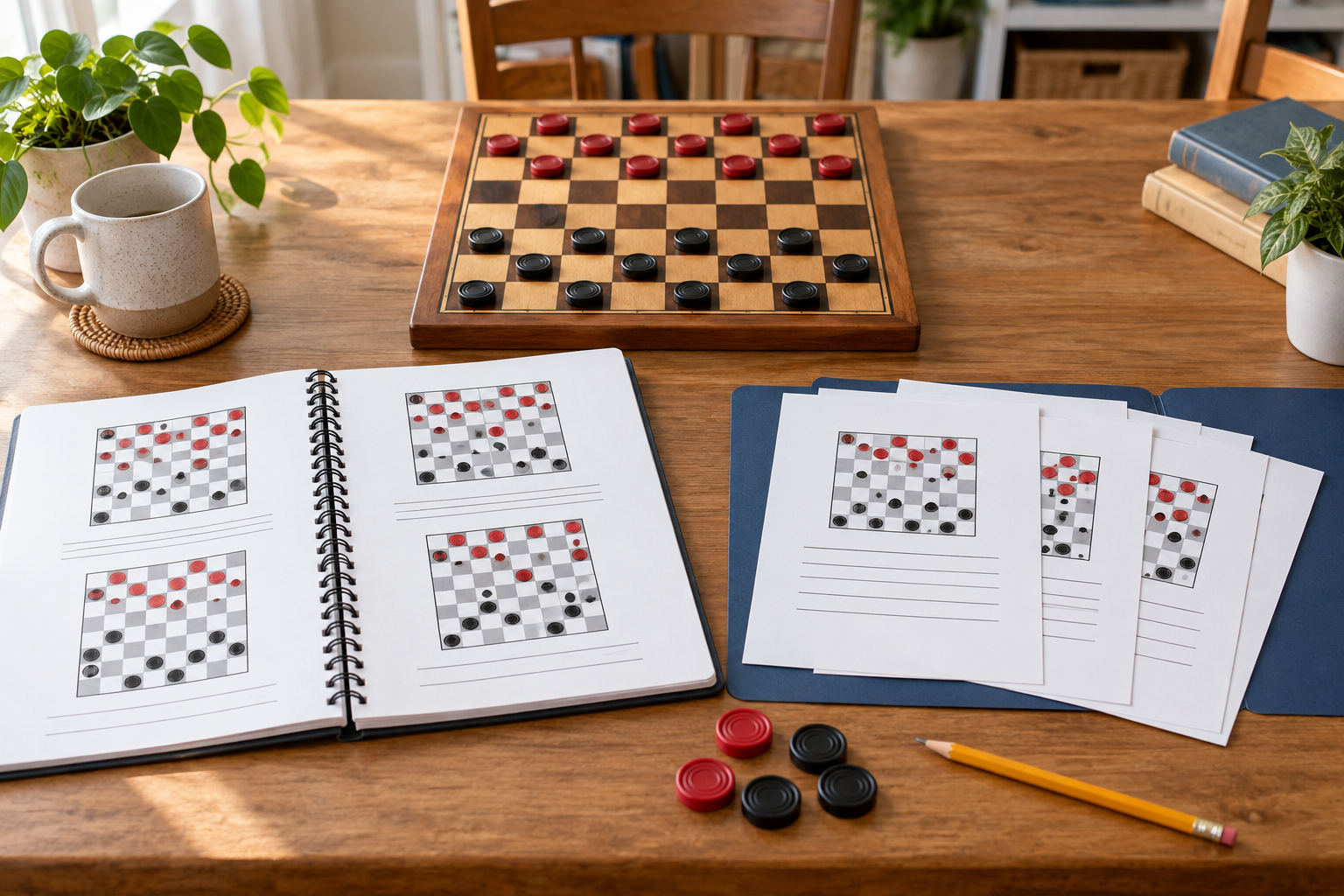
Compare checkers teaching formats
For a book, preview the lesson order, diagram clarity, named ruleset, answer support, binding, and table footprint. For worksheets, verify the topic, print size, answer key, file format, and the creator's current printing and sharing terms.
Quick decision
- Use a lesson book when a parent or volunteer needs a ready order for setup, movement, captures, multiple jumps, kings, and beginner positions.
- Use worksheets when every learner needs a copy, the group is practicing one narrow idea, or the helper must adjust the level between tables.
- Use both when the book guides preparation and the worksheet is clearly licensed or sold for the intended number of copies.
- Buy neither yet when the group still benefits more from short board demonstrations and a few-piece mini-game than written work.
Where a lesson book is stronger
A useful lesson book reduces sequencing decisions. The helper can see what concept comes next and avoid introducing strategy before learners can move, capture, complete a multiple jump, and show a king correctly. A bound resource also keeps explanations, diagrams, and answers together between sessions.
The tradeoff is fixed pacing. One chapter may be too dense for a first session, while another may repeat skills the group already knows. A book can also be awkward beside the board if it will not stay open or if diagrams are too small to share. Preview a middle lesson, not only the contents page.
Where printable worksheets are stronger
A worksheet can isolate one decision: find every legal capture, finish a multiple jump, choose a promotion route, or rebuild a simple position. Separate pages are easy to distribute, annotate, collect, or place in a reusable sleeve when the usage terms allow it.
Flexibility creates preparation work. The helper must choose an appropriate page, verify the position, print it at a readable scale, prepare an answer, and file it for later. A folder full of unrelated downloads is not a curriculum. Record the topic and intended lesson order so the next volunteer can continue coherently.
Check the ruleset before using either format
“Checkers” does not identify every rule. American checkers and English draughts normally use an 8-by-8 board, while international draughts commonly uses a 10-by-10 board and differs in important capture and king rules. Other variants differ too. The material should name or clearly define its board, starting position, capture rules, crowning procedure, and king movement.
Do not mix a worksheet with a book simply because both show round pieces on dark squares. Compare their rule explanations first. If a family or group uses a house rule, state that separately rather than editing an answer key into apparent universal authority.
Compare the complete group workflow
| Decision | Lesson book | Printable worksheets |
|---|---|---|
| Lesson order | Usually supplied by the author | Chosen and recorded by the helper |
| Copies | Often one shared reference unless terms say otherwise | Potentially one per learner, subject to current usage terms |
| Level changes | Limited to the book's sequence | Pages can be selected for different tables |
| Answers | May be collected in one section | May be separate, brief, or absent |
| Preparation | Preview and mark the lesson | Select, verify, print, distribute, and file |
| Storage | One bound item | Folder, binder, or approved digital archive |
Run a one-session format test
- Choose one narrow topic the group is ready for, such as mandatory captures in the ruleset being taught.
- Preview one book lesson and one legally usable worksheet on that same topic.
- Confirm both positions against the physical board and prepare the answers before the session.
- Give the same amount of board practice with each format; do not compare a reading-only lesson with a hands-on activity.
- Note setup time, learner questions, diagram readability, answer-check time, and what must be stored for next week.
- Choose the format that makes the next session easier to prepare and understand, not the one with the most material.
Buying and printing checks
- Preview: inspect actual interior pages, not only a cover or marketing description.
- Diagrams: confirm an accurate grid, clear playable squares, distinct sides, visible kings, and an obvious side to move.
- Answers: prefer explanations or move sequences that a helper can verify on a board.
- Reading fit: check a middle page with the actual learners; an audience label is not enough.
- Copying terms: use only the number and type of copies allowed by the publisher, seller, or creator's current terms.
- Print routine: include paper, ink, scale, duplex settings, folder space, and reprinting in the real workload.
- Board connection: every written position should be easy to rebuild and discuss on the group's physical board.
Who should skip each format?
Skip a lesson book when the group already has a clear teaching sequence and only needs occasional targeted practice. Skip worksheets when no helper has time to select, verify, print, answer, and organize them. Skip both for a first meeting if learners need an inviting rules demonstration and short mini-games more than desk work.
For a teacher-facing curriculum rather than learner handouts, compare checkers lesson-plan book formats. For independent problem practice after the rules are secure, see checkers puzzle books for adult beginners.
Bottom line
A lesson book is the simpler anchor when a beginner group needs order and continuity. Printable worksheets are better when the helper needs copies, one-topic practice, or different levels at different tables. Preview the real pages, match the ruleset, verify answers and usage terms, and test the format with one lesson before building a larger library.