
An adult beginner who already knows how checkers pieces move may not need another cover-to-cover rules manual. A focused puzzle book can turn a quiet study session into a sequence of small decisions: find the required capture, compare landing squares, plan a multiple jump, or avoid giving the opponent an immediate reply.
This is category guidance, not a ranking of named books. It does not claim hands-on testing, guaranteed improvement, current prices, ratings, review counts, or availability. Preview the actual edition, sample pages, stated ruleset, contents, and answer section before buying.
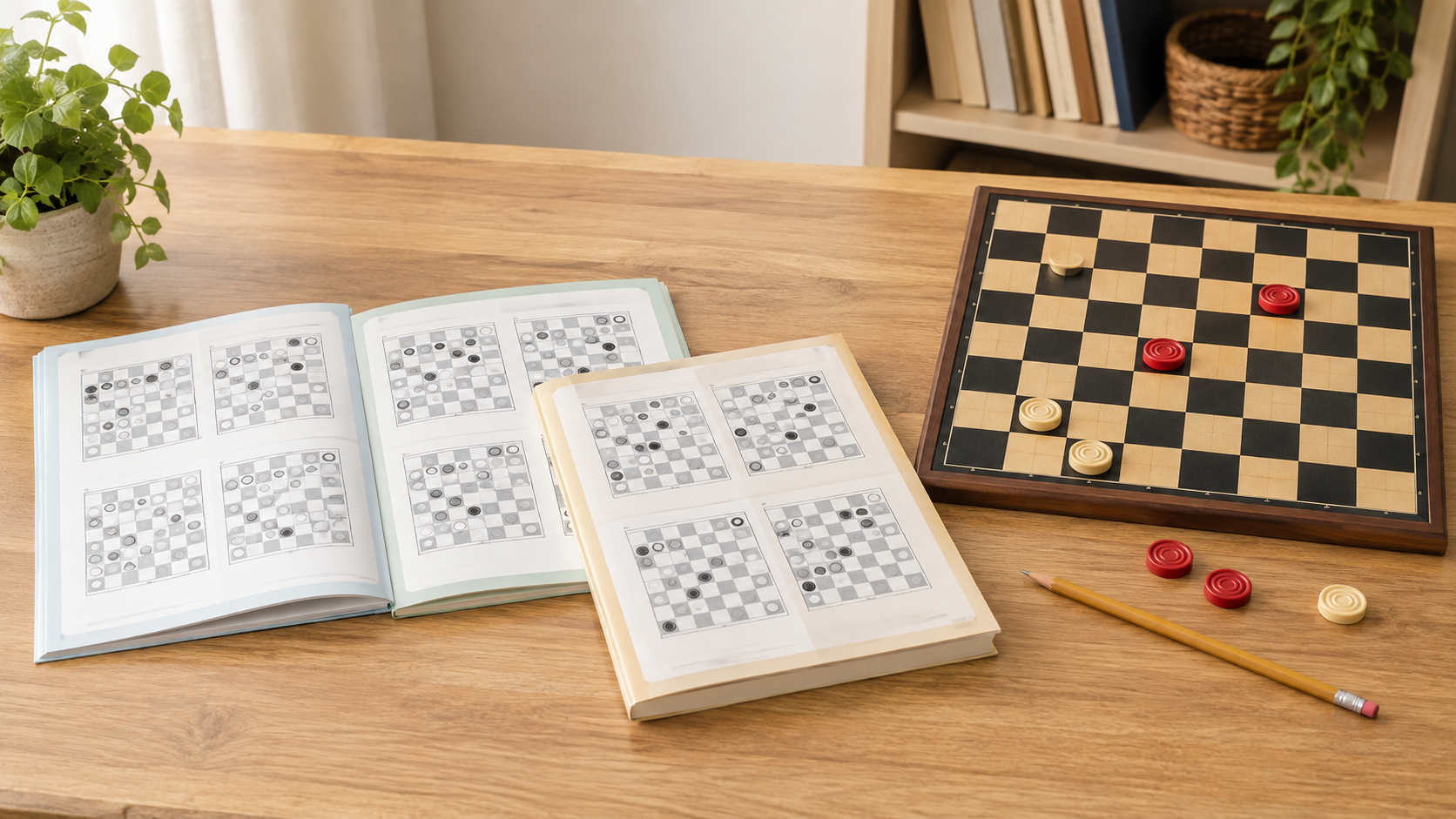
Quick answer
The best first puzzle book for an adult beginner states which checkers variant it uses, prints large and unambiguous board diagrams, starts with one clear idea, and provides explained answers. It should let the learner rebuild positions on an 8-by-8 board without decoding advanced notation first.
Choose a graduated workbook when the learner wants a repeatable practice routine. Choose a mixed instruction-and-puzzle book when the rules still need occasional review. Borrow or preview before buying when the diagram size, answer quality, or game variant is unclear.
What to verify before buying
| Criterion | What to look for | Why it matters |
|---|---|---|
| Ruleset | American checkers, English draughts, international draughts, or another named variant | Board size, captures, kings, and move choices can differ. |
| Diagram clarity | Visible dark squares, distinct sides, obvious kings, and a stated side to move | The exercise fails if the position must be guessed. |
| Difficulty path | Short sections that progress from one-move captures to longer plans | A mixed pile of hard positions can frustrate a new solver. |
| Answers | Move sequence plus a plain-language reason | An unexplained destination square gives little help after a mistake. |
| Notation load | Coordinate key, worked example, and consistent notation | Notation should support the puzzle, not become a hidden prerequisite. |
| Physical format | Previewed print size, binding, page layout, and room for notes | The book needs to stay usable beside a real board. |
Best format for learning one idea at a time
A graduated workbook is the strongest general format when its sections have a clear purpose: mandatory captures first, then multiple jumps, promotion choices, simple traps, and end positions. A label such as “beginner” is less useful than sample pages showing what the first ten exercises actually require.
Look for a worked example before each new puzzle type and answers separated from the exercise page. If every solution is visible beside the diagram, it becomes difficult to calculate honestly. If the book begins with dense analysis and no guided example, start with the broader beginner checkers book guide instead.
Skip this format when the learner is still unsure about ordinary movement, capturing, or kinging. A puzzle routine works better after those rules are comfortable.
Best format when the rules still need reinforcement
A hybrid instruction-and-puzzle book can help a learner who knows the basic goal but still checks a rule during play. The useful version gives a short rule explanation, a worked position, several closely related exercises, and explained solutions. A general strategy book with a few scattered diagrams is not automatically a puzzle workbook.
Confirm that the book distinguishes legal captures from optional-looking moves. In common American checkers rules, a capture is required when available, but variants differ. Use the site's forced-jump guide to establish the rule baseline before solving, and check the book for its own stated convention.
How to judge a sample puzzle page
- Identify the variant and board. An adult beginner should not have to infer whether an 8-by-8 or 10-by-10 game is being taught.
- Find the side to move. The prompt or consistent diagram orientation should make this explicit.
- Distinguish men from kings. Crowns, rings, doubled discs, or another legend must remain clear in print.
- Read the task. “Find the capture,” “win a piece,” and “reach king row” are different decisions.
- Inspect the solution. Prefer an answer that explains why the move works and mentions a tempting wrong choice.
If a sample cannot pass those five checks, a familiar title or thick page count does not rescue it. Listing descriptions sometimes combine editions and formats, so match the author, publisher, publication date, binding, and identifier shown for the copy being ordered.
A simple board-and-book practice routine
Rebuild one position on a physical board, confirm whose turn it is, and scan every available capture before moving. Write down the intended sequence, play it through, then compare it with the explanation. If the answer differs, reset the position and locate the first decision where the lines separated.
Three carefully reviewed puzzles are more useful than rushing through a page and checking only whether the final square matches. Keep the same ruleset throughout a session. Adults who prefer continuous examples and longer explanations may get more value from a checkers strategy book for casual play.
Who should skip a checkers puzzle book?
- A complete newcomer should first learn setup, movement, captures, and kings with the beginner checkers rules guide.
- A learner who dislikes solitary exercises may benefit more from short guided positions with a patient playing partner.
- A buyer who cannot preview the diagrams, answers, or variant should borrow a copy or choose a better-documented book.
- A player seeking advanced opening analysis should choose a strategy reference at the appropriate level, not an adult-beginner workbook.
If the learner is still choosing between short position practice and longer explanations, start with the checkers puzzle-book vs strategy-book comparison.
Bottom line
Choose a checkers puzzle book for the quality of its practice loop: a clear position, one defined decision, a sensible progression, and an explained answer. Confirm the ruleset and actual edition, preview the print layout, and use a board to replay mistakes. The right book is not the one with the most puzzles; it is the one whose diagrams and explanations make the next puzzle easier to understand.