
A useful first checkers book does more than restate the rules. It should make diagonal movement easy to see, explain captures and kings without ambiguity, and give the learner a manageable way to practice. Families also need to know which rule version the book teaches before a disagreement reaches the board.
This is a format-and-fit guide, not a hands-on ranking. We have not worked through every exercise in every edition. Check the publisher description, contents, sample pages, edition details, and the rules used before buying.
As an Amazon Associate, The Good Chess & Checkers may earn from qualifying purchases.
Quick decision aid
Look inside for clear board diagrams
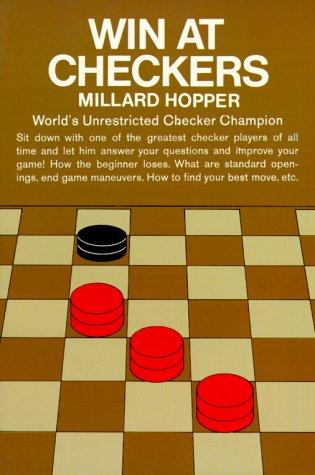
Win at Checkers by Millard Hopper is one recognizable instruction title to compare with newer beginner books. Confirm the exact edition and make sure its notation, diagrams, and level fit the learner.
What to Look For in a Beginner Checkers Book
- Large, readable diagrams: dark squares, pieces, kings, and move paths should be distinct without guesswork.
- Rules before strategy: setup, diagonal movement, captures, multiple jumps, crowning, king movement, and the winning condition should appear before advanced positions.
- A named ruleset: “checkers” can mean American/English checkers, international draughts, or another variant. The board size and rules should be explicit.
- Short practice positions: a learner should be able to rebuild an example on a real board and try both sides.
- Explained answers: a useful solution says why a move works and what the tempting mistake was.
- An honest reading fit: a children’s label does not guarantee independent reading. Preview a middle lesson, not only the cover.
Best First Format: Illustrated Rules and Mini-Games
For a child or adult starting from zero, choose a book with one concept per spread, full-board setup pictures, and arrows that show the direction ordinary pieces move. Mini-games using only a few pieces are especially helpful because they let the learner practice captures or king movement without managing a full position.
Best for: families learning together, visual learners, and readers who need rules in plain language.
Skip it if: the learner already completes games confidently and wants deeper position analysis.
Best for Building Skill: Problem and Tactics Books
A tactics or problem book works after the learner understands legal moves. Look for exercises grouped by a single idea—forced captures, multiple jumps, promotion races, exchanges, or simple traps—before the book mixes them. Problems should identify whose turn it is and give enough explanation to learn from a wrong answer.
Dense numeric notation can be efficient, but it is not automatically beginner-friendly. If the learner cannot map numbered squares to the board, choose a diagram-led book or keep a numbered-board reference beside it.
Best for: players who know the rules, enjoy puzzles, and want structured practice between games.
Skip it if: captures, multiple jumps, or crowning still cause confusion.
Best for a Committed Learner: Full Strategy Manuals
A traditional manual may cover openings, midgame plans, endgames, annotated games, and many problems. That depth can make it a durable reference, but it can also bury a first-time player in notation and named lines. Preview the first instructional chapter and a page from the middle. If both make sense without constant translation, the depth may be useful.
Older books can still teach sound board-reading habits, yet wording, notation, diagrams, and assumed rules may feel dated. Treat age as a usability question, not proof that a title is either authoritative or obsolete.
Best for: older beginners and returning players who want one substantial reference.
Skip it if: the learner wants a quick rules answer, dislikes notation, or needs short shared activities.
Quick Comparison Framework
- Choose an illustrated introduction when the learner still needs setup, movement, jumps, and kings explained visually.
- Choose a tactics book when the rules are secure and the learner wants focused positions with answers.
- Choose a full manual for a motivated reader who is comfortable with notation and longer explanations.
- Choose a printable rules reference instead when the only need is settling a rule during family play.
- Choose no book yet when ten-minute mini-games and guided play would be more inviting than reading.
Check the Rule Variation Before You Buy
Most US beginner readers mean American checkers, closely related to English draughts, played on an 8-by-8 board. International draughts commonly uses a 10-by-10 board and different capture and king rules. Other regional variants differ too. A strong book identifies its game rather than presenting every rule as universal.
Check how the book handles mandatory captures, choosing between available captures, multiple jumps, when crowning ends a turn, and how kings move. For a clear family baseline, read our beginner checkers rules guide. Our forced-jump guide explains the common American-checkers approach while flagging variation.
How to Preview the Actual Edition
Match the author, title, ISBN, publisher, binding, and publication date because listings can combine formats or editions. Open a sample to a diagram-heavy page. Confirm that the dark squares are clear, kings are visibly marked, move sequences have an obvious order, and the answer text explains more than the final square.
If the book expects the reader to rebuild positions, pair it with pieces that stack clearly for kings. The family checkers board guide covers contrast and piece fit, while the checker-pieces guide explains stacking and replacement considerations.
Who Should Skip a Checkers Book?
Skip a purchase for now if the learner only needs a one-page rule reminder, is not interested in reading instruction, or already owns an unused guide at the right level. Also skip a dense strategy manual for a child who needs encouragement to finish a first game. A patient opponent, a readable board, and a few short capture exercises may be the better lesson.
Bottom Line
The best beginner checkers book matches the next problem: illustrated rules for a newcomer, focused puzzles for a player who knows the moves, or a full manual for someone ready to study. If repeated positions are the next step, compare checkers puzzle books for adult beginners. Preview the real pages, confirm the ruleset, and choose diagrams the learner can transfer to a physical board. A short book that reaches the table is more useful than an impressive one that stays closed.