
Choose a checkers puzzle book first when the learner already knows ordinary movement, required captures, multiple jumps, and kinging, then wants short positions to solve. Choose a strategy book first when the learner needs connected explanations of ideas such as keeping pieces together, planning exchanges, and finding routes to the king row.
This compares study formats, not named winners. We have not tested every book and do not claim current prices, ratings, review counts, availability, or learning results. Preview the exact edition, ruleset, diagrams, notation, contents, and answers before buying.
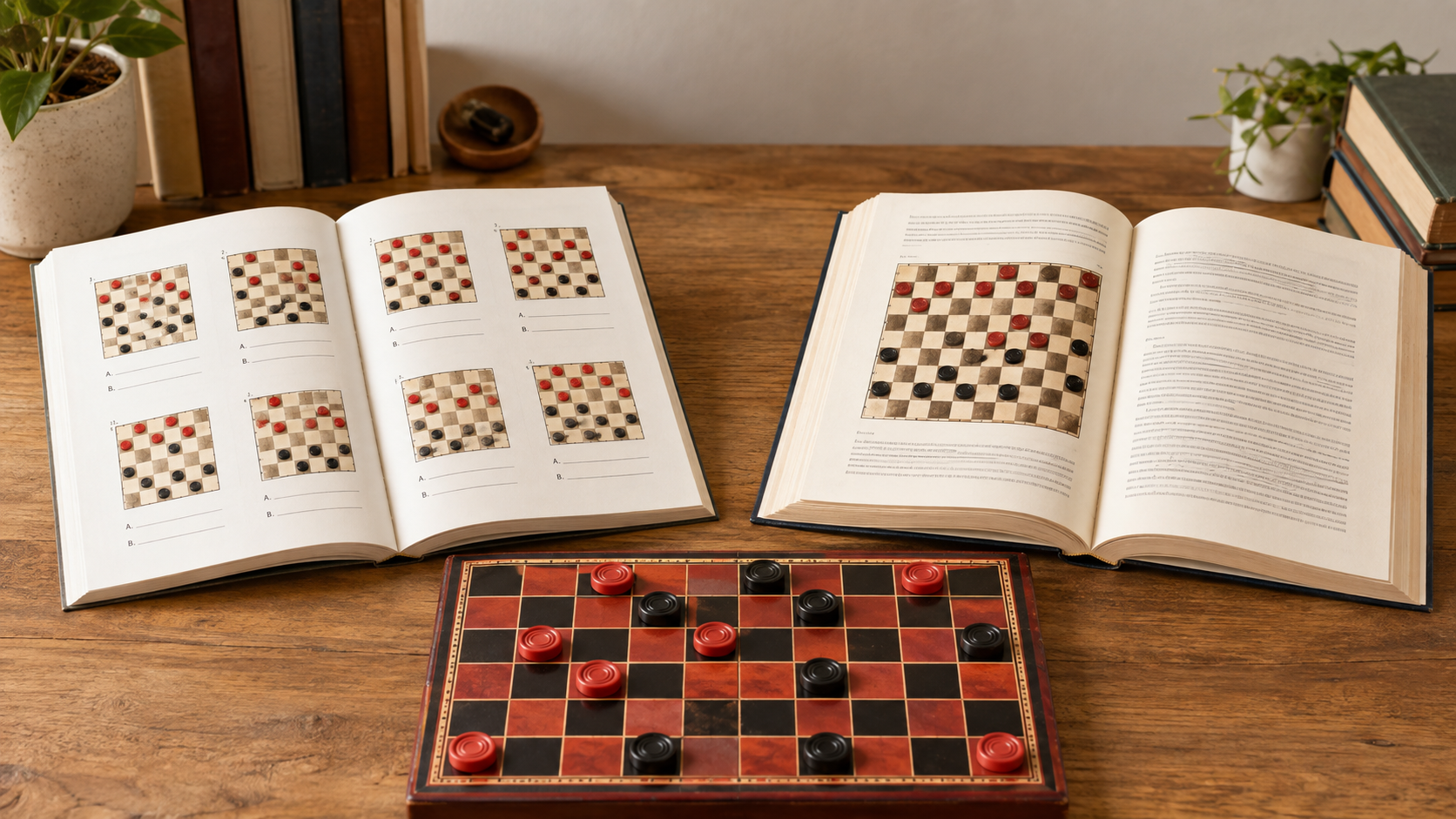
Quick decision
Start with puzzles when legal moves feel automatic and the beginner can study a position without every rule being restated. A useful puzzle book provides a side to move, a clear task, a progressive sequence, and answers that explain the first important decision.
Start with strategy when the learner finishes games but cannot explain what to aim for between captures. A useful strategy book introduces one idea in plain language, shows it in complete positions, and does not assume unexplained notation.
Start with neither when captures and kings are still confusing. Use the beginner checkers rules guide and play several slow games first.
Side-by-side comparison
| Decision | Puzzle book | Strategy book |
|---|---|---|
| Main job | Repeated position practice and calculation. | Connected explanations of plans and recurring ideas. |
| Best starting level | Rules are comfortable; choosing among legal moves is the problem. | Basic games are possible; the learner needs reasons and direction. |
| Session shape | Several short exercises with checking after each one. | A section of reading followed by replaying examples. |
| Answer quality | Needs explained solutions, not only destination squares. | Needs worked positions that connect advice to moves. |
| Common friction | Guessing and checking without reviewing why. | Dense notation or long game records hide the idea. |
Choose puzzles when practice is missing
Puzzles work well for a learner who understands the rules but overlooks captures, sees only the first jump, or needs practice comparing two plausible moves. The best beginner sequence isolates one decision at a time before combining ideas. A random collection of difficult positions is not automatically a course.
Preview whether each diagram states whose turn it is, distinguishes men from kings, and makes playable squares obvious. Check that solutions explain why the move works and what an alternative misses. The checkers puzzle-book buying guide has a detailed format checklist.
Skip puzzle-first study if the learner still forgets forced captures or needs to look up how kings move.
Choose strategy when explanations are missing
Strategy books fit a learner who can complete a game but moves without a plan. Look for short chapters, readable diagrams, worked examples, and plain explanations of what changes after a move. Advice such as “control the center” only helps when the book shows which squares, the tradeoff, and how the opponent can respond.
Verify the variant. American checkers and international draughts do not share every board, capture, and king rule. Use the checkers strategy-book guide to compare edition, notation, diagrams, and difficulty.
Skip strategy-first study when the sample begins with dense notation and no board diagrams, or when the learner strongly prefers small tasks to reading.
Run a two-session test
- Confirm the ruleset. Use material for the same variant the learner plays.
- Try three sample puzzles. Rebuild each position and explain the answer.
- Try one strategy section. Replay its example, close the book, and state the idea plainly.
- Play a slow game. Notice whether the learner applies a pattern or strategy idea.
- Choose the repeatable format. Favor the session the learner could realistically repeat.
A library copy, publisher sample, or borrowed book can make this test possible. Ensure the sample represents the edition and print format being considered.
Can a beginner use both?
Yes, but two books are not necessary at the start. A practical pairing is one short strategy section followed by positions using the same idea. If the books cover unrelated material, alternating them may add confusion.
When buying only one, fix the current bottleneck. A rules-fluent learner needing repetitions is usually better served by puzzles. A learner asking “what should I be trying to do?” usually needs strategy first.
Who should delay both?
- A complete beginner who has not played several legal games.
- A learner who cannot identify the ruleset or read the sample diagrams.
- Someone who already owns suitable material that has not been tried with a board.
- A reader who wants live correction more than solitary study.
- A buyer expecting a book alone to guarantee improvement.
Bottom line
A puzzle book is the better first tool for a rules-fluent beginner who needs focused decisions and repetition. A strategy book is better for a beginner who can play but needs connected explanations and a plan. Preview both formats, confirm the variant, use a real board, and choose the one that removes the present obstacle.