
A purpose-made checkers scorebook fits a club that records games regularly and has agreed on one notation system. A plain notebook is the safer first choice when players are still learning how to describe moves, the club plays more than one checkers variant, or organizers want to test a review routine before buying dedicated supplies.
Neither format is required for casual play. A written record helps only when someone can read it later, reconstruct the game, and discuss one or two useful moments. First confirm the variant and notation your group will use; square numbering and move conventions are not identical across every form of draughts.
The Good Chess & Checkers may earn commissions from qualifying purchases.
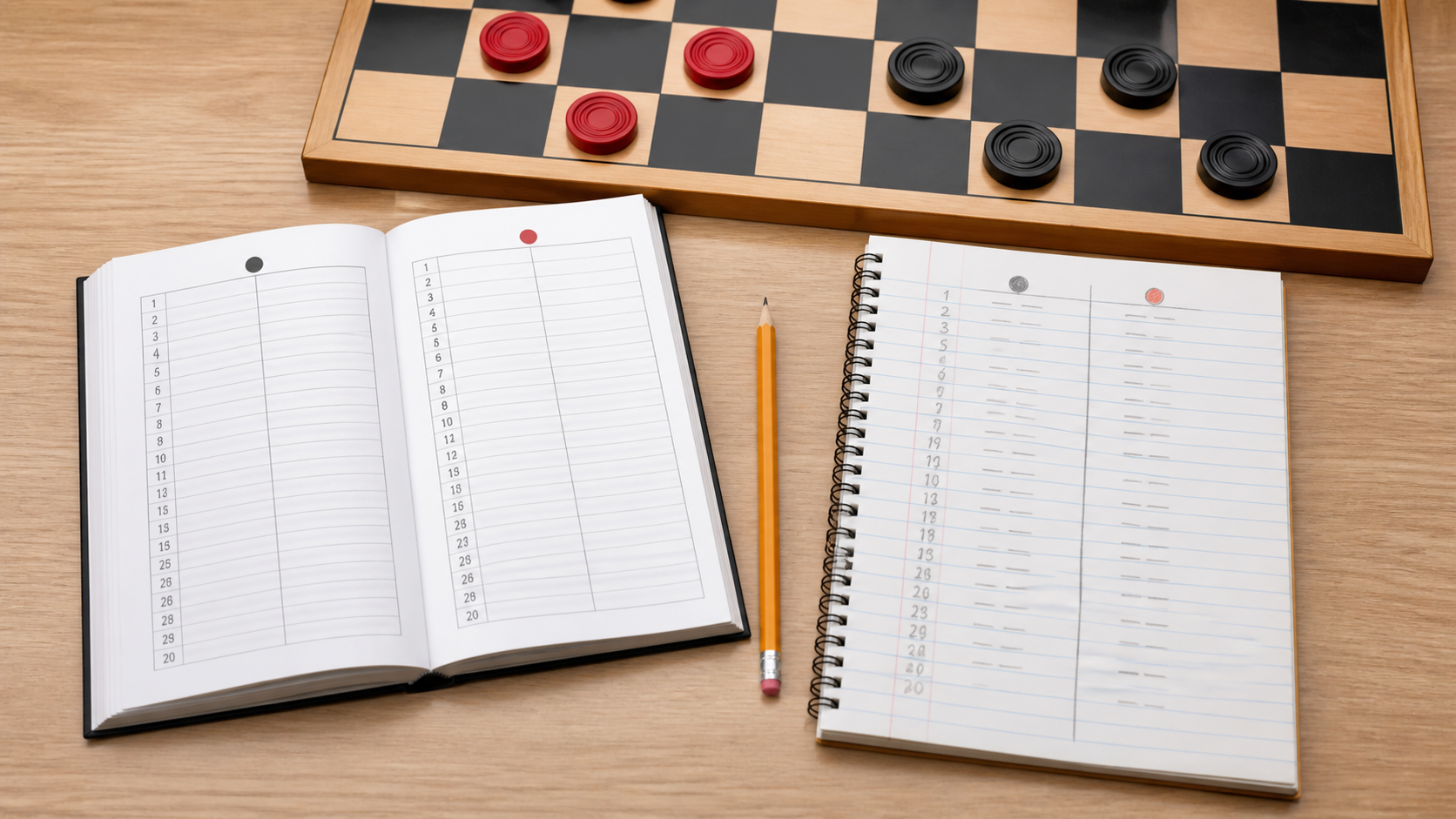
Quick decision aid
Compare structured pages with flexible paper
Inspect actual inside pages before buying. A scorebook should match the club's notation and leave enough writing space; a notebook should lie open and make repeated move columns easy to draw.
Quick answer
- Choose a scorebook when the page layout matches the notation used by the club and players expect to record and revisit games often.
- Choose a plain notebook when the group needs flexible columns, lesson notes, diagrams, or room to change its recording method.
- Try loose practice sheets first when notation is new and the club has not yet built a review habit.
- Skip recording for now when writing interrupts legal play or no one plans to replay the games.
The main difference: structure versus flexibility
A scorebook supplies repeated fields and move rows. That saves setup time, keeps games in a consistent order, and can make a shared review routine easier. The tradeoff is that its layout may assume a notation system, game length, or amount of detail that does not fit the club.
A notebook begins as a blank tool. Players can create two move columns, draw a small position, write a lesson note, or devote extra pages to a long game. That flexibility costs a little time at the start of every record and can produce inconsistent pages when several people use the same book.
When a checkers scorebook fits better
Choose a scorebook for a group that already knows what it wants to record. Useful pages have clear move numbers, enough horizontal room for the chosen notation, space for player names and date, and a binding that stays open beside the board. If the club owns one shared book, add a simple index so a player can find a game without flipping through every page.
Skip a scorebook if the listing shows only the cover, the inside layout is unclear, the rows are cramped, or the printed labels assume a different game or notation. A product labeled for chess may not translate cleanly to checkers merely because it has two move columns.
When a plain notebook fits better
Choose a notebook when the club is experimenting. Rule one page with move numbers and two player columns, then leave a margin for captures, kinging notes, questions, or a small diagram. One notebook can also hold attendance, lesson topics, and equipment notes if formal game records are only occasional.
Look for a book that opens flat enough to stay clear of the board and pieces. Page size matters more than total page count when handwriting is large or the group adds diagrams. Number the pages, date every game, and use the same heading format so flexibility does not turn into a pile of hard-to-find notes.
Skip a notebook when drawing columns becomes a recurring nuisance, players omit essential headings, or the club needs uniform sheets that different volunteers can read without explanation.
Side-by-side club tradeoffs
- Notation fit: a scorebook is efficient only when its printed structure matches the club's variant; a notebook can adapt but requires a written house template.
- Setup: scorebook rows are immediately ready; notebook columns take a minute to prepare.
- Writing space: verify the scorebook's actual page sample; notebooks offer more freedom for large writing and diagrams.
- Consistency: printed fields encourage similar records; notebooks depend on players following the same headings.
- Portability: either can travel well, but compare closed size, binding, cover stiffness, and whether it fits the club bag without bending.
- Review: both work if games are dated and indexed. Neither explains mistakes by itself.
- Replacement: changing scorebook designs may change the workflow; an ordinary notebook is easier to replace with a similar format.
Setup and maintenance for a shared record
- Write down the checkers variant and notation system the group has chosen.
- Create one sample page and ask two players to record a short game.
- Replay the record on a board. Mark where the notation or layout became unclear.
- Choose required headings such as date, players, variant, result, and page number.
- Keep the book and two pencils in a labeled pouch away from loose pieces and drinks.
- Assign one person to index completed games and check that the book returns to storage.
Do not erase an ambiguous record until the game has been replayed; add a small correction beside it. When several players share the book, legibility and consistent symbols matter more than compact notation.
Who should skip both?
New players who are still learning legal diagonal moves, captures, and kings should focus on completing short games first. Use the forced-jump guide when capture rules are the source of disagreement, then add recording only after play feels comfortable.
A club should also skip paper records when nobody has a specific review plan. Instead, pause once after a game and rebuild the most confusing position on the board. If the group wants structured study rather than an archive, compare checkers strategy-book formats.
If the club wants to hand out one fresh record at each board rather than maintain player-owned books, use the checkers score-sheet pad guide to compare ruleset, numbering, move capacity, distribution, and filing.
Bottom line
Choose a checkers scorebook for repeatable, uniform records after the club has settled on a variant and notation method. Choose a plain notebook for a new or flexible group that needs room for custom columns, diagrams, and lesson notes. Test the full record-and-replay routine before buying several copies.
The planned beginner-checkers pillar is not yet built, so the best next step is the existing beginner checkers rules guide. It gives the rules context needed before any written game record can be useful.