
Choose strategy or position cards when a beginner benefits from one short prompt at a time, portable practice, and the freedom to sort or shuffle positions. Choose a puzzle book when the learner wants an ordered path, room for notes, and answers that stay attached to a defined sequence.
This comparison is about format, not a named-product ranking or a promise of improvement. Preview the actual contents before buying: “strategy cards” can mean rules reminders, trivia, chess cards, or generic activity prompts rather than checkers positions.
As an Amazon Associate, The Good Chess & Checkers may earn from qualifying purchases.
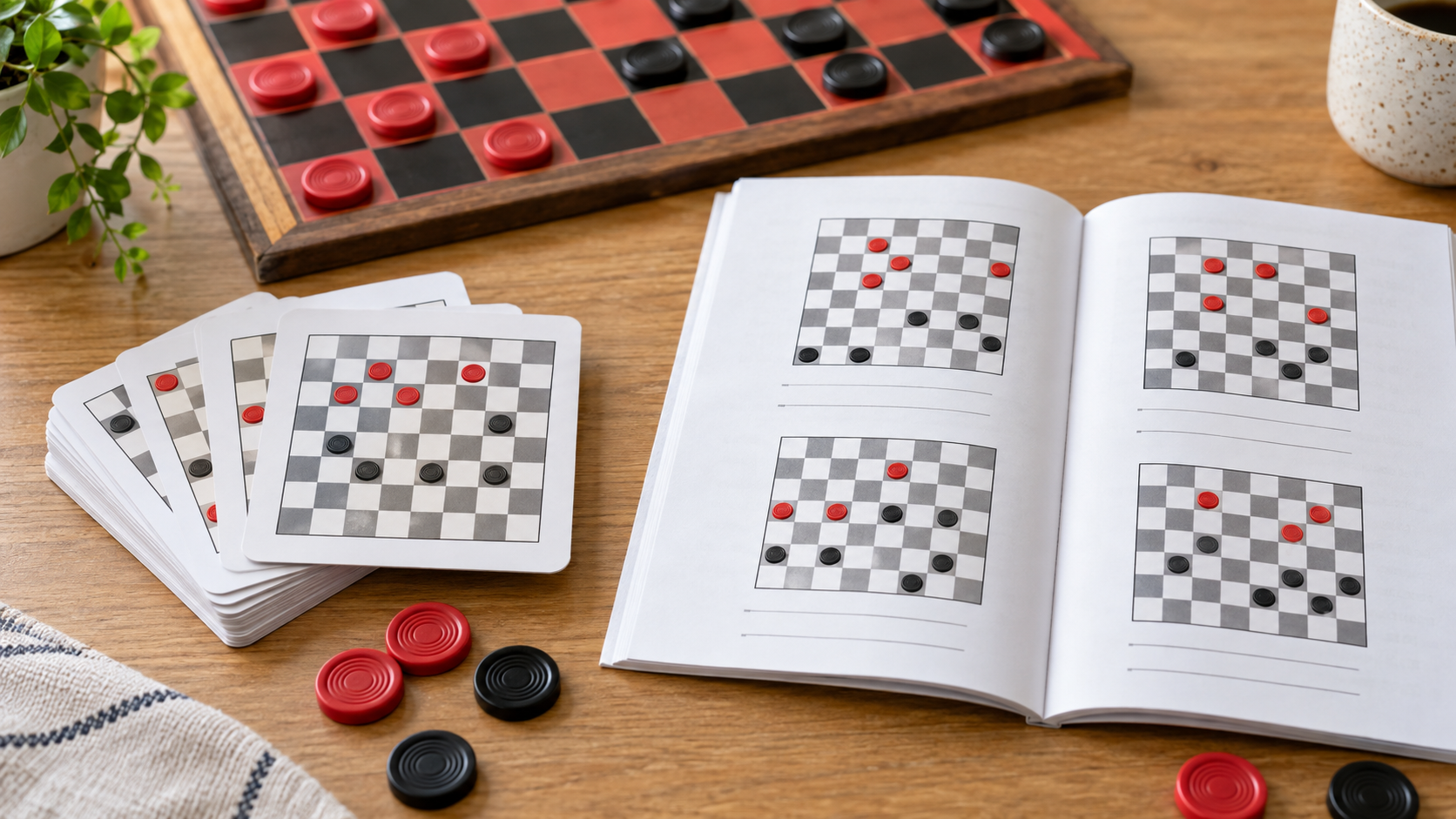
Single prompts or a planned sequence
Preview the practice format before buying
For cards, verify that previews show real checkers positions, a stated rules variant, and an answer system. For a book, check the progression, diagram size, notation assumptions, answer depth, and whether the binding stays usable beside a board.
Quick decision
- Choose strategy cards for five-minute practice, travel, paired discussion, or a learner who feels overwhelmed by a full page.
- Choose a puzzle book for independent study, visible progression, written notes, and a stable answer section.
- Use both only for different jobs: follow the book for sequence, then use cards for review or group warm-ups.
- Choose neither yet if required captures, multiple jumps, and king movement are still uncertain.
How the formats change practice
| Decision | Strategy cards | Puzzle book |
|---|---|---|
| Sequence | Can be shuffled, sorted, or repeated selectively | Usually follows a fixed order chosen by the author |
| Prompt length | One compact position or idea at a time | May place several positions and explanations on a page |
| Answer access | Back of card, separate key, or companion material; verify before buying | Usually a later section or facing explanation; preview its depth |
| Tracking | Sort into new, review, and understood piles | Use page order, notes, or a bookmark |
| Portability | Compact, but individual cards can be misplaced | One bound item, but size and binding affect table use |
| Best fit | Short sessions, pairs, families, and group warm-ups | Longer independent study and planned progression |
Who strategy cards fit
Cards fit a beginner who is ready to solve a position but prefers a small visual task. A parent or club helper can hand over one card, ask what captures are required, and let the learner set the position on an ordinary board. Sorting cards also creates a simple review system without writing in a book.
They are less useful when the deck has no deliberate order. Shuffling can mix basic capture checks with positions that assume ideas the learner has not met. Look for an index, level marks, or another documented way to separate introductory prompts from later ones; do not assume a large deck is well sequenced.
Who a puzzle book fits
A puzzle book fits a learner who wants to work through a planned set and return to a known place. A useful beginner book states which checkers variant it uses, makes the side to move obvious, prints readable diagrams, and gives enough explanation to compare the learner's choice with the intended line.
The fixed sequence is a strength only when the early pages match the learner's level. Preview samples for notation, answer style, and progression. A book that supplies only a final move with no reason may not answer a beginner's real question, while dense notation can add a second lesson before the position itself is understood.
Rules variant and answer checks
Checkers is not one universal ruleset. American checkers, English draughts, international draughts, and household variations can differ in board size, starting position, capture rules, and king movement. The cards or book should name the version used. If it does not, compare several sample diagrams and instructions with the rules your family or group has agreed to use.
- Confirm whether captures are compulsory and whether a multi-jump must continue.
- Check how kings are shown and how they move in the stated variant.
- Verify that every prompt identifies the side to move and has a usable answer.
- Prefer explanations that discuss the first decision rather than presenting only an unexplained solution.
- Make sure the diagrams can be reconstructed on the learner's physical board.
Setup and maintenance
Using cards beside a board
Keep the deck in a fitted box or labeled pouch, and count it according to the maker's contents list before putting it away. Use three temporary piles—new, review, and comfortable—rather than marking cards before deciding that permanent notes are useful. If several learners share the deck, return cards to the documented order after the session.
Using a book beside a board
Leave enough table space for the open book without covering playable squares. A book stand or page holder can help only if it supports the book's size and does not hide diagrams; otherwise a bookmark and a clear space beside the board are enough. Follow the publisher's care guidance and use removable notes if the book is shared.
A no-buy test
- Choose four positions from a checkers guide you already own or have permission to use.
- Put each position on a separate index card and try one per short session.
- Then put the same four positions in a numbered packet with the answers at the end.
- Notice whether the learner prefers isolated prompts and sorting, or ordered pages and visible progress.
The trial tests the routine, not the quality of a commercial product. Do not copy or distribute copyrighted book pages or card content without permission.
Who should skip each option?
Skip strategy cards when no current listing shows checkers-specific positions, the variant is unnamed, answers are missing, or keeping a loose deck complete would become a burden. Also skip them when the learner needs connected explanation more than another isolated problem.
Skip a puzzle book when sample pages are too dense, the diagrams are hard to read, the answer key is too terse, or the binding makes the book impractical beside the available board. A free rules guide and a few slow games may be the better next step.
Skip both when the learner does not yet recognize forced captures or cannot set up a position from a diagram. Work through the beginner rules guide first, then consider family checkers teaching aids if a physical prompt still helps.
Bottom line
Strategy cards are the better format for short, sortable, portable prompts and shared warm-ups. A puzzle book is better for a fixed learning path, longer independent sessions, and answers that stay connected to a numbered sequence. Preview the real content, confirm the rules variant and answer method, test the routine with materials already available, and buy only when the format solves a repeated practice problem.
The planned beginner-checkers pillar is not built yet. Continue with the beginner rules guide, or compare puzzle and strategy books when the learner needs to choose between repeated positions and longer explanation.