
A family does not always need a full strategy book to get past a confusing checkers rule. A well-chosen teaching aid can make diagonal movement, required captures, multiple jumps, or kinging visible while everyone continues using the same board.
This is a comparison of aid categories, not named product winners or a hands-on review. Start with the specific learning problem, preview any sample pages or cards, and confirm which checkers variant the material teaches before buying.
As an Amazon Associate, The Good Chess & Checkers may earn from qualifying purchases.
Product-category guide
Choose the aid that makes one hard rule visible
Compare move diagrams, jump prompts, king markers, practice positions, variant labels, durability, and storage rather than buying the largest bundle.
Selection criteria that matter
- Variant clarity: the aid should identify American checkers or explain when its rules differ from another draughts game.
- One-step visibility: arrows and examples should show the starting square, landing square, and captured piece without a crowded page.
- Forced-capture support: useful prompts remind learners to scan for a jump before considering an ordinary move.
- Kinging clarity: the material should show when a piece becomes a king and how your physical set marks one.
- Age and reading fit: visual aids reduce reading, while rule cards and booklets suit learners comfortable following short instructions.
- Board compatibility: separate pieces, overlays, or markers must fit the squares without hiding the position.
- Storage: an aid that stays with the checker pieces is more likely to reach the table when a question appears.
Best for the first game: a visual move guide
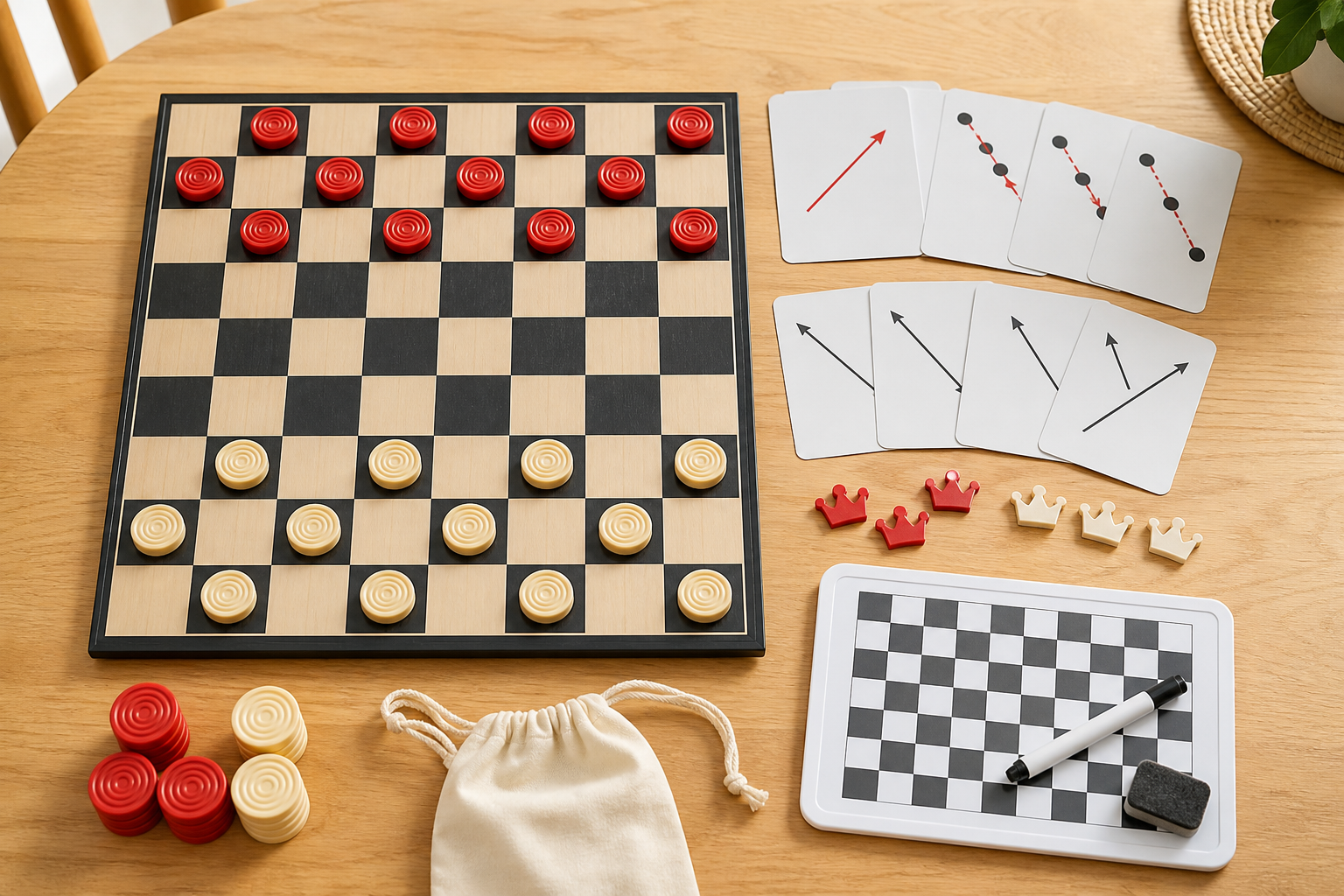
A one-page diagram or small set of cards can show forward diagonal movement, a single jump, a multiple jump, and a king moving in either direction. It gives the adult a quick prompt without turning the first game into a reading session.
Best for: families learning setup and legal movement together.
Skip it if: the examples omit forced captures, fail to name the variant, or are too small to compare with the board.
Best for missed jumps: capture-check prompt cards
A simple card that says, visually, “look for a jump first” can build the habit of scanning the whole position. Choose examples that show both a single capture and a continuing jump rather than presenting every capture as a one-step move.
Best for: players who understand diagonal moves but repeatedly overlook required captures.
Skip it if: your family intentionally uses an optional-capture house rule. Agree on the rule before play instead of letting the card settle an argument.
Best for confusing kings: stackable pieces or clear king markers
Physical kinging support is often more useful than another written explanation. Stackable checkers make a crowned piece visible in the normal American checkers convention; separate crown markers can help when pieces do not stack well.
Best for: sets whose kings are easy to forget during a family game.
Skip it if: the markers cover too much of a square, slide off during movement, or create a second loose-parts problem. Compare flat and stackable checkers when replacing the pieces would solve the issue more cleanly.
Best for short practice: reusable position cards or a mini board
Position prompts isolate one decision: find the capture, complete a jump sequence, reach the king row, or stop an opponent from crowning. Reusable cards or a small erasable board let a parent create a three-minute puzzle without committing to a full workbook.
Best for: a child or adult who learns by rebuilding and moving a real position.
Skip it if: nobody wants to prepare positions, the answers are unclear, or the diagrams use a board orientation the learner cannot match. A structured checkers activity book may be easier when you want a longer sequence of ready-made exercises.
Best low-cost option: a homemade two-card aid
Before buying a bundle, make one card for the turn routine—look for a jump, choose a move, check for another jump—and one card showing how your family marks kings. Add a few drawn positions only after a repeated mistake identifies what needs practice.
Best for: families who already own a readable board and need a narrow reminder.
Skip it if: the adult teaching the game is uncertain about the rules. Use the beginner rules guide and confirm the variant first.
Quick comparison framework
- Choose a visual move guide when legal movement is the main barrier.
- Choose a capture prompt when players forget to check for mandatory jumps.
- Choose stackable pieces or king markers when crowned pieces disappear into the position.
- Choose position cards or a mini board when a learner benefits from short, repeatable puzzles.
- Make a two-card aid when the need is narrow and you already know the rules.
Pre-purchase check
- Name the one rule or habit causing trouble.
- Confirm the aid teaches the same checkers variant your family plays.
- Preview diagrams for readable colors, correct diagonal movement, and clear landing squares.
- Check whether a board or extra pieces are required but not included.
- Compare marker and overlay dimensions with your board squares.
- Choose storage that keeps the aid with the set.
- Ignore unsupported claims about rapid improvement and judge the visible teaching method instead.
Who should skip checkers teaching aids?
Skip a purchase if the family only needs the basic rules once, already plays confidently, or would rather learn through casual games. The site's checkers rules and forced-jump explanation may be enough. Also skip an all-in-one bundle when only king visibility or one missed-jump habit needs fixing.
The planned beginner-checkers rules and strategy pillar is not yet built. Until it is, the beginner rules guide, forced-capture guide, and activity-book comparison provide the clearest internal learning path.
Bottom line
The best checkers teaching aid for a family solves one visible problem with the fewest extra parts. Match a move guide to first-game confusion, a capture prompt to missed jumps, king markers to unclear crowns, or position cards to short practice—and confirm the variant before the aid reaches the table.