
Club storage comparison
Chess Carrying Bag vs Hard Case: Which Protects a Club Set Better?
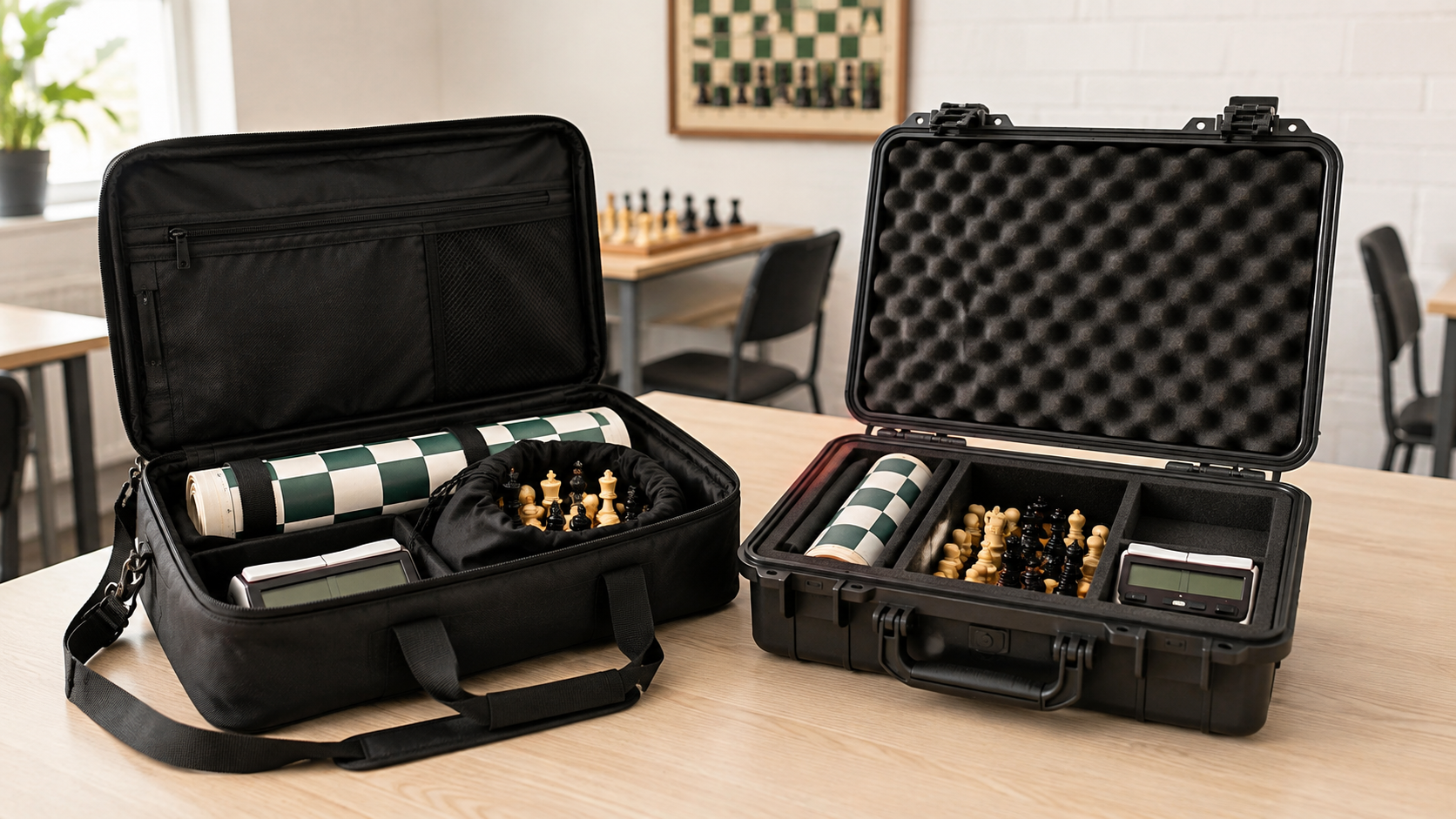
A soft chess carrying bag is usually easier to carry, squeeze onto a shelf, and open during a fast club setup. A hard case is the better format when equipment may be stacked with other supplies or moved through a rougher transport routine. Neither protects a set well unless its interior actually fits the board, pieces, clock, and small accessories.
This guide compares storage formats, not named winners. It does not claim hands-on testing, impact ratings, waterproofing, current prices, availability, or guaranteed protection. Verify the exact interior dimensions, shell material, padding, closures, handle attachment, and included dividers on the current listing before buying.
Quick answer
Choose a soft carrying bag when one helper carries a standard roll-up board, pieces, and perhaps a clock between nearby rooms or from a car. It usually offers lower empty weight, flexible pockets, quick access, and easier closet storage.
Choose a hard case when the packed set may sit below other supplies, move in a shared vehicle, or needs firm dividers that stop a clock and pieces from colliding. The tradeoffs are greater bulk, more empty weight, and a fixed interior shape.
Choose neither yet if complete sets stay in one locked cabinet or several boards move together in a labeled tote. A purpose-made single-set carrier can add work without solving the club's actual storage problem.
Side-by-side decision table
| Decision | Soft carrying bag | Hard case |
|---|---|---|
| Fit | Flexible walls and pockets may accept a rolled board and irregular accessories, but loose space can let items shift. | Fixed dimensions and dividers reward careful measuring; equipment that is too tall or wide simply will not fit. |
| Protection format | Padding can separate ordinary bumps and scuffs; verify its placement and thickness rather than assuming. | A rigid shell resists compression better as a format, but only the maker can support a specific impact or weather claim. |
| Carry load | Usually the lighter, more flexible option, often with a shoulder strap. | Adds shell and divider weight; confirm total packed weight and handle comfort. |
| Access | Pockets can make pieces, clock, notebook, and rule cards quick to reach. | A divided layout makes missing items visible, though latches and fitted slots may slow repacking. |
| Storage | Can compress somewhat when empty and fit shallow shelves; a packed bag still needs support. | Keeps its shape and stacks predictably only within stated limits, but consumes the same volume empty. |
| Best fit | Routine light transport and fast weekly setup. | Rougher shared transport or equipment that needs firm separation. |
Start with what must travel
Lay out one complete club station before shopping: board, all 32 pieces plus any spares, piece pouch or trays, clock, scorebook, pencils, rule card, and labels. Measure the rolled or folded board, the tallest piece, the clock, and the combined bundle. Interior dimensions matter; exterior measurements only tell you whether the carrier fits a shelf or vehicle.
A roll-up board usually suits a long bag or compartment. A folding rigid board may need a wider case and can make a purpose-built roll-up carrier irrelevant. If the club moves several identical stations at once, compare one carrier per board with a larger labeled group tote before multiplying cost and storage volume.
When a soft chess bag fits best
A soft carrier works well for predictable trips: a helper walks from a parking area to a meeting room, sets out equipment, then returns the bag to a shelf. Look for stated interior dimensions, a board sleeve that matches the rolled-board length, a separate closed piece compartment, a clock pocket with useful padding, strong-looking handle attachment, and labels visible without opening every bag.
Maintenance is straightforward but easy to neglect. Empty crumbs and debris, follow the maker's fabric-cleaning instructions, let the bag dry fully before closing it, and check seams, zippers, straps, and clips during inventory. Do not assume a padded textile bag is waterproof or safe beneath heavy boxes.
Skip a soft bag when the carrier will routinely be stacked, checked as luggage, left where equipment can be crushed, or loaded so heavily that a shoulder strap becomes uncomfortable.
When a hard case fits best
A hard-sided case suits a less controlled route or a delicate accessory that benefits from firm separation. Compare usable internal length, width, and depth after foam or dividers are installed. Check whether dividers can be moved, whether small pieces can migrate between sections, and whether the open lid needs more table or floor clearance than the setup area allows.
Inspect and clean the interior according to the maker's directions, keep foam and dividers dry, and check latches, hinges, handle mounts, and any seal before each transport cycle. A hard appearance does not prove a particular drop, crush, dust, or water rating; rely only on current documented specifications.
Skip a hard case when its empty weight strains the regular helper, it cannot fit the board without awkward folding, or its fixed shell consumes scarce closet space between sessions.
A practical club packing routine
- Photograph the intended inventory: keep a simple visual checklist inside the lid or pocket without recording personal information.
- Separate the clock: do not let heavy pieces or board edges press on its buttons or display.
- Close the pieces: use a drawstring pouch, zip compartment, or fitted section so one spill does not scatter a set.
- Pack the board without forcing it: follow the board maker's folding or rolling guidance and avoid sharp bends.
- Lift the complete load: the regular helper should test the packed weight and route, not just the empty carrier.
- Count at both ends: use labels and a short reset check so missing pieces are found before the next meeting.
Which format fits your setting?
- Weekly club in one building: a labeled soft bag is often the simpler single-station carrier.
- Mobile teacher using a shared vehicle: a hard case can make sense when other supplies may press against the chess equipment.
- Several clocks but no full sets: use the chess clock carrying-case guide; its fit and counting problem is different.
- Collectible display set: this club-transport comparison is the wrong tool. Use the display-case guide for stationary presentation and dust considerations.
- New club still buying equipment: plan boards, pieces, labels, replacements, and storage together with the club starter-kit guide.
Bottom line
Pick a soft chess carrying bag for low weight, quick access, and routine light transport. Pick a hard case for a rigid outer format and firm separation when the route is less controlled. In either case, measure the exact equipment, confirm the current specifications, and rehearse the full carry-and-reset routine before standardizing the same carrier across a club.
If a soft bag is the likely fit, continue with the club chess carrying-bag guide to compare board sleeves, piece compartments, clock pockets, handles, labels, and packed fit.