
A decorative chess set can gather dust quickly when it stays assembled, yet a case bought from the board's advertised size alone may not fit the frame, tallest king, or your hands. The useful choice is a cover with verified internal dimensions, a supported base, and an opening method that matches how often you play.
This is a comparison of display-case categories, not named winners or cases we claim to have tested. Ordinary acrylic and glass covers can reduce routine dust exposure, but they are not automatically airtight, archival, UV-filtering, childproof, or suitable for a valuable antique. Confirm the case maker's specifications and seek specialist advice for conservation needs.
As an Amazon Associate, The Good Chess & Checkers may earn from qualifying purchases.
Quick decision aid
Choose clear tabletop chess display cases
Compare listings by internal width, depth, and height—not the outside footprint. Allow usable clearance around the full board frame and tallest piece, then verify the base, opening method, assembly, and care instructions.
Selection criteria that matter before style
- Internal dimensions: record usable width, depth, and height inside the cover. Exterior dimensions do not prove that the set fits.
- Board clearance: include the full frame, handles, drawers, hinges, feet, and any pieces placed outside the grid.
- Piece clearance: measure the tallest piece on the surface where it will stand and leave practical space above it.
- Access: decide whether you can lift the whole cover safely or need a front, side, or hinged opening for frequent play.
- Base support: verify how the case and chessboard sit on the base, its published load guidance, and whether the finished setup stays level.
- Material and care: acrylic is lighter and easier to move; glass can feel more rigid but is heavier and breakable. Use only the maker's cleaning guidance.
- Placement: check the shelf's depth and load guidance plus room for opening, lifting, cleaning, and normal household traffic.
Best all-around category: lift-off acrylic cover with base
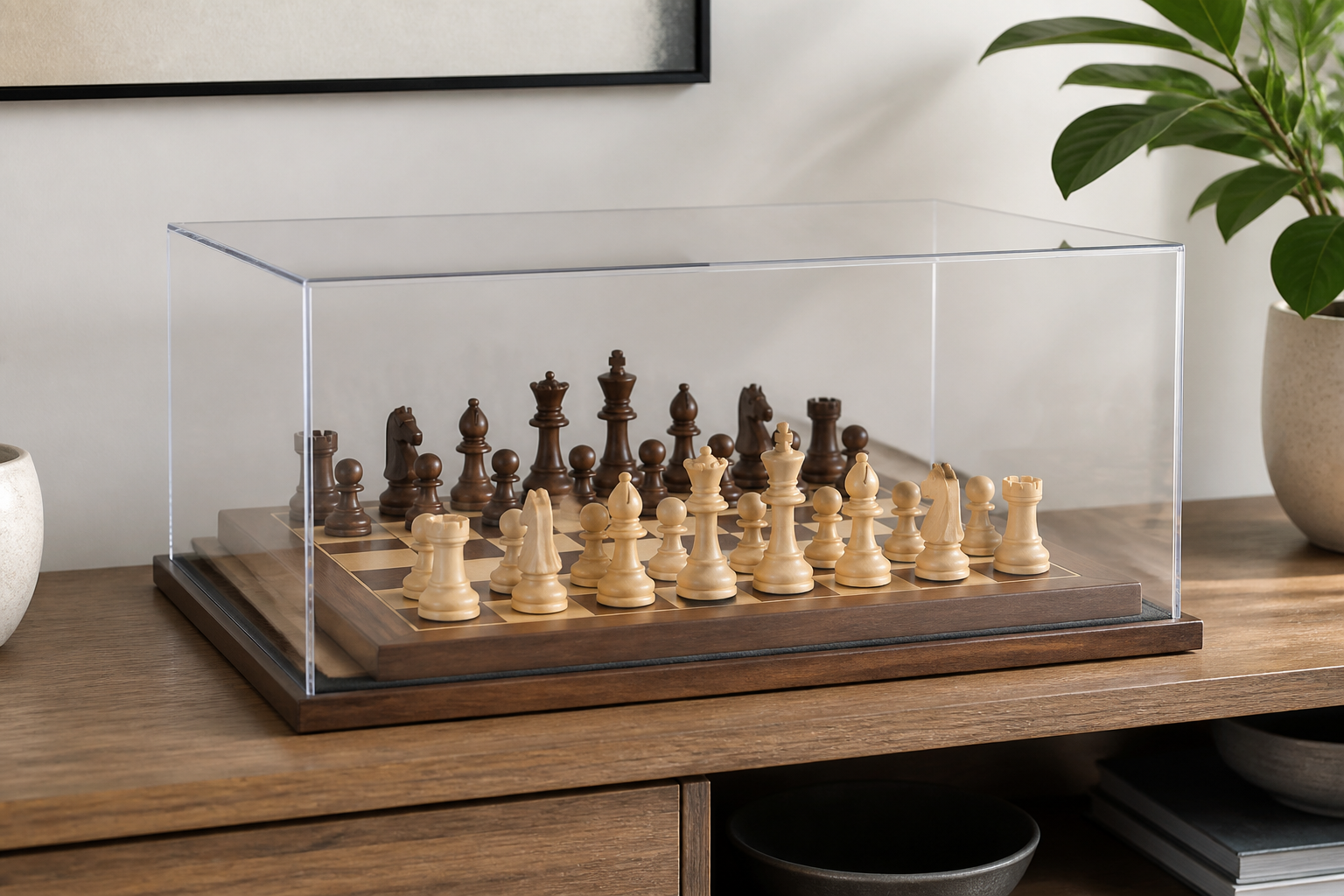
A clear acrylic cover on a fitted base is the simplest format for a set that is displayed more often than played. It gives an unobstructed view and avoids door hardware near the pieces. A removable cover also makes the complete board accessible at once.
Best for: an assembled set on a deep, stable console where an adult can lift and store the cover during play.
Skip it if: the cover would be awkward to grip, there is nowhere safe to put it, or the listing omits usable internal measurements.
Best for frequent access: front-opening clear case
A front-opening case avoids lifting a large cover over tall pieces. Look closely at the door opening, hinge or track clearance, and the amount of reach required to move the board. The opening still needs to be wide and tall enough for the way you remove or reset the set.
Best for: a display set that comes out for regular games while the case stays in place.
Skip it if: the frame blocks the board, the door needs more room than the shelf provides, or the latch and hardware details are unclear.
Best for a heavy presentation: glass case
Glass offers a rigid, traditional display appearance, but the complete case can be substantially heavier than an acrylic cover. Check published weights, base construction, shelf guidance, assembly instructions, and how the glass edges and panels are handled before buying.
Best for: a permanent display position with a base and shelf intended for the complete stated load.
Skip it if: the case will move often, the placement is exposed to knocks, or the seller does not provide construction, assembly, and weight information.
Best for an unusual set: made-to-measure acrylic cover
A custom cover can solve a nonstandard board footprint, unusually tall king, or sculptural themed pieces. Specify internal measurements and opening needs rather than sending only a board size. Confirm tolerances, base groove dimensions, material thickness, return terms, and whether assembly is required.
Best for: a set that does not fit credible stock-case dimensions.
Skip it if: the set may be replaced soon, the board is routinely packed away, or the maker cannot document the final usable space.
Quick comparison framework
- Choose a lift-off acrylic cover for a lighter, clear enclosure and infrequent access.
- Choose a front-opening case when the set must be reachable without removing the cover.
- Choose glass for a permanent position only after confirming weight, support, and handling.
- Choose made-to-measure acrylic when verified stock dimensions cannot fit the assembled set.
- Choose no case when the set is played constantly, packs into its own box, or your shelf cannot safely accommodate a larger enclosure.
Build an internal-dimension worksheet
- Set up every piece exactly as it will appear, including extra queens or decorative pieces.
- Measure the board's maximum outer width and depth, not only its playing grid.
- Measure from the intended base surface to the highest point of the tallest piece.
- Add practical clearance for placement and removal without promising a universal allowance.
- Write down the resulting minimum internal width, depth, and height.
- Compare that worksheet with the listing's internal dimensions, base groove, door opening, material, weight, and assembly notes.
- Measure the final exterior footprint against the shelf and verify the furniture maker's load and placement guidance.
Dust control, light, and cleaning limits
A cover can reduce settling dust and direct handling, but seams and doors may admit dust. Do not infer UV filtering, humidity control, or conservation performance unless the manufacturer documents those properties. Keep the case away from conditions the chess-set and case makers discourage, and clean acrylic or glass only with methods approved for that material; the wrong cloth or cleaner can scratch or haze a clear panel.
Who should skip a chess display case?
Skip a case when you need the set ready for spontaneous family games, cannot lift or open the enclosure comfortably, or lack a stable surface with enough depth. If ordinary settling dust is the only problem, compare a simpler chess set dust cover. A fitted piece box or chess piece storage bag may suit a set that is packed away after every game. Owners of historically important, fragile, signed, or unusually valuable sets should not treat a generic retail cover as conservation advice.
Bottom line
For a typical home display, a lift-off acrylic cover with a fitted base is the easiest category to evaluate—provided the seller publishes usable internal dimensions and you have room to remove it. Frequent players may prefer front access, while glass and custom cases make sense only when their added weight, cost, or measurement demands solve a real display problem. Measure the assembled set, the opening, and the furniture before judging appearance.