
Choose a chess diagram stamp when you make a few custom positions by hand; choose printable sheets when several learners need the same exercise or you want a predictable page layout. A stamp trades batch consistency for quick one-off flexibility. Printable sheets trade printer setup for easy duplication and cleaner revision.
This is a category comparison, not a named-product ranking or hands-on test. Verify the stamp grid, usable impression size, ink requirements, sheet layout, file terms, and your printer settings before buying or distributing materials.
As an Amazon Associate, The Good Chess & Checkers may earn from qualifying purchases.
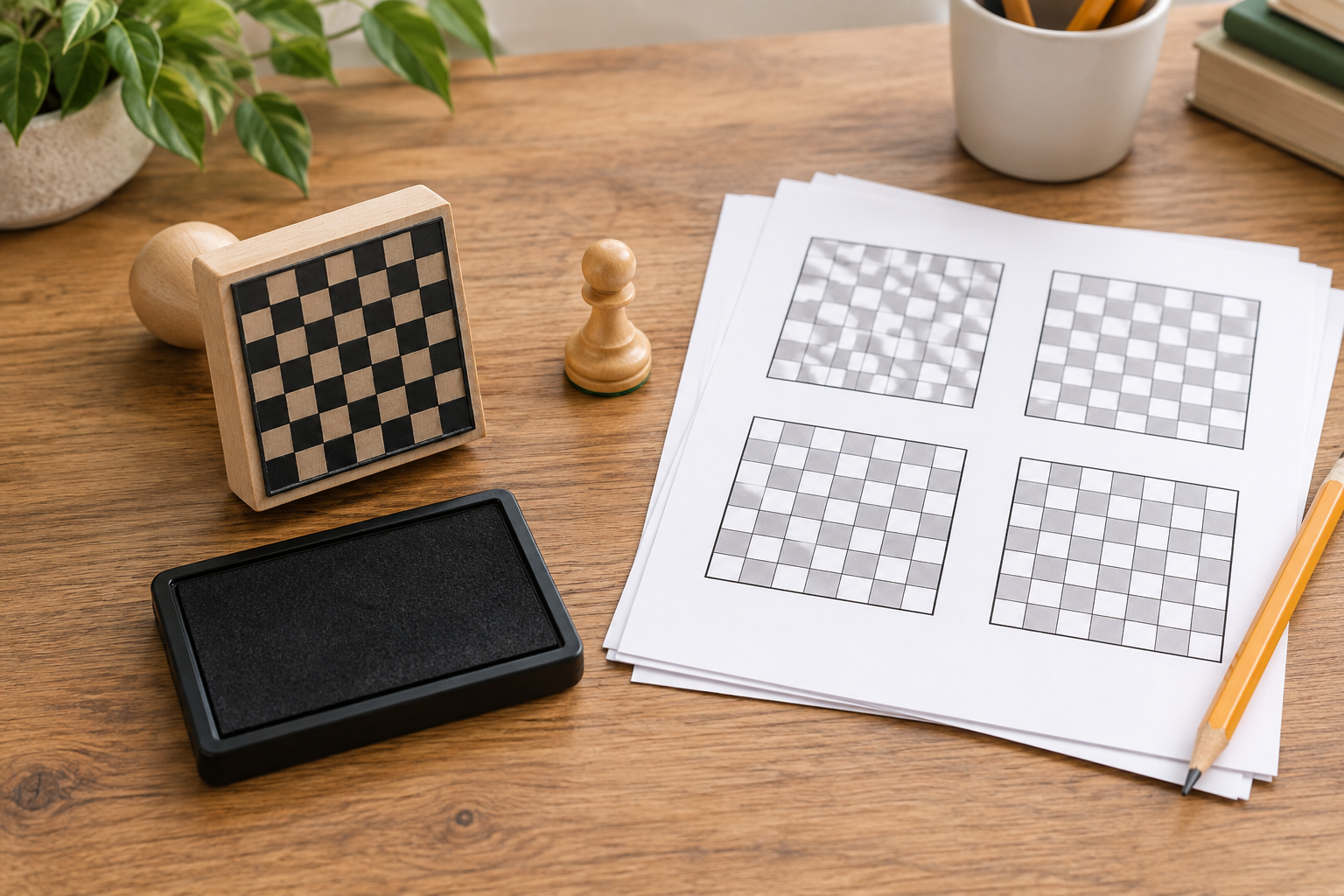
Match the tool to the preparation job
Compare one-off stamping with repeatable printing
Check exact grid dimensions before buying. The diagram must leave enough room for clear piece marks, arrows, notes, and coordinates while still fitting the worksheet or notebook you use.
Quick decision
- Pick a stamp for a tutor notebook, a quick position on an index card, or a few exercises that change every session.
- Pick printable sheets when every learner needs the same position, answer space, heading, and page order.
- Use both when a printed lesson template needs an occasional hand-stamped extension or correction.
- Buy neither yet if a hand-drawn grid or a free, clearly licensed template handles your next two lessons.
What a diagram stamp does well
A stamp can put one blank board exactly where it is needed: beside a note, on a feedback slip, or in a learner's existing notebook. There is no document editing, printer queue, or requirement to prepare a full page. The teacher can stamp first, let the ink dry, and add pieces, arrows, move numbers, or questions by hand.
The tradeoff is repetition. Every impression must be inked, aligned, pressed, and checked. Uneven pressure can make squares or borders faint, and wet ink can smear when pieces are added too soon. A very small grid may save page space but leave too little room for recognizable piece symbols.
What printable sheets do well
A printable layout makes identical copies. It can reserve space for a name, prompt, candidate moves, and an answer while keeping every board the same size. That consistency helps when a group reviews one position together or when completed sheets are filed in lesson order.
Printing adds its own setup. Scaling can shrink a diagram, margins can clip it, and automatic duplex settings can put exercises in the wrong order. Color is rarely necessary for a basic position sheet; a clear black-and-white grid is easier to copy and usually simpler to annotate.
Compare the preparation workflow
| Criterion | Diagram stamp | Printable sheets |
|---|---|---|
| Best volume | A few changing positions | Repeated copies of the same lesson |
| Layout control | Place a board on an existing page | Set headings, prompts, and answer space in advance |
| Revision | Change handwritten pieces after stamping a new blank grid | Edit the source once, then print corrected copies |
| Supplies | Stamp, compatible ink pad, paper, and drawing tool | Printer access, paper, ink or toner, and a usable source file |
| Storage | Keep the stamp clean, dry, and separated from loose paper | Store source files and organize printed masters or copies |
| Portability | Compact, but ink can leak or mark a bag | Carry only the copies needed for the session |
Check diagram size before choosing
Measure the actual printed or stamped board, not the handle or package. Divide the board width by eight to estimate the space available in each square. Then draw the piece symbols you plan to use. Pawns, rooks, bishops, knights, queens, and kings must remain distinct after ordinary copying and at the viewing distance learners will use.
Coordinates can help beginners connect the sheet to a physical board, but only if they are legible and oriented consistently. If a product or file includes coordinates, check that the lower-right square is light from White's side and that the labels do not crowd the outer squares.
Setup and maintenance
For a stamp, confirm which ink type the maker specifies and test it on the paper used in class. Clean and store the stamp according to its instructions. Keep the ink pad closed between uses, and make one test impression before preparing the final sheet.
For printables, save an untouched master and a dated lesson copy. Print one page at actual size before starting a batch, then check borders, square proportions, contrast, and writing room. Confirm that you have permission to copy or distribute the particular file; buying a book or download does not automatically grant every reuse.
Who should skip each option?
Skip a stamp when you regularly need a full group's identical copies, cannot allow ink-drying time, or need polished typed prompts and answer areas. Skip printable sheets when printer access is unreliable, lessons change at the last minute, or you only need one or two diagrams inside notes you already keep.
Skip both when learners mainly need to move real pieces rather than interpret flat symbols. In that case, put the position on a physical board first and use a sheet only after the board-to-diagram connection is understood.
A no-buy trial
For the next lesson, hand-draw one grid for a custom exercise and print or copy one page with four identical blank boards. Record how long each method takes, how many usable copies you need, and where learners run out of writing space. That simple test reveals whether the recurring problem is one-off placement or batch preparation.
Next steps
If sheets will be reused with wipe-clean markers, compare dry-erase sleeve formats by exact page fit, glare, closure, and cleaning. If the diagrams need to be visible to the whole group, compare a magnetic demonstration board with a dry-erase board instead of enlarging individual worksheets beyond their useful role.
Bottom line
A chess diagram stamp is the flexible choice for a small number of changing, hand-annotated positions. Printable sheets are the efficient choice for consistent group copies and repeatable lesson layouts. Verify the grid at actual size, plan the complete supply and storage routine, and choose the method that removes the bottleneck you encounter every week.