
The best dry-erase sleeve is not a chess-specific product: it is a clear pocket that fits the complete worksheet, gives the learner room to mark moves, and survives your actual distribute-write-erase-file routine. Start with the paper size and lesson task, then compare usable writing area, closure, glare, marker storage, and filing.
This is a product-category guide, not a ranking of named sleeves or a claim of hands-on testing. Verify the current listing's interior dimensions, supported marker type, cleaning instructions, closure, quantity, and storage features before ordering.
As an Amazon Associate, The Good Chess & Checkers may earn from qualifying purchases.
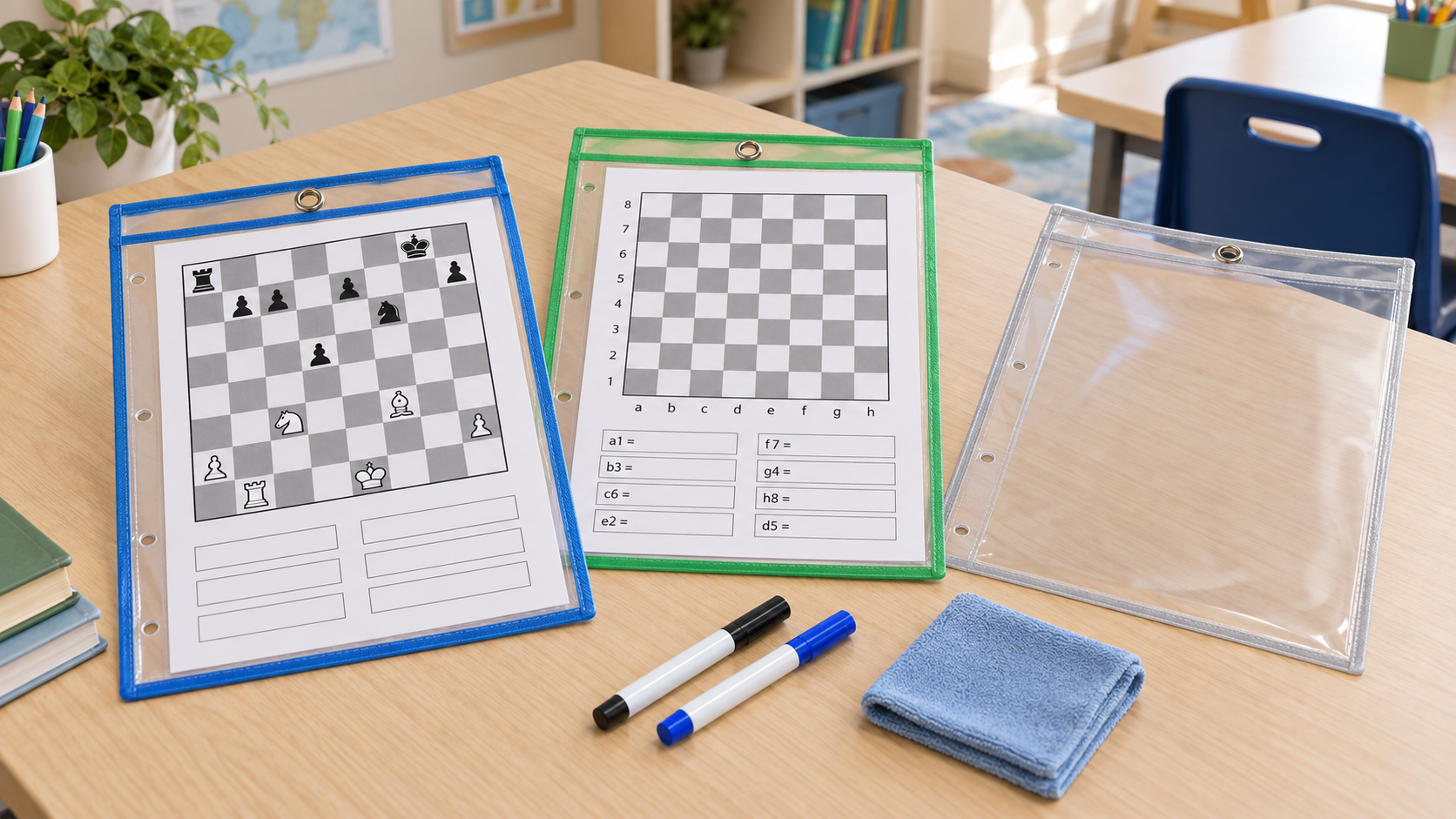
Measure the insert, not the label
Compare reusable worksheet pockets
Confirm the interior page opening, visible writing area, closure, supported marker and cleaning method, hanging or binder holes, and whether markers travel with the sleeve.
Quick choices
- Choose a basic letter-size pocket for one-page puzzles, coordinate drills, and notation prompts that already fit standard paper.
- Choose a sleeve with a secure top or side closure when learners carry sheets between stations and inserts tend to slide out.
- Choose a sleeve with a marker loop only if it holds the marker model you actually use without covering the worksheet.
- Choose a binder-ready or hangable edge when the same exercises must be sorted, counted, and returned after every session.
- Skip dedicated sleeves if an existing page protector works with your approved marker and cleaning routine.
Measure the worksheet before shopping
“Letter size” may describe the paper a sleeve is marketed for, not its clear interior opening or writable area. Measure the finished worksheet, including margins that contain coordinates, instructions, answer boxes, or a second position. Then compare those measurements with the listing's stated interior dimensions.
Run one printed sheet through the whole lesson. Learners should be able to see all 64 squares, piece symbols, coordinates, and prompts without the seam or colored border covering them. If the worksheet uses both sides, confirm that the insert can be turned or replaced without bending it.
Compare the features that change the lesson
| Feature | Why it matters | What to verify |
|---|---|---|
| Interior size | Keeps the complete board and response area visible | Stated usable opening, not only overall dimensions |
| Surface and marker | Controls writing feel and reset routine | Maker-supported marker type and cleaning instructions |
| Closure | Stops inserts from shifting during distribution | Opening location, flap or fastener, and page-change effort |
| Glare and contrast | Affects whether pieces and pencil-thin lines remain readable | Real product imagery and a trial under the room's lights |
| Marker storage | Can reduce missing supplies between stations | Loop size, placement, and whether it blocks writing |
| Filing edge | Makes collection and inventory easier | Hole spacing, hook, ring, or folder fit |
Best for simple station work: standard clear pockets
A plain pocket is usually enough for “circle the legal move,” coordinate matching, mate-in-one positions, or a short move-sequence prompt. Its advantage is a large uninterrupted writing surface and a low-friction page change.
Choose it when: every insert uses one consistent paper size and the sleeves remain at the same table. Skip it when: papers slide out, the seam covers a needed margin, or loose markers repeatedly disappear.
Best for mobile groups: closable sleeves
A top flap, zipper-style edge, or other closure can help when worksheets move on a cart or between rooms. The useful question is not whether the sleeve is “secure,” but whether the closure holds the insert while remaining easy for the responsible adult to open and reset.
Choose it when: learners carry the complete activity between stations. Skip it when: the added edge reduces writing room or makes changing a set of worksheets slow.
Best for faster supply checks: marker-loop sleeves
A visible marker loop can make a missing marker obvious before the next group begins. Verify the loop against the actual marker barrel; a loop that is too tight, too loose, or positioned across the page does not improve the routine. Keep cleaning cloths in a separate counted container rather than stuffing them against the worksheet.
Choose it when: each learner or pair receives one sleeve-marker unit. Skip it when: markers are already issued from a central tray or the loop encourages storing an uncapped marker.
Best for a lesson library: binder-ready or hangable sleeves
Holes or a reinforced hanging point can help sort exercises by piece movement, coordinates, checks, captures, or notation. Confirm that the holes fit the binder rings, hooks, or file system you already own, and count the filled stack: thick borders and closures can make a small lesson library surprisingly bulky.
Choose it when: the instructor retrieves and returns several labeled activities each week. Skip it when: the filing edge makes the worksheet harder to use at the table or duplicates an effective binder or accordion-file workflow.
Test one complete chess exercise
- Print a representative 8-by-8 position with the smallest labels and response boxes you expect to use.
- Insert it and check that the opening, border, seam, and closure hide none of the lesson.
- Place the sleeve under the room's normal lights and view it from the learner's seated angle.
- Use only the marker type the sleeve maker supports, then complete arrows, circles, notation, and erasing.
- Inspect the worksheet after cleaning for moisture, smearing, or a shifted insert.
- Distribute, collect, count, clean, and file it exactly as the real session requires.
A sleeve does not make a worksheet accurate. Check every chess position, side to move, coordinate, legal-move prompt, and answer before it enters the lesson library. Absolute beginners should first learn how the chess pieces move on a physical board.
Who should skip dry-erase sleeves?
Skip them when learners need to move real pieces rather than mark a diagram, when the exercise changes too often to justify printing, or when glare makes the page harder to read. A shared board may suit one group discussion better, and ordinary paper may be simpler for work that needs to be saved or sent home. Do not assume a generic sleeve is durable, stain-free, or compatible with every marker; rely on the maker's current guidance and your own small workflow trial.
Next step: create the diagram
If the worksheet source is still the problem, compare a chess diagram stamp with printable diagram sheets by one-off flexibility, repeated copies, grid size, revision, supplies, and storage before choosing the reusable outer sleeve.
Sheet protector or permanently laminated page?
If the remaining decision is whether the printed exercise should stay replaceable or become a finished reusable sheet, compare sheet protectors with laminated chess worksheets by page changes, distribution, writing surface, cleanup, filing, and replacement.
Bottom line
Choose a dry-erase sleeve by exact worksheet fit and classroom routine, not by a broad “teacher” label. A basic pocket suits stable table stations, a closure helps mobile groups, a marker loop can simplify counted kits, and a filing edge can support a reusable lesson library. Test one real chess worksheet from distribution through cleanup before buying a class set.