
Group chess lessons
Magnetic Demonstration Board vs Dry-Erase Chess Board: Which Fits Group Lessons?
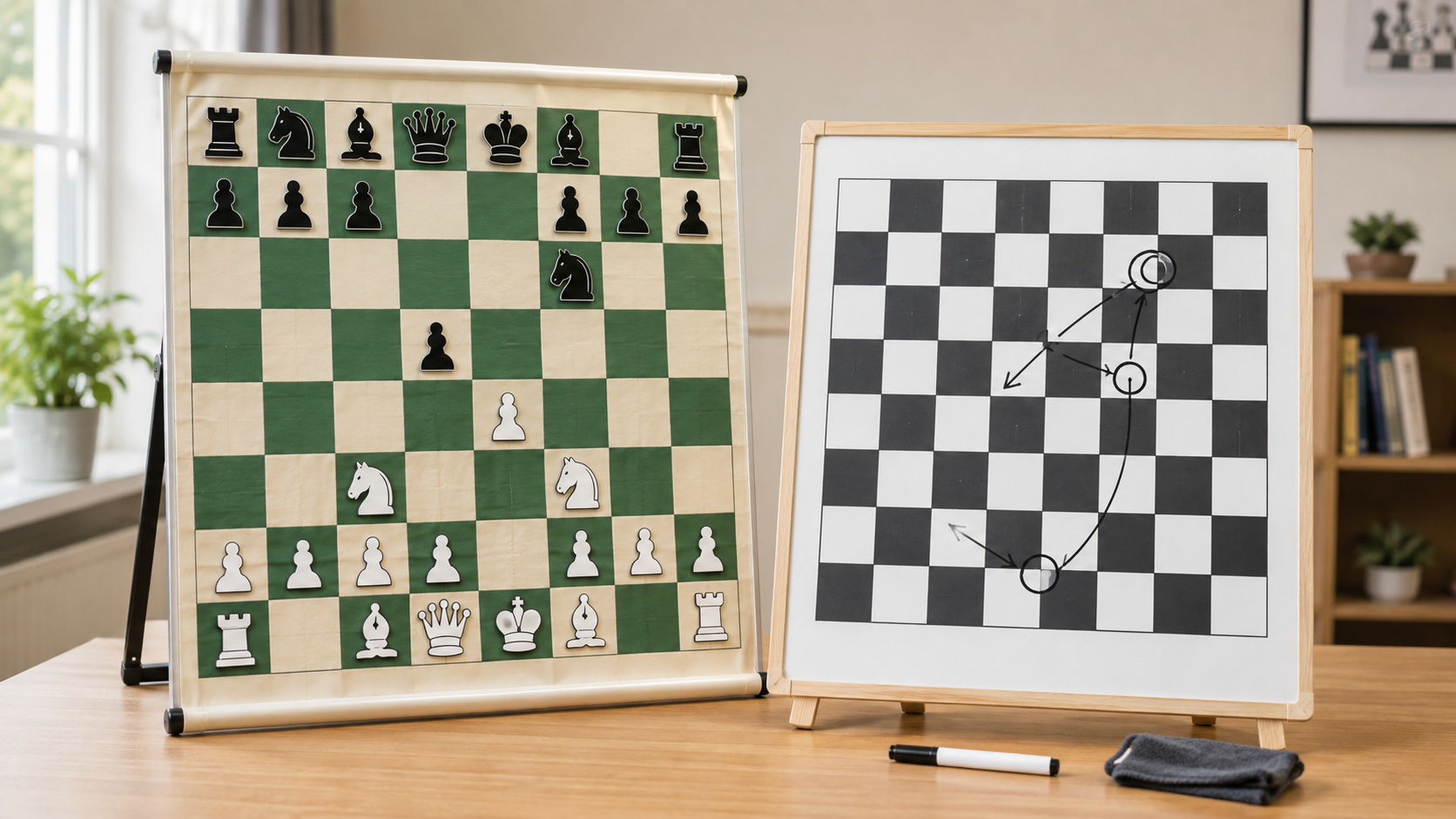
Choose a magnetic demonstration board when learners need to watch real pieces move through a position. Choose a dry-erase diagram board when arrows, circles, labels, and quickly sketched variations carry the lesson. The better format is the one that makes your repeated teaching action easiest to see and reset.
This is a category comparison, not a hands-on test. Verify the exact display dimensions, square contrast, piece attachment or writing-surface instructions, support method, included supplies, and current care guidance before buying.
As an Amazon Associate, The Good Chess & Checkers may earn from qualifying purchases.
Quick decision aid
Movable pieces or erasable annotations?
Start with viewing distance and lesson routine. Then compare usable board size, square clarity, setup, piece or marker care, support, and packed storage.
Quick Verdict
- Choose magnetic for piece movement, legal-move demonstrations, learner participation, and positions that should remain visible between explanations.
- Choose dry-erase for arrows, circles, coordinates, plans, several sketched variations, or lessons built around marking relationships.
- Choose neither yet if the group cannot see the proposed size from its normal seats or most lesson time should be spent playing on pair boards.
The Core Difference: Objects Versus Marks
A magnetic demonstration board represents a chess position with separate pieces. Moving a knight, removing a captured pawn, or resetting the starting position resembles the actions learners perform on a normal board. That physical continuity can help a beginner connect the group explanation to the game at the table.
A dry-erase chess board represents the position with erasable marks or may combine a printed grid with annotations. Its strength is not merely drawing pieces. A teacher can trace a rook’s line, circle a weak square, mark candidate moves, or leave two ideas visible at once. The tradeoff is that a crowded diagram or unclear symbols can become harder to read than familiar pieces.
When a Magnetic Demonstration Board Fits Better
Magnetic pieces suit lessons that unfold move by move. They make captures, exchanges, castling examples, promotion setups, and short tactics concrete without redrawing the position after every change. A learner can also come forward and make a move, turning the shared display into a participation tool.
Check that pieces are distinct from the usual viewing distance and remain attached when the board is upright. “Magnetic” alone does not establish holding strength, and some demonstration boards use pockets or hook-and-loop pieces instead. Confirm the actual attachment system, piece set, replacement route, and whether the board hangs, stands, or needs separate support.
Skip magnetic when the main lesson depends on several arrows or written prompts, when loose display pieces will be difficult to inventory, or when the mounting and storage routine does not fit the room.
When a Dry-Erase Chess Board Fits Better
A writable grid suits explanation-heavy lessons. Arrows can show movement and pressure; circles can hold attention on key squares; brief symbols can separate candidate moves. Erasing one mark while leaving the rest can make a comparison faster than moving many pieces.
Verify that the grid remains visible after marks are added and that the stated marker type and cleaning method suit the surface. Test the teaching habit too: drawings must be large and consistent enough for the back row. A teacher who spends the lesson carefully redrawing recognizable pieces may be better served by a movable-piece board.
Skip dry-erase when learners need repeated practice identifying and moving normal piece shapes, when marker management is unreliable, or when the surface cannot be stored and cleaned according to its directions.
Compare the Complete Lesson Workflow
- Visibility: mock up the advertised display dimensions and inspect them from the farthest normal seat; do not rely on “classroom size” wording.
- Position changes: count how many pieces or marks a typical example requires and how often the position resets.
- Participation: movable pieces usually make “come make the move” prompts more natural; markers can support learner annotation if writing is large and controlled.
- Setup: include hanging or stand assembly, sorting pieces, finding compatible markers, and preparing the starting position.
- Maintenance: magnetic formats need complete, readable pieces; writable formats need the maker-approved markers, erasing method, and surface care.
- Storage: measure the packed board, stand or hanging hardware, pieces, markers, and eraser—not only the visible grid.
Run a No-Spend Trial
- Write down the three group explanations you repeat most often.
- Use a paper grid at the proposed display size and place it where the board would go.
- Teach one example with paper piece cutouts, then the same example with drawn symbols and arrows.
- Ask learners in the nearest and farthest seats what they can identify without guessing.
- Time setup, position changes, reset, and packing for both approaches.
- Choose only if one format removes a real teaching bottleneck.
Could One Board Do Both Jobs?
Some products combine movable pieces with a writable surface, but confirm both functions rather than assuming them from a listing title. Check whether marks remain legible around the pieces, whether the correct markers are specified, and whether cleaning can be done without disrupting the attachment system. A hybrid is useful only if both workflows remain clear and manageable.
For a small group gathered close to a table, a tabletop demonstration set may be simpler than either large display. For a program still allocating its first equipment budget, decide between pair boards and one shared display before choosing the display format.
Bottom Line
Use a magnetic demonstration board when group lessons depend on recognizable pieces moving through real positions. Use a dry-erase chess board when annotation is the lesson: arrows, circles, plans, and quick variations. Confirm sightlines, support, care, storage, and the complete teaching routine before buying; the right display is the one learners can follow and the instructor can reset without losing lesson time.