
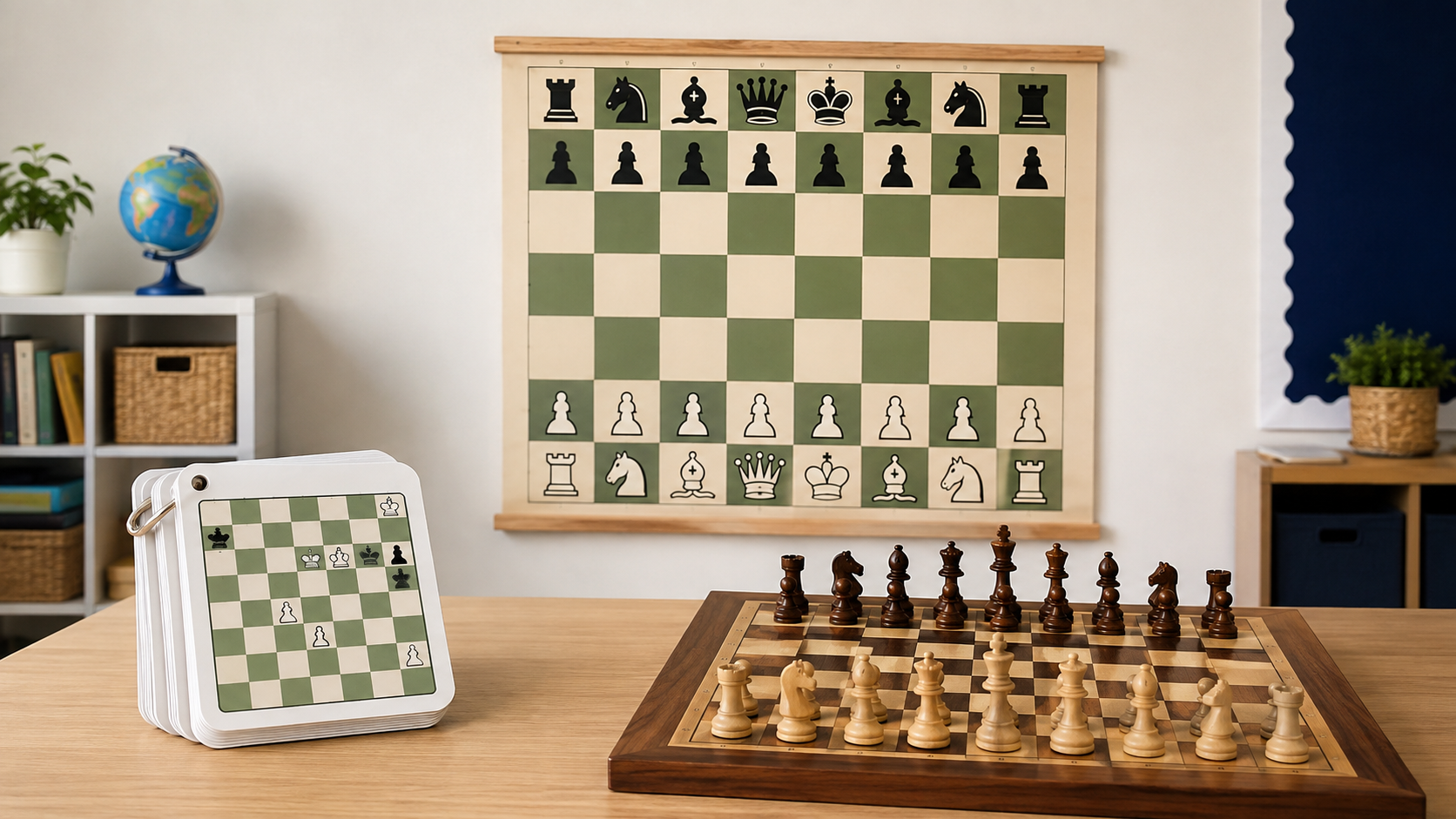
A chess lesson poster is usually the better first aid when several beginners need the same reference during setup or a whole-group explanation. Flash cards are stronger when learners need to handle, sort, discuss, or revisit a small number of positions. Many classrooms can use both, but each should have a defined job rather than becoming extra visual clutter.
This comparison is about teaching format, not a claim that one product makes students improve faster. Check the visible content and physical specifications of the exact item before buying; a clear sample matters more than the word “educational” in a listing.
The Good Chess & Checkers may earn commissions from qualifying purchases.
Quick decision aid
Compare group references with portable prompts
For posters, verify viewing distance, board orientation, topic density, and mounting space. For cards, check diagram size, answer format, sequence, durability, and whether one set can serve the planned group.
Quick answer
- Choose a poster for a stable reference that the whole group can see during board setup, piece-movement lessons, or independent reminders.
- Choose flash cards for short partner activities, position prompts, sorting tasks, review stations, or a portable teaching kit.
- Use both when the poster holds one durable class-wide reference and the cards supply a small sequence of active prompts.
- Skip both for now when students cannot see the graphics clearly, the content does not match the lesson, or a board and a simple printed reference already do the job.
The real difference: reference versus activity
A poster stays in one place and answers the same recurring question for everyone. That makes it useful for board orientation, piece names, movement reminders, or a short sequence that learners need to check without asking an adult. Its value comes from being visible at the moment of confusion.
Flash cards move between people. A teacher can reveal one prompt, ask pairs to set up a position, let students sort cards by piece or idea, or keep a small review stack for the next session. Their value comes from participation and selection, not from showing every topic at once.
When a chess lesson poster fits better
Choose a poster when instruction begins with the whole group and the same visual stays relevant for several weeks. A piece-movement chart can reduce repeated questions while students practice on table boards. A board-coordinate chart can support later notation work if the learners are ready for square names.
Inspect the poster from the farthest seat before relying on it. Large overall dimensions do not guarantee large diagrams. Look for recognizable piece shapes, high contrast, an unambiguous board orientation, restrained text, and enough spacing that one rule does not blur into the next.
Skip a poster when wall space is temporary, glare makes a laminated surface hard to read, several topics are compressed into tiny panels, or room rules do not permit mounting. If the group needs changing positions rather than portable prompts, compare a static chess rule poster with an interactive demonstration board.
When chess flash cards fit better
Choose cards when a lesson works best as one question at a time. Cards can support piece-recognition games, legal-move checks, board-coordinate practice, simple tactical positions, or opening ideas, but those are different learning levels. Confirm that the deck matches what students already know.
A useful card has a large, readable diagram; states which side moves when that matters; and provides an explanation or an answer that a teacher can verify. For group use, check whether the cards are large enough to share, whether the order can be restored, and whether the surface and corners suit repeated handling.
Skip flash cards when the class needs one shared visual, when answers are too terse to teach the reason, or when there is only one small deck for a large group with no rotation plan. A board position prepared by the teacher can provide the same prompt without another product.
Side-by-side classroom tradeoffs
- Group visibility: a well-sized poster can serve the room; cards normally serve one learner, pair, or small group at a time.
- Interaction: cards can be sorted, sequenced, discussed, and set up on a board; a poster is mainly viewed and referenced.
- Lesson sequence: a poster keeps one framework visible; cards let the teacher choose only the prompts needed today.
- Storage: a poster needs safe wall or tube storage; cards need a labeled box, ring, band, or pouch so the deck stays complete.
- Setup time: a mounted poster is always ready; cards need distribution, collection, and a quick count.
- Portability: cards move easily between classrooms or club tables; a poster is better for a stable teaching space.
- Adaptability: neither format is automatically adaptable. Verify the exact topics, notation assumptions, board orientation, and answer depth.
A five-minute pre-purchase check
- Name the lesson: piece movement, setup, coordinates, tactics, or another single job.
- Count the viewers: decide whether the aid serves a room, a table, a pair, or one learner.
- Inspect a real sample: confirm diagram clarity, board orientation, terminology, and the presence of usable explanations.
- Measure the setting: check poster wall space and viewing distance, or card size, storage, and number of simultaneous groups.
- Plan the action: write down what students will do with the aid during a ten-minute lesson.
- Choose a fallback: know whether a table board, teacher-made reference, or projected position would work if the product is unnecessary.
Simple lesson routines for each format
Poster routine: point, find, demonstrate
Point to one piece or rule on the poster, ask learners to find the matching piece on their board, and have them demonstrate one legal move. Cover only one or two ideas before practice begins. Leave the poster available as a reference instead of reading every panel aloud.
Card routine: predict, build, explain
Give each pair one card. Ask them to predict the answer, build the position on a board when needed, and explain the reason before checking the reverse. Rotate cards only after both learners can describe what changed. A few well-used prompts are better than racing through a deck.
Combined routine: anchor and rotate
Use the poster for the shared rule—such as how a knight moves—then give each pair a card with a different legal-move question. The poster remains the anchor while the cards create practice. Avoid using a crowded poster and an unrelated card deck in the same session.
Who should skip both?
Skip a purchase if the learner still needs direct help recognizing the board and pieces; begin with how chess pieces move and a physical board. Also pause when the classroom has no confirmed wall space, storage location, printing permission, or routine for checking missing cards.
Teachers who already have a clear demonstration board, document camera, or reusable whiteboard may not gain much from another format. If several table sets are the larger constraint, prioritize playable equipment using the prebuilt classroom kit vs DIY setup guide.
Bottom line
Choose a chess lesson poster when the class needs one persistent, readable reference. Choose flash cards when beginners need short, movable prompts that turn a rule or position into an activity. The strongest choice is the format that fits the group size, room, lesson sequence, and storage routine—not the one that displays the most information.
The planned classroom-and-club pillar is not yet built, so this comparison links to the closest available setup guides. For a broader room plan, continue with the beginner-friendly classroom and club station guide.