
Choose a chess rule poster when beginners need the same reminder throughout a session. Choose a demonstration board when the instructor needs to build positions and move pieces while everyone watches. A poster is a reference; a demonstration board is a live teaching surface. A recurring group may eventually use both, but most new programs should buy for the more frequent job first.
This is a category comparison, not a named-product ranking or hands-on test. Verify the exact visible content, dimensions, mounting or stand requirements, supplied pieces, storage size, and maker instructions before buying.
As an Amazon Associate, The Good Chess & Checkers may earn from qualifying purchases.
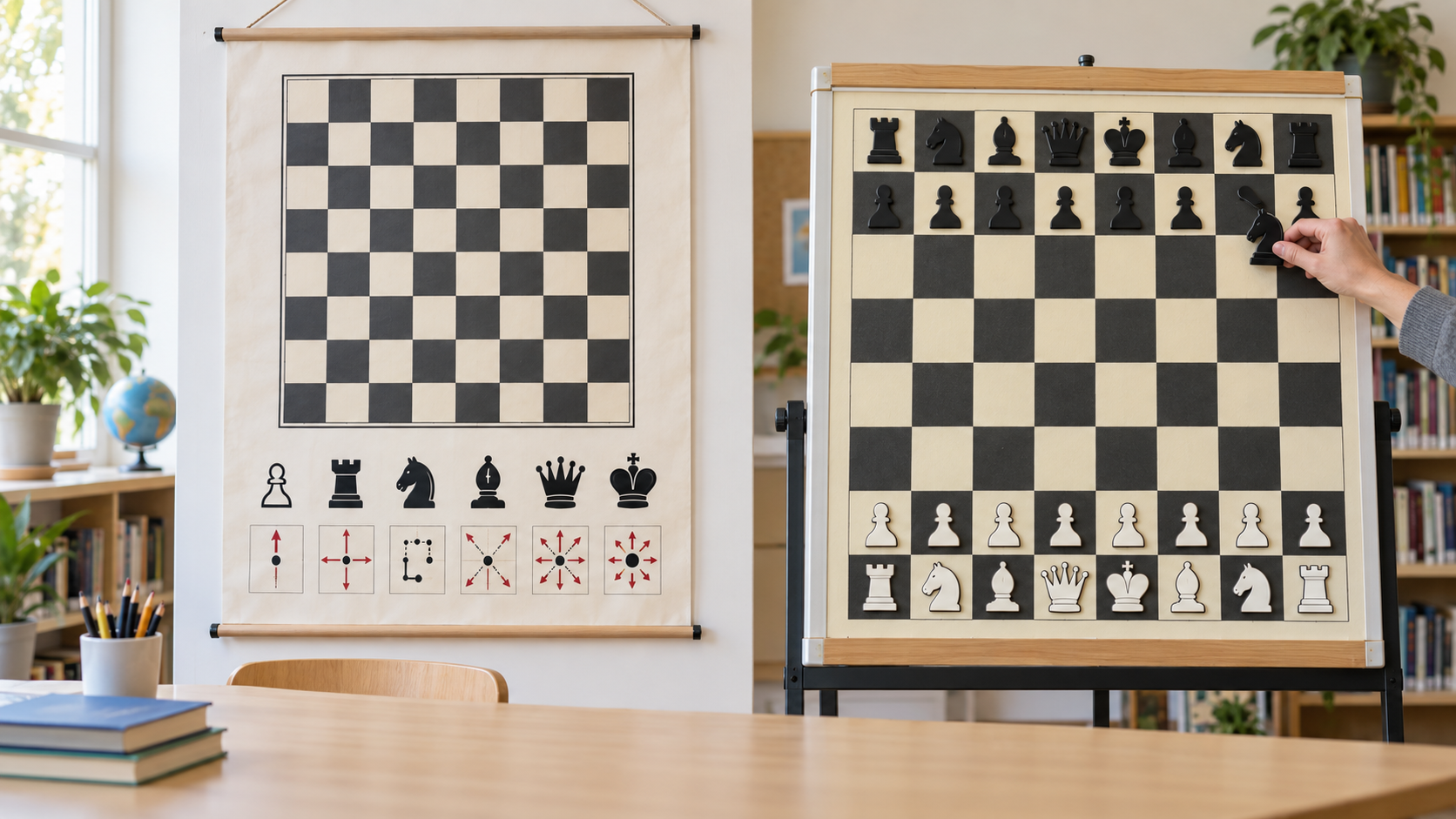
Persistent reference or live position?
Compare the two teaching jobs
For a poster, inspect diagram size, topic focus, board orientation, viewing distance, and mounting space. For a demonstration board, inspect board and piece size, contrast, piece retention, setup route, folded or stored dimensions, and replacement-piece availability.
Quick decision
- Choose a rule poster for piece names, movement reminders, board setup, or coordinates that remain useful while pairs practice.
- Choose a demonstration board for move-by-move explanations, legal-move checks, tactics, game review, and learner participation.
- Use both only when the poster has one stable reference job and the board has a separate live-teaching job.
- Skip both when the group is small enough to gather around an ordinary board or when playable table sets are still the larger need.
What each option actually does
Option A: a static chess rule poster
A poster shows information prepared in advance. Beginners can glance back at it without stopping play, and an instructor does not need to reset it between examples. It fits recurring questions such as how each piece moves, which corner color begins on a player's right, or how files and ranks are labeled.
The limitation is fixed content. A crowded all-in-one poster can make every diagram too small, and it cannot show the position that just appeared on a learner's board. Check a real preview rather than trusting a broad “chess rules” label.
Option B: an interactive demonstration board
A demonstration board gives the group one shared position that the instructor can change. It suits a lesson where learners predict the next move, identify an illegal move, replay a short sequence, or explain why a king is in check. The teaching value comes from the live position, not merely from a larger board.
The tradeoff is a longer routine. Pieces must be sorted and counted, the board must be hung or placed as directed, and the current position disappears when the next example begins. The instructor also needs a plan for storing the board and its special pieces together.
Side-by-side tradeoffs
- Visibility: either format can fail if diagrams or pieces are too small at the farthest seat. Compare visible square and piece size, not just overall dimensions.
- Lesson flexibility: a poster repeats its printed topics; a demonstration board can show any position the supplied piece set supports.
- Interaction: learners can point to a poster, but a demonstration board better supports moving a piece and explaining a choice.
- Setup: a permanently placed poster is nearly instant; a board may require hanging, unfolding, arranging pieces, and restoring the starting position.
- Wall and floor space: posters need a readable wall location; rigid boards may need a wall, easel, or stand plus clearance for the instructor.
- Storage: posters need flat or rolled protection; boards need room for the board, pieces, hanging hardware or stand, and labels.
- Maintenance: posters need careful cleaning according to their finish; demonstration boards add missing-piece checks and possible pocket, magnet, or surface upkeep.
Who each format fits
A poster fits a group that practices independently
Use a poster when the instructor gives a short explanation and then several pairs practice at their own boards. One focused piece-movement or setup reference is usually easier to use than a dense poster that tries to cover rules, notation, openings, tactics, and checkmate patterns at once.
A demonstration board fits instructor-led lessons
Use a demonstration board when the group regularly watches the same sequence. Before buying, rehearse a sample lesson with a projected diagram, document camera, or an ordinary board held where everyone can see. That trial reveals whether live shared positions actually improve the routine enough to justify storage and setup.
Libraries and mobile clubs need a route check
A shared room may not allow a poster to remain mounted, while a mobile club may find a rigid board awkward to carry. Measure doorways, shelf space, cart space, and the display location. Follow the venue's placement rules and the maker's setup instructions; this guide does not authorize mounting.
Setup and maintenance checklist
- Name the first three lessons and mark which need a fixed reminder versus a changing position.
- Measure the display area and view both formats from the farthest learner's normal seat.
- For a poster, verify the exact diagrams, terminology, orientation, finish, and stored size.
- For a board, verify all 64 squares, recognizable pieces, retention method, coordinates, mounting or stand needs, and stored dimensions.
- Assign a labeled home for the aid and a count routine for demonstration pieces.
- Trial one aid through setup, instruction, learner practice, cleanup, and storage before standardizing.
When to skip a rule poster
Skip it when no approved wall location is readable, the sample crams too many topics into small panels, terminology conflicts with the lesson, or a one-page table reference already answers the recurring questions. If learners need portable prompts rather than a room-wide reference, use the poster vs flash cards comparison.
When to skip a demonstration board
Skip it when the group is small, the instructor rarely changes shared positions, table sets are incomplete, or the board cannot be stored with every piece. A normal board under a document camera may suit a room that already has approved display equipment; compare those formats in the demonstration board vs document camera guide.
Bottom line
Buy a chess rule poster for a stable reminder beginners can consult during practice. Buy a demonstration board for interactive, instructor-led positions. Start with one clear teaching job, verify readability in the real room, and skip either product when ordinary boards or existing display equipment already solve the problem.
For the wider equipment and reset routine, continue to the beginner-friendly chess and checkers station guide. It is the closest available setup pillar while the planned classroom-and-club pillar remains unbuilt.