
Beginner chess learning comparison
Chess Book vs Online Course: Which Fits an Absolute Beginner?
Choose a beginner chess book when the learner likes a quiet, reusable reference and will rebuild diagrams on a board. Choose an online course when a visible lesson sequence, demonstrations, and built-in prompts make it easier to keep going. If the learner does not yet know whether studying chess is enjoyable, borrow or sample both formats before buying either.
This is a format comparison, not a ranking of named books or courses. We have not tested every product, and we do not claim current prices, access terms, ratings, results, or availability. Check the exact edition, syllabus, sample lesson, account requirements, billing, cancellation terms, and device support with the publisher or course provider.
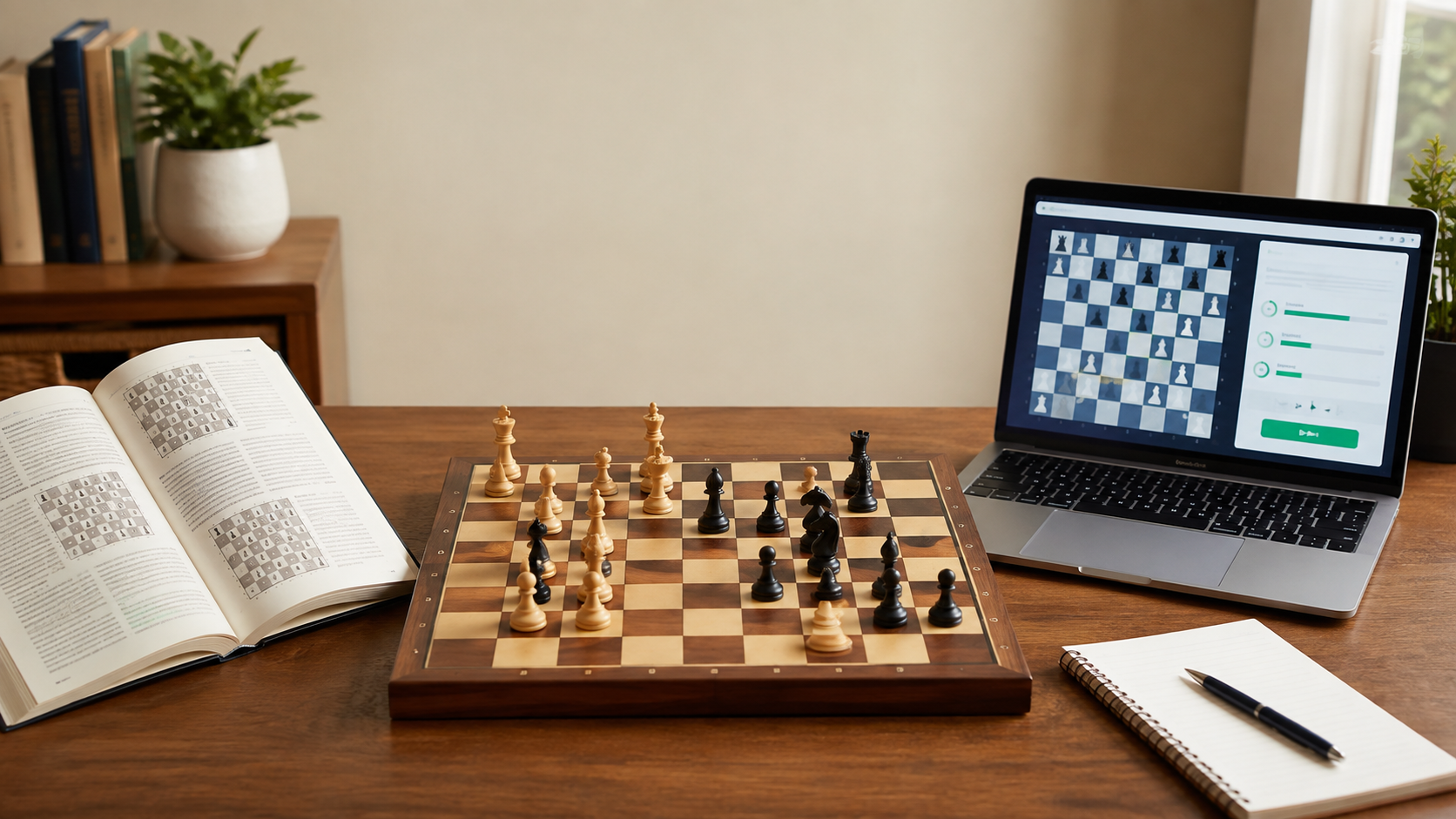
Quick answer
Start with a book if the learner enjoys reading instructions, wants something that works without an account or connection, and has a board on which to copy each example. A book is especially useful as a stable reference that can remain open beside the position.
Start with an online course if the learner benefits from demonstrations, a fixed next lesson, and prompts that reduce the work of deciding what to study. Confirm that the course truly starts with board setup and legal moves; “beginner” can describe very different starting points.
Start free if interest, routine, or prerequisites are uncertain. Learn how the chess pieces move, play a few slow games, and complete one legitimate sample lesson in each format. The result is more useful than guessing from a cover or sales page.
Side-by-side decision table
| Decision | Beginner chess book | Online chess course |
|---|---|---|
| Lesson structure | A fixed table of contents and pages that are easy to revisit. | A sequenced path that may track progress or unlock the next lesson. |
| Demonstration | Static diagrams require the learner to follow changes and rebuild positions. | Video or interactive boards may show moves in sequence; verify the actual lesson format. |
| Feedback | Exercises rely on answer sections, a partner, or careful self-checking. | May check answers or moves immediately; the depth of explanation varies. |
| Access | Remains usable as long as the copy is readable and available. | May depend on an account, supported device, connection, subscription, or access period. |
| Physical-board practice | Naturally encourages setting up positions when a board is beside the book. | Can keep all activity on screen unless the learner deliberately transfers examples to a board. |
| Best fit | Self-directed readers who value reference and a screen-free study option. | Learners who value guided sequence, motion, prompts, and faster checking. |
Choose by the friction that stops the learner
A format should remove a real obstacle. If the beginner opens random videos but never knows what comes next, a clearly sequenced course may solve the problem. If menus, logins, notifications, or expiring access interrupt study, a book may be the calmer tool.
Neither format supplies practice automatically. A book can sit unopened, and a course can become a row of completed buttons without better board decisions. The useful routine is small: learn one idea, reconstruct one position, explain the idea in plain words, and play a short game or exercise where it matters.
When a book fits better
- The learner likes to pause, reread, annotate, or keep a stable page open.
- A shared family device is not consistently available for study.
- The learner wants a reference next to a physical board rather than another screen activity.
- A library or borrowed copy makes it possible to test the exact reading level first.
- The diagrams, board orientation, vocabulary, notation, and answers are clear at the learner's current level.
Skip a book whose sample pages begin with unexplained notation, crowded diagrams, or long game records when the learner still needs legal-move practice. The separate guide to whether a beginner chess lesson book is worth it gives a fuller buy, borrow, delay, or skip test.
When an online course fits better
- The learner understands a move more easily when it is demonstrated in sequence.
- A defined lesson path prevents endless searching and switching between unrelated explanations.
- Short prompts or checked exercises help the learner spot a misunderstood rule quickly.
- The published syllabus starts at the learner's actual level and a sample lesson feels clear.
- The household has confirmed current access, account, device, billing, cancellation, and support details.
Skip or delay a course when its syllabus is vague, no useful sample is available, or the learner has no repeatable time for lessons. Use the detailed online-course readiness guide before paying for structured access.
Compare total setup, not just the purchase
A book needs a comfortable reading level, enough space to sit beside the board, and patient position setup. Binding matters when pages keep closing, while a notebook can preserve answers without marking a reusable copy. A course needs a suitable screen, reliable access for the intended study setting, and a plan for transferring digital examples into actual play.
Do not compare page count with lesson count as though either proves value. Check whether the material covers the missing next step, whether explanations are understandable, and whether the learner can finish a small unit. For any course, verify current terms on the official provider page; for any book, verify the exact edition and format because listings can group different versions.
A two-session test before buying
- Choose one topic: use the same beginner idea for both tests, such as check, castling, or a simple capture.
- Try print: borrow a book or use a complete publisher sample, then rebuild one diagram on a physical board.
- Try digital: use an official free sample or a clearly free lesson covering the same idea.
- Close the material: ask the learner to explain the rule and recreate one example without copying.
- Notice the friction: record whether reading, navigation, setup, feedback, or attention caused the session to stop.
- Choose the next month: pick the format the learner requests and can realistically use twice a week—or keep using free material until that preference becomes clear.
Who should choose neither yet?
- A learner who is still deciding whether chess is enjoyable.
- Someone who needs a patient person to explain the legal moves during the first few games.
- A household that already owns unused beginner material at the right level.
- A buyer who cannot inspect sample pages, a syllabus, or the current access terms.
- A beginner expecting either purchase to guarantee progress without regular board practice.
In those cases, use the site's beginner set guide if a readable shared board is the missing tool, then pair it with free rules help and complete games.
Bottom line
A chess book fits an absolute beginner who prefers a lasting, quiet reference and is willing to translate diagrams onto a board. An online course fits a beginner who benefits from demonstration, sequencing, prompts, and faster checking. Neither category is automatically more complete or more effective.
Test one comparable lesson in each format, then choose based on the friction it removes and the routine the learner will repeat. If both samples go unused, delay the purchase and spend the next sessions learning the moves and playing.