
Classroom chess storage comparison
Drawstring Piece Bag vs Compartment Box: Which Organizes a Classroom Chess Set Better?
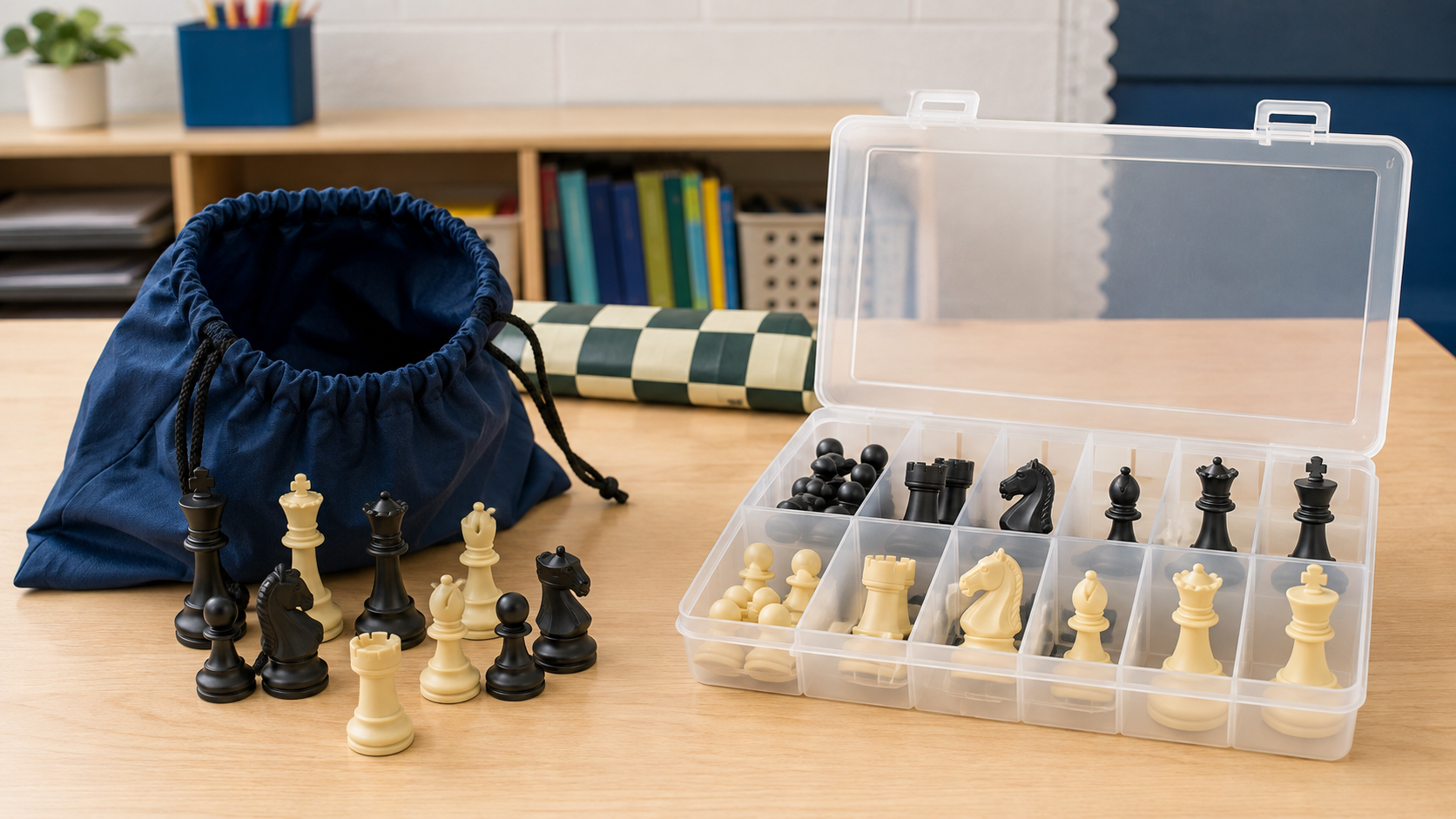
A drawstring bag is usually the faster, smaller way to collect one complete chess set. A compartment box is better when helpers need to see, separate, and count pieces before the equipment returns to a shelf. The right choice depends less on “organization” in the abstract than on who packs up, how often pieces go missing, and how much shelf and carrying space the container can use.
This guide compares storage formats rather than named products. We have not tested the items returned by the shopping links and do not claim current prices, ratings, availability, durability, or classroom approval. Verify internal dimensions, compartment layout, closures, materials, and cleaning instructions on the current listing before buying.
Quick answer
Choose a drawstring bag when each board has one complete set, students need a fast end-of-session sweep, and the container must tuck inside a larger board bag or shallow cabinet.
Choose a compartment box when adults or student helpers routinely inventory pieces, replacements are stored by type, or mixed sets must be sorted before the next lesson.
Use both only for different jobs: one bag per active board and one labeled compartment box for spare pawns, queens, and replacement pieces. Buying two containers for every board usually adds bulk without improving the routine.
Side-by-side classroom decision
| Decision | Drawstring bag | Compartment box |
|---|---|---|
| Pack-up | Pieces can be gathered quickly into one opening. | Each type or color needs a chosen cell, so sorting takes longer. |
| Missing-piece check | Usually requires emptying and arranging the pieces. | A consistent layout can reveal an empty cell at a glance. |
| Capacity | Flexible fabric accommodates mixed piece shapes, but stated dimensions still matter. | Every king, queen, and knight must fit below the closed lid and within the cell walls. |
| Shelf space | Collapses around its contents and often fits inside other equipment. | Keeps a fixed footprint and needs clearance for its hinges and lid. |
| Carrying | Light and easy to assign to one board, but offers little structure. | Structured and easy to label, but bulkier and dependent on a secure latch. |
| Best fit | Fast stations with complete sets stored separately. | Inventory-heavy rooms, shared spares, and visible sorting routines. |
Who fits a drawstring piece bag?
A bag fits a class where “one board, one set, one bag” is the easiest rule to remember. Students can slide pieces into a wide opening, pull the cord, and return the bundle with its board. Soft storage also adapts to tall kings and oddly shaped knights without requiring one compartment for every outline.
Before buying, lay out all 32 pieces plus any extra queens and measure the pile loosely rather than compressing it. Check the opening width, cord, seams, label area, and whether the fabric can be cleaned under the maker’s instructions. A bag that technically holds the set but requires careful stacking will slow the exact routine it is meant to simplify.
Skip a bag when pieces disappear often, several sets are already mixed together, or a helper needs to confirm a complete set without pouring everything onto a table. It also gives hard pieces little protection from impacts; do not treat fabric as a protective case.
Who fits a compartment box?
A divided box turns storage into a visible checklist. A class might reserve cells for pawns, major pieces, light pieces, dark pieces, and extras, then place a simple inventory card under the clear lid. That can make a missing group obvious and keep replacement stock from becoming another mixed bag.
The critical measurement is usable cell space with the lid closed. Confirm cell width, depth, divider height, latch position, and the height of the tallest king. Removable dividers can help, but only if they stay seated during carrying. Test whether the closed box can be lifted by its base rather than its lid, and store it flat unless the maker documents another orientation.
Skip a compartment box when lesson time is too short for sorting, shelf depth is limited, or younger helpers are likely to force tall pieces under the lid. A box also becomes inefficient if every cell contains a random mix; its value comes from a layout the group can repeat.
Setup and maintenance issues
- Count the real set. Include two colors, any extra queens, king markers, and the small reference card that travels with the pieces.
- Assign an identity. Use a board number or color code on the container and board so mixed equipment has a clear return path.
- Photograph the finished layout. For a box, keep a printed layout card inside the lid. For a bag, keep a 32-piece checklist with the station supplies.
- Plan cleaning. Follow the stated fabric or plastic care instructions. Let every container dry fully before closing it around pieces.
- Audit the closure. Inspect cords, seams, hinges, dividers, and latches periodically; retire a container that opens during normal carrying.
A practical classroom workflow
For a small beginner group, start with one labeled bag per board. Put a simple picture checklist at the return shelf and have the same pair count before closing. If missing pieces become a recurring problem, trial one compartment box at a single station before replacing every bag.
For a larger club with centralized supplies, keep complete active sets in bags and use one compartment box as the spare-parts bank. That separates rapid daily reset from slower inventory work. The broader classroom and club station guide explains how labels, boards, rule cards, and storage fit together.
Bottom line
A drawstring bag wins on speed, flexible capacity, and compact storage. A compartment box wins on visibility, sorting, and repeatable counting. Choose the bag when keeping each complete set together is the main problem; choose the box when finding what is missing is the main problem.
If the whole set travels between rooms, compare a chess carrying bag with a hard case. If the classroom already has incomplete sets, use the school replacement-piece guide before buying more organizers.