
Choose a floor checkers mat when the family wants an active, highly visible game and has a clear area that can stay comfortable for the full session. Choose a tabletop board when players prefer chairs, faster setup, compact storage, and familiar piece handling. The floor format changes the way people reach, move, and gather around the game; it is not automatically better simply because it is larger.
This comparison is for indoor family play. If the real goal is a party-size or outdoor setup, use the giant checkers guide, which covers more formats and placement conditions.
As an Amazon Associate, The Good Chess & Checkers may earn from qualifying purchases.
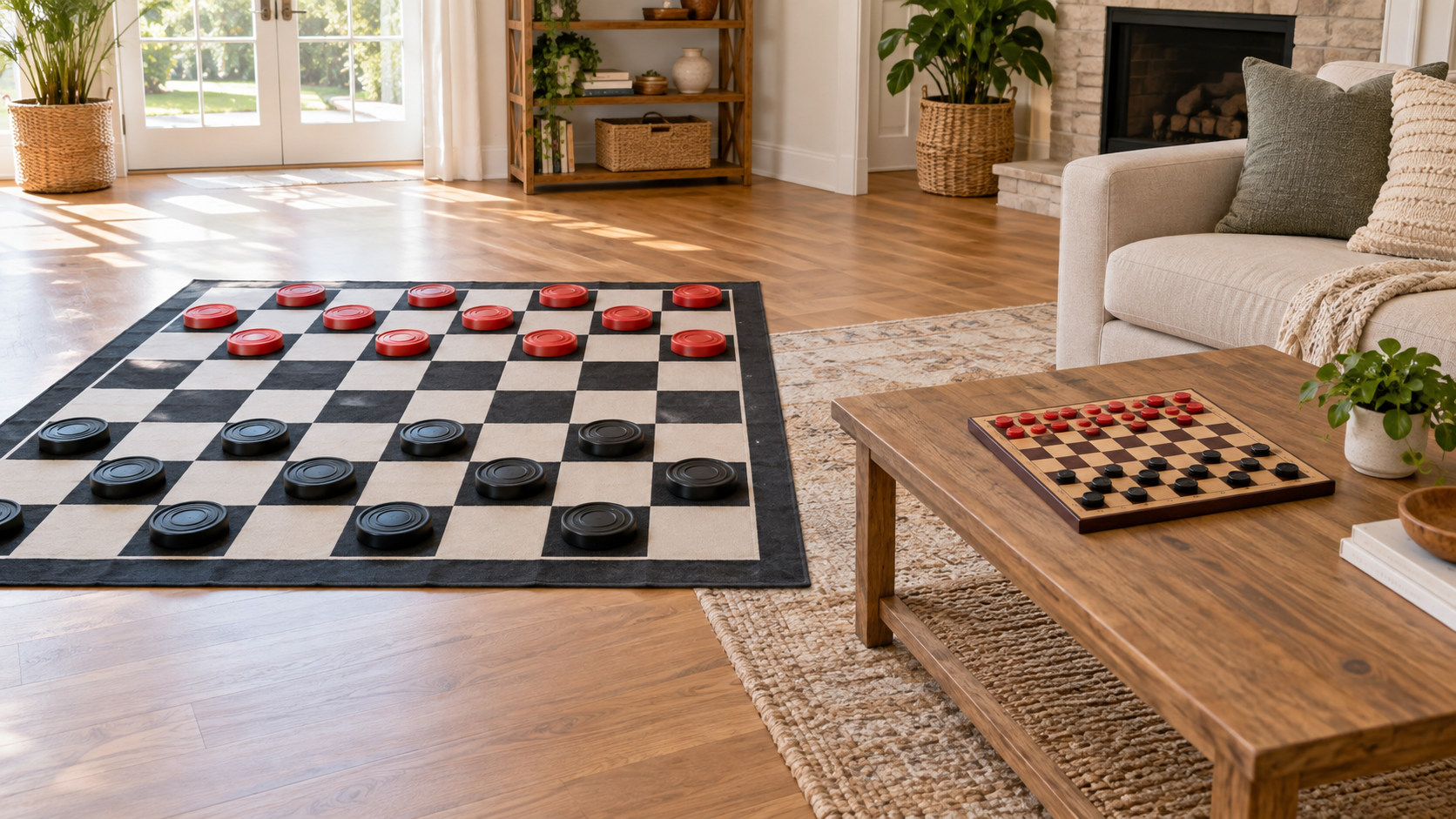
Compare the complete play setup
Check dimensions before choosing a format
For a floor set, verify the mat's open dimensions, square size, checker diameter and thickness, kinging method, packed format, material, and maker care instructions. For a tabletop set, verify the playing-square size, checker fit, board support, storage, and whether seated players can reach the whole board comfortably.
Quick decision
- Choose a floor mat for active play, a strong group visual, and players who can comfortably kneel, sit, or move around the playing area.
- Choose a tabletop board for chairs, smaller rooms, quicker resets, and a game that can share space with ordinary family activities.
- Keep both only for different jobs: a tabletop set for regular games and a floor set for occasional gatherings.
- Buy neither yet until painter's tape or paper markers have tested the proposed footprint and reach.
Where a floor checkers mat fits
A floor mat turns each move into a larger physical action. Bigger squares and pieces can make the position easier for a group to see, and spectators can gather along more than one side. That makes the format appealing for a relaxed family activity or a short teaching demonstration.
The tradeoff is the entire floor zone. Players need space to approach the board without stepping on pieces or blocking a route through the room. Sitting or kneeling may be uncomfortable for some people, while standing and bending over can make careful moves awkward. Measure the open mat and add circulation space around it rather than assuming the listed board size is the whole footprint.
Where a tabletop board fits
A standard board keeps the game within a familiar seated reach. It is usually simpler to pause, review a position, or play a longer game without moving around the room. It also leaves the floor available and can pack into a cabinet, drawer, or game shelf when the session ends.
A small board can be hard to read from the side, and tiny or low-contrast pieces may be difficult to distinguish. Confirm the actual square and checker dimensions. A larger tabletop set may solve visibility and grip problems without requiring floor play, provided the table still has room for hands, captured pieces, and drinks kept safely away from the board.
Compare the tradeoffs that change family play
Visibility and group participation
A floor board can be seen by several people at once, but the nearest players may still block sightlines. A tabletop board is best for two seated players and one or two nearby helpers. If the purpose is teaching, test where every learner will stand or sit before treating size alone as the answer.
Comfort and access
Floor play assumes that players can get down, remain comfortable, and reach across large squares—or walk around the board for distant moves. A table and suitable chairs can provide a more stable posture. Families should choose around the actual players rather than an age label or the novelty of oversized pieces.
Setup and interruption
A mat needs a clear, clean area and may need flattening according to its design and instructions. A tabletop board needs a stable surface with enough edge clearance. Consider what happens when someone needs to cross the room, the game pauses for dinner, or younger children and pets enter the area.
Piece handling and kinging
Checkers commonly marks a king by stacking a second checker, although a set may use another visible method. Verify that the included floor pieces can stack securely or otherwise show kings clearly. On a tabletop board, confirm that pieces fit inside the squares with enough finger room to move and stack them without disturbing neighbors. House and regional checkers rules can vary, so agree on the rules before play.
Storage
Measure the mat and all pieces when packed, not just the open board. A loosely folded or rolled mat and a bag of oversized pieces may need a long or bulky shelf. A tabletop folding set may store more compactly, but only if its pieces have a dependable compartment or pouch.
Setup and maintenance checks
- Mark the advertised open dimensions on the intended floor or table.
- Add space for player positions, movement, captured pieces, and a clear room route.
- Confirm the board has 8 by 8 squares and that the pieces begin and move on the dark playable squares under the rules your family uses.
- Check how kings are shown and whether every player can handle that method.
- Read the maker's cleaning, folding, rolling, and storage instructions for the exact materials.
- Plan one container for the complete piece count so missing pieces are obvious at cleanup.
Do not assume a fabric-like mat is machine washable, that a printed surface tolerates household cleaner, or that folded creases can be heated away. Follow the current care directions for the specific product. Sweep or clean the play surface as appropriate before setup, count pieces after play, and let any approved cleaning moisture dry fully before packing.
Who should skip each option?
Skip a floor mat when it would block a walkway, when players cannot use the floor comfortably, when pets or foot traffic would repeatedly interrupt the position, or when the packed mat and pieces lack a real storage place. Skip a tabletop board when its measured squares and pieces are too small for the intended players or when the group needs a shared visual more than a two-player setup. Skip both as a new purchase when an existing board works and the family is still learning how to play checkers.
Bottom line
A floor checkers mat is an occasional active-play format with strong visibility and a large total footprint. A tabletop board is the more compact seated format for routine games and easier pauses. Mock up both spaces, check comfort and reach with the actual players, verify piece and kinging details, and choose the setup the family can start, finish, count, and store without friction.