
A folding game table gives the room back after play. A dedicated chess table removes setup friction and can keep a position available between sessions. In a small home, the better option depends less on the furniture label than on the complete play zone, storage route, and how often the board will actually be used.
This is a format comparison, not a ranking or a claim that we tested individual tables. Use published dimensions and instructions for any table you consider, then measure the board, chairs, legroom, walking path, and folded storage space in your own room.
As an Amazon Associate, The Good Chess & Checkers may earn from qualifying purchases.
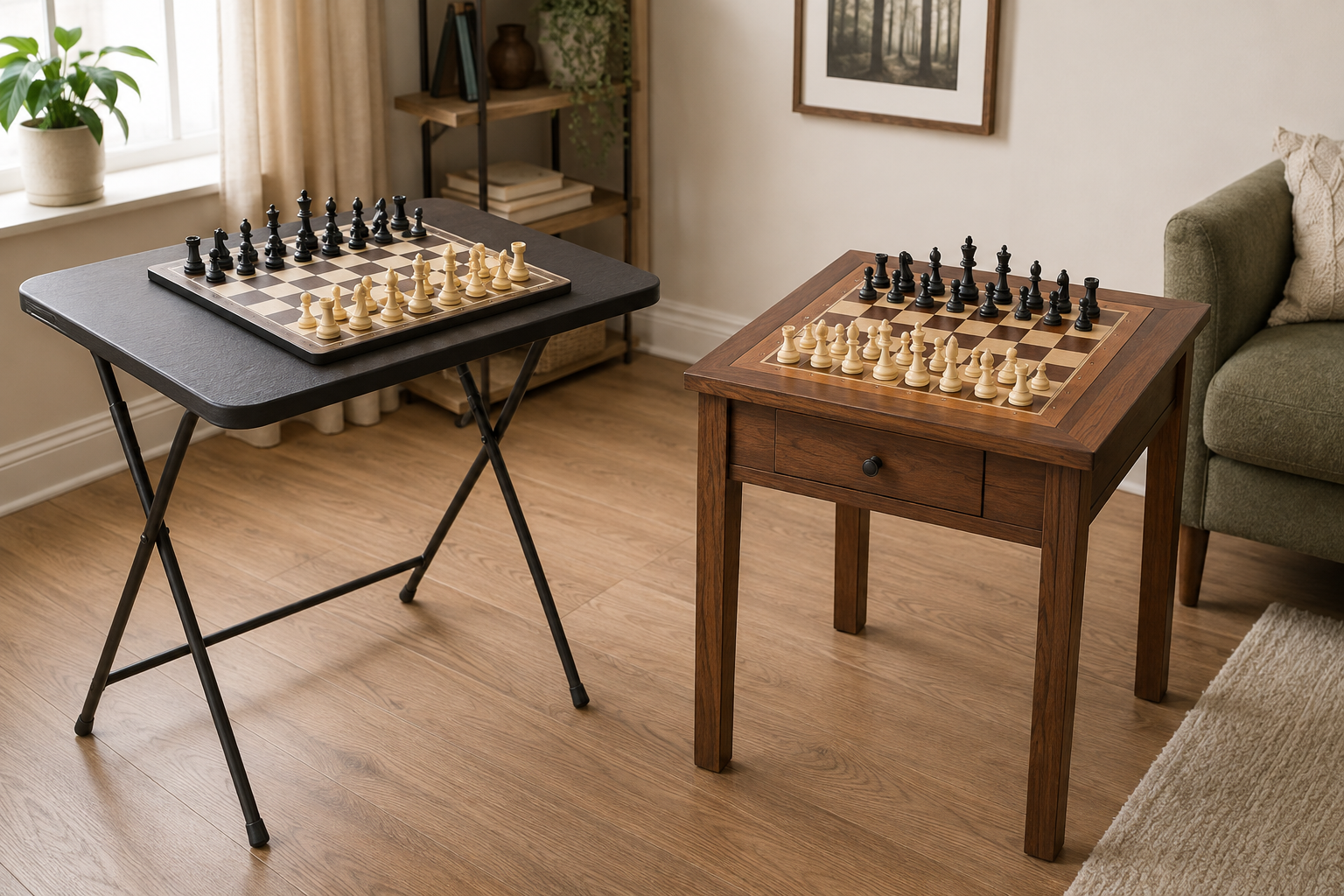
Quick decision aid
Browse both table categories
Confirm the open footprint, chair clearance, tabletop or playing-surface dimensions, leg layout, and delivery or storage route on the current listing before buying.
Quick verdict
Choose a folding game table when the room serves several purposes, you have a realistic storage slot, and setting up the board will not discourage play. Choose a dedicated chess table when chess is frequent, a board or study position should remain ready, and the full table-and-chair zone can stay clear every day. Use existing furniture when a dining table or desk already supports the board comfortably; buying another table is not automatically an upgrade.
What changes in a small room?
| Decision | Folding game table | Dedicated chess table |
|---|---|---|
| Floor space between games | Can be reclaimed after folding | Remains occupied |
| Setup | Table, board, and pieces must be brought out | Board surface is already available |
| Storage | Needs a measured folded slot plus a route to it | May offer drawers, but the table itself does not store away |
| Other uses | Can support checkers and other tabletop activities | Integrated squares can limit general-purpose use |
| Board choice | A separate board can be replaced or changed | Square size and contrast are tied to the furniture |
| Visual role | Usually temporary, practical furniture | Can function as a permanent room feature |
Measure the complete play zone
Do not compare tabletop width alone. Mark the table outline on the floor, place the intended chairs, and allow room to sit down, move an arm, and walk past. Check where table legs, aprons, drawers, and folding braces meet knees. A compact tabletop can still create an awkward room if chairs block a doorway or the leg structure forces players outward.
For a folding model, also measure its closed thickness and height, the closet or wall gap, and every turn along the carrying route. For a dedicated table, measure the delivery path before treating a narrow room footprint as proof that it will fit.
Compare the actual playing surface
A folding table needs enough level area for the board frame, hands, captured pieces, and an optional clock or scorebook. A dedicated table needs squares and pieces that are easy for both players to distinguish. If pieces are included, compare their base diameter with the square size rather than assuming the proportions will feel comfortable.
The separate-board approach is more adaptable: you can swap chess for checkers, replace a worn board, or choose coordinates for learning. An integrated chess surface is quicker to use, but its contrast, square size, and finish are permanent parts of the furniture.
Setup friction versus permanent clutter
A folding table only saves space if someone will reliably fold and store it. Count the real steps: clear the surface, box the pieces, move the board, release the table according to its instructions, carry it, and later rebuild the setup. If that routine makes short games unlikely, removable furniture may solve the floor plan while hurting the playing habit.
A dedicated table has the opposite tradeoff. It can keep a board ready for a quick game or a study position, but pieces left out can turn the surface into visual clutter. Decide where unused pieces, clocks, books, and score sheets go; a drawer is useful only when its internal dimensions fit those items.
Who should choose each format?
A folding game table fits best when
- The room is a living room, guest room, or dining space first.
- Chess and checkers happen occasionally rather than every day.
- A measured closet, wall gap, or under-bed route can hold the folded table.
- You want to change boards or use the surface for other games.
A dedicated chess table fits best when
- Two chairs and the table can remain without narrowing an important walkway.
- Frequent games or board study benefit from an always-ready position.
- The integrated squares, piece proportions, and contrast suit the intended players.
- The furniture has a useful role in the room even when nobody is playing.
Reasons to skip both
Skip a folding table if its stored form has no practical home, its braces conflict with the intended chairs, or repeated setup will reduce play. Skip a dedicated table if it would become an obstacle, if the fixed board is hard to read, or if the room needs flexible furniture. Skip both when an existing table already provides a flat, comfortable play zone; a board mat or protective pad may be the only missing piece.
Continue with the right category guide
If removable furniture wins, use the folding game table guide to compare square, rectangular, adjustable-height, and group formats. If a permanent setup wins, use the small-room chess table guide to compare fixed, drawer-equipped, folding-top, and existing-furniture options. For a broader board-and-piece decision, return to the beginner chess and checkers set guide.
Bottom line
A folding table is usually the safer small-home choice when flexibility matters and the storage routine is easy. A dedicated chess table earns its permanent footprint when frequent play, an always-ready board, and furniture appeal genuinely matter. Measure the whole system—not just the tabletop—and keep your current furniture in the comparison.