
Yes—an app is worth trying first when you are testing interest, learning alone, or unsure which game the household will actually play. Use a free or already available option for a few short sessions before buying equipment. Buy or borrow a physical board sooner when face-to-face family play, hands-on setup, classroom use, or confidence with real pieces is the goal.
An app can delay a purchase; it does not have to replace one. The best decision comes from what the learner wants to do next, not from treating digital or physical play as universally better. For the wider learning path, start with how chess pieces move or how to play checkers.
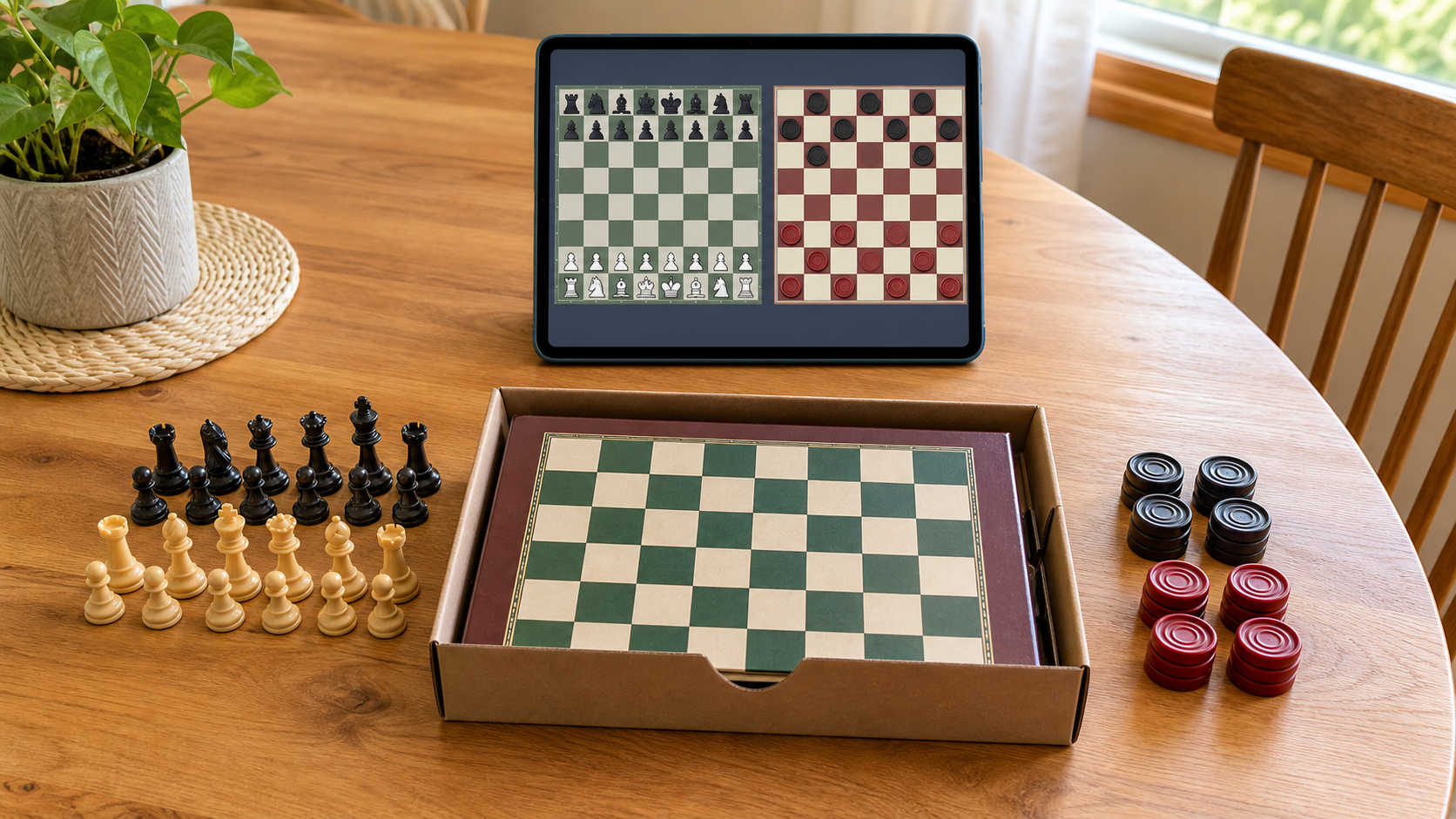
If the trial leads to a board
Use the beginner chess and checkers set guide to compare board readability, piece shapes, stackable kings, storage, and age fit before choosing equipment.
Quick decision: buy, skip, delay, choose an alternative, or escalate
- Try an app first when interest is uncertain, the learner needs legal-move guidance, or no regular opponent is available.
- Buy a board now when two people already want to play together, physical setup is part of the learning goal, or the set will serve a recurring family routine.
- Delay the purchase when the app trial has not yet led to complete games or a clear preference for chess, checkers, or both.
- Choose a cheaper alternative by borrowing a set, using a library or club board, printing a temporary board, or playing on equipment already in the household.
- Skip the app when account requirements, ads, confusing prompts, unreliable access, or device rules add more friction than the tool removes.
- Escalate the choice to a parent, teacher, club helper, or program administrator when privacy, age requirements, classroom accounts, chat, purchases, or required equipment must be approved.
When an app earns the first chance
An app is useful for a low-commitment trial because it can put a board on screen immediately, enforce legal moves, and provide a solo opponent or short exercise. That answers the first question cheaply: does the learner want another session? If the answer is no after several calm attempts, a physical set is unlikely to fix the lack of interest by itself.
For chess, automatic setup and move checking can get a beginner into a first game quickly. For checkers, the app must clearly state which rules it uses. American checkers and other draughts variants can differ in board size, capture rules, and king movement, so confirm the variant before treating the app as a rules teacher.
An app is also practical when storage and table space are unresolved. It gives the household time to decide whether they need chess only, checkers only, or one combo set instead of buying the first attractive box.
When a physical board should not wait
Buy or borrow a board sooner when the purpose is face-to-face play. A shared screen can work for a trial, but two people sitting across from real pieces can point, pause, discuss a move, and reset a mini-game without navigating menus. A board also teaches setup, orientation, piece recognition from different angles, and the cleanup routine that digital play handles automatically.
Physical equipment matters when the learner plans to join family games, a club, or a classroom that uses table boards. The transition need not be expensive: a complete, readable borrowed set can reveal whether over-the-board play feels different before anyone buys a permanent one.
Checkers players should pay particular attention to kinging. On a physical set, pieces should stack securely or provide another clear way to mark kings. An app handles that state automatically, so a digital trial cannot tell you whether tiny, slippery, or non-stackable checkers will be frustrating.
Practical criteria for the app trial
- Rules clarity: it identifies chess or the exact checkers variant and explains legal movement in beginner language.
- Useful feedback: it explains a mistake or rule instead of merely rejecting a move.
- Beginner pace: it allows untimed practice without pushing the learner toward fast games, streaks, or advanced lessons.
- Access: it works on the available device and, when needed, without a constant connection.
- Account fit: the household understands current sign-in, age, privacy, chat, advertising, and purchase requirements before use.
- Two-player fit: if family play matters, the app supports a simple local turn-taking mode or the household has another workable setup.
- Transfer: after a few sessions, the learner can explain a rule or predict a move without relying on highlighted squares.
Red flags before using an app as the teacher
- The app does not identify its checkers or draughts variant.
- Move highlights show every legal destination but never explain how the piece moves.
- The first session requires a paid plan, public profile, chat, or permissions the learner does not need.
- Advertisements, rewards, streaks, or repeated prompts distract from finishing one thoughtful exercise.
- The difficulty jumps from piece movement to full games without mini-games or short practice positions.
- The learner can move on screen but cannot describe board orientation, setup, kinging, captures, check, or another basic rule without prompts.
- A listing calls the app child-, classroom-, or school-friendly without current requirements being checked by the responsible adult or organization.
Cost, maintenance, and setup tradeoffs
A free app can avoid an immediate equipment purchase, but “free” does not guarantee that every lesson, opponent, or offline feature is included. App costs, ads, accounts, and policies can change, so check the current store listing and publisher information rather than relying on an old comparison. This page does not recommend or review a named app.
Digital maintenance includes software updates, charging, passwords, notifications, and keeping the account settings appropriate. Physical maintenance includes storing all pieces, keeping the board flat or properly folded, cleaning it according to its material, and replacing lost pieces. Neither format is maintenance-free; the burdens are simply different.
Setup is fastest in an app because the position appears automatically. That convenience can hide a learning gap. If a board purchase is likely, ask the learner to set up a borrowed board after the app trial. Use our chess and checkers setup guide and notice which steps still need help.
Who should skip or delay each option?
Delay buying a board when:
- The learner is trying chess or checkers only because someone else suggested it.
- No one yet knows whether the household wants chess, checkers, or both.
- Storage, table size, travel needs, or small-piece concerns have not been resolved.
- A complete borrowed set is available for the first few physical games.
Skip or limit the app when:
- The main goal is conversation and shared family play around one table.
- The learner follows highlights without understanding the rule behind them.
- Access depends on an account, network, purchase, or device the learner cannot reliably use.
- A parent, school, library, or program has not approved the current privacy, communication, or account setup.
- The beginner becomes more interested in rewards or speed than in understanding positions.
A five-session try-before-you-buy test
- Choose the game. Complete one short chess movement lesson or one checkers rules lesson, with the variant clearly identified.
- Repeat without prompts. Before touching the screen, predict one legal move and explain why it works.
- Finish a simple game. Play slowly enough to notice whether the learner wants another attempt.
- Try shared play. Play with another person digitally or on a borrowed physical board and compare the experience.
- Name the missing tool. Buy only when the learner can say what a physical set would add: easier family play, real-piece confidence, fewer device barriers, or a regular place to practice.
Choosing the cheaper or better alternative
If the app works and the learner is content with solo practice, there is no deadline to buy. If shared play is the missing piece, borrow first. If chess and checkers both survive the trial, a readable combo set may be more useful than two specialized purchases; compare that choice in the combo-set worth-it guide.
If only chess sticks, the first chess set guide explains conventional pieces, board contrast, and storage. If checkers becomes the clear favorite, use the checkers-only set decision to judge stacking, kinging, board readability, and whether dedicated equipment is worthwhile.
Bottom line
Try an app before buying when the main job is to test interest, learn a few legal moves, or practice alone. Set a short trial, confirm the checkers variant and current account requirements, and judge success by whether the learner understands more and wants to return—not by streaks or screen time accumulated.
Buy or borrow a physical board when it solves a demonstrated need: shared play, hands-on setup, real-piece recognition, classroom consistency, or a device-free routine. The sensible sequence for many beginners is app, borrowed board, then purchase—not because every learner needs all three, but because each step answers a different decision before money is spent.