
A chess notation scorebook is worth buying when a beginner can record ordinary moves without losing track of the game and plans to review completed games regularly. It is a convenient organizer, not a requirement for learning chess and not a shortcut to improvement.
Delay the purchase if writing moves still distracts from legal play, check, or finishing a game. A printed scoresheet or plain notebook is the better trial. If square names are still unfamiliar, start with our beginner chess rules and piece-movement pillar.
The Good Chess & Checkers may earn commissions from qualifying purchases.
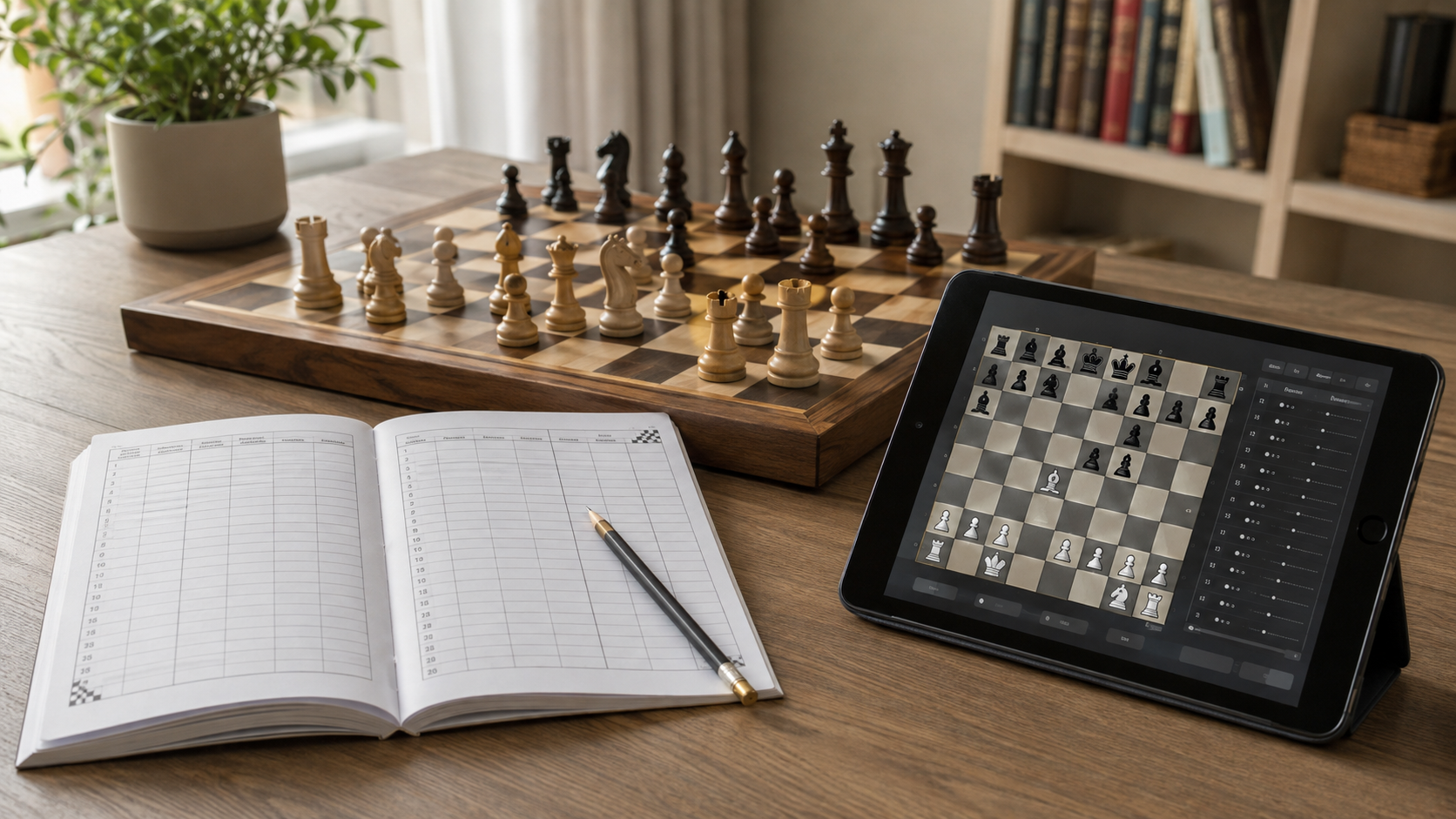
Quick decision aid
Compare beginner chess scorebooks
Look for actual inside-page photos, roomy White and Black columns, a binding that stays open, and enough space for your handwriting. We have not tested the products returned by this shopping link.
Quick verdict: buy, skip, delay, choose an alternative, or escalate
- Buy when the learner knows basic algebraic notation, finishes games, and wants a single paper record to revisit.
- Skip when games are purely casual and nobody expects to replay or discuss them afterward.
- Delay when recording moves repeatedly interrupts legal play or makes the learner enjoy chess less.
- Choose a cheaper alternative by printing a scoresheet or ruling move-number columns in a notebook for several games.
- Record digitally when games are already played online or the learner reliably reviews them there.
- Escalate the choice to the responsible teacher, club, or event organizer if a specific form or recording rule may apply.
Five criteria that decide whether a scorebook is worth it
- Notation readiness: the learner can identify files and ranks and write common moves without turning every turn into a notation lesson.
- A review purpose: there is a plan to replay a game, find a turning point, or discuss it with a teacher or practice partner.
- A repeatable habit: the learner expects to record more than one or two novelty games.
- A usable layout: the page has distinct move numbers and White/Black spaces large enough for the learner's handwriting.
- Paper fits the setting: there is table space beside the board and a practical way to carry the book.
What a scorebook does—and does not—do
A scorebook keeps games together in chronological order. Compared with loose sheets, it is harder to misplace and easier to browse. Compared with a plain notebook, its numbered rows reduce setup and help keep White's and Black's moves paired.
It does not explain whether a move was good, prevent notation errors, or guarantee that anyone reviews the games. Beginners still need a clear board, legal-move knowledge, and a simple review routine. For practice with named squares, see whether a coordinate chessboard is worth it.
Red flags before buying
- The listing shows an attractive cover but no sample of the inside pages.
- Move columns look too narrow for the learner's ordinary handwriting.
- The book includes dense reference material but leaves little room for actual games.
- A glued binding appears unlikely to stay open beside the board.
- The listing does not clearly state dimensions, page layout, or approximate game capacity.
- Marketing implies the book itself improves chess skill or is required for every beginner.
- A teacher, club, or event uses supplied scoresheets, making a personal book redundant.
Cost, maintenance, and setup tradeoffs
A scorebook is a paper accessory, but the bigger cost is attention. Recording every move slows a game and occupies mental space that a new learner may need for piece safety, legal moves, and check. The value comes from later review; an unread archive is just added expense.
Bound books keep records together but can resist lying flat. Spiral books usually stay open more easily but take more bag space and can catch on other items. Loose printed sheets cost less to trial and work well for occasional games, though they need a folder. A plain notebook is flexible, but the learner must create consistent move columns.
Setup needs a working pen, a dry place beside the board, and enough light to read small notation. Keep the book away from drinks. For digital recording, consider battery, screen distraction, and whether manual entry is permitted in the setting; ask the organizer rather than assuming.
Who should skip a scorebook for now?
- Brand-new players who are still learning piece movement, check, and board setup.
- Reluctant writers for whom recording turns an enjoyable game into paperwork.
- Online-only players whose game platform already stores the games they actually review.
- Occasional family players who want conversation and play rather than analysis.
- Learners without a review routine who have no concrete use for the finished notation.
- Anyone facing a formal requirement until the relevant organizer confirms what format is accepted or supplied.
Run a three-game no-spend test
- Print three simple scoresheets or draw numbered White and Black columns in a notebook.
- Record one untimed game without worrying about perfect handwriting.
- Replay the game and mark the first place where the record becomes unclear.
- Adjust the column width or notation reminder, then repeat for two more games.
- Notice whether recording becomes easier and whether the learner actually reviews the pages.
- Buy only if a bound record would remove real friction from a habit that now exists.
Better alternatives by situation
If notation is unfamiliar: practice naming squares during short positions before recording a complete game. A paper edge reference costs nothing.
If games are occasional: use printable sheets kept in a folder. You gain the same test without committing to a full book.
If handwriting space is the problem: use a wide-ruled notebook or full-page score pad rather than a compact book.
If games are online: use the platform's saved record and add one short note about the position to revisit.
If a class or club directs the activity: ask whether learners should record games and whether sheets are provided. Do not buy based on an assumed rule.
Once recording has become a real habit, compare a printed scorebook with a digital game record by the complete capture-and-review workflow.
Bottom line
A chess notation scorebook is worth buying for a beginner who can already record moves, plays often enough to fill it gradually, and returns to completed games with a real question. Choose the inside-page layout for readable writing and easy replay, not the cover.
Skip or delay it when notation competes with learning the game, when digital records already work, or when nobody reviews the pages. Three printable games are the best test: if the habit survives and loose sheets become annoying, the scorebook has earned its place.