
Renting chess sets can be worth it when one event needs more matched, complete sets than the organizers can borrow, and a provider can document the exact inventory, delivery window, inspection process, and return terms. Borrow first when a venue or partner already has suitable equipment. Buy when the same kit will serve several planned events. Delay or reduce the event size when no option leaves enough time to count and test every set.
This guide covers a batch of ordinary boards, pieces, storage bags, and optional clocks for a multi-board club or community event. It does not identify local rental providers, quote current fees, certify equipment for a federation or tournament, or replace the event organizer's rules. Verify every specification and contract term with the actual provider and venue. For one oversized activity rather than many ordinary games, use the separate giant chess rental decision.
The Good Chess & Checkers may earn commissions from qualifying purchases.
Quick decision aid
Will this equipment work beyond one event?
If the group expects several future sessions, compare a reusable batch of club chess sets with the rental quote. Confirm each current listing's board, pieces, bag, quantity, dimensions, and included contents; a marketplace title does not establish event approval.
Quick verdict: rent, borrow, buy, or delay
- Rent when this is genuinely a one-time need, borrowing leaves a real shortfall, and the written agreement makes the full batch and logistics verifiable.
- Borrow when the venue or a partner can supply complete, compatible sets with a clear handoff, count, and return owner.
- Buy when a named person will store and maintain the kit and several likely uses make ownership more practical than a single return deadline.
- Use a mixed plan only when borrowed and rented equipment remains readable and each source can be labeled and returned separately.
- Delay or reduce capacity when quantities, delivery timing, condition, contract responsibility, or event requirements cannot be confirmed in time.
Start with playable-board count, not attendance
Write down the event format before requesting equipment. A room with 30 attendees does not automatically need 15 boards: spectators, lessons, byes, staff tables, and scheduled rounds can change the count. Define the maximum simultaneous games, then add only the spare capacity the organizer can actually store, inspect, and supervise.
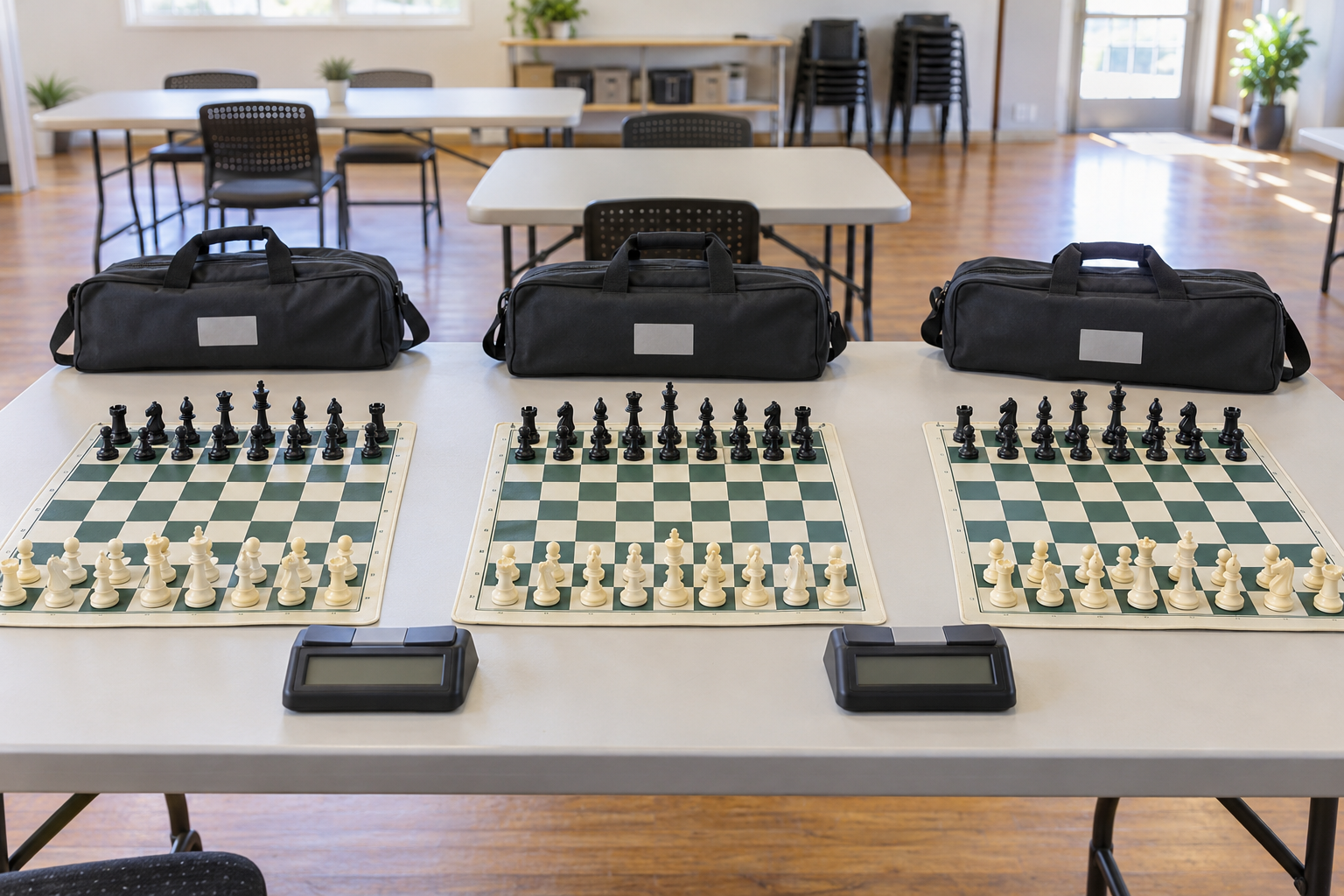
For each playable board, list the board, all 32 starting chess pieces, any agreed extra queens, and one container that keeps that table's equipment together. Treat clocks as a separate line item. A provider may offer boards and pieces without clocks, and an event may not need a clock at every table. Ask the organizer responsible for the format what is required; do not infer it from a product or rental label.
Get one written inventory for the complete batch
| Verify in writing | Question to answer | Why it changes the decision |
|---|---|---|
| Quantity and contents | How many boards, complete piece sets, bags, extra pieces, and clocks are included? | Prevents a headline set count from hiding missing components. |
| Dimensions and format | What are the board, square, king, base, and packed dimensions? | Lets the organizer check table fit, readability, transport, and storage. |
| Consistency and substitutions | May the provider substitute a different board, piece, bag, or clock format? | A mixed batch can slow setup and make counts or clock operation less consistent. |
| Handoff window | When and where can the equipment be received, checked, and collected or returned? | A narrow window may remove the rehearsal and inspection time the event needs. |
| Condition process | How are existing marks, missing pieces, and nonworking items recorded at handoff? | Separates pre-existing issues from the event's return responsibility. |
| Money and cancellation | What rental charge, deposit, delivery charge, tax, late charge, damage term, and cancellation rule currently applies? | The usable comparison is the complete commitment, not an advertised starting figure. |
Inspect before event day
Arrange a handoff early enough to open every bag. Count pieces by type and color, unroll or unfold each board, and confirm that the board lies suitably for play. Pair every board with its pieces and give the unit a temporary table or set number. Photograph or record the batch only as the agreement permits, and send any discrepancy through the provider's stated process before play begins.
If clocks are included, identify the exact model, obtain the current instructions, check displays and controls, confirm the required timing mode with the event organizer, and rehearse setup and reset. Similar-looking clocks can operate differently. A volunteer learning an unfamiliar model as a round begins is not a workable equipment plan.
Compare rental with borrowing honestly
Venue inventory can be the simplest option, but “we have chess sets” is not an inventory. Ask for a count and inspect the actual boards, pieces, bags, and clocks. Confirm when the room and storage area can be accessed, who can authorize use, and who receives the equipment after the event.
For equipment borrowed from several people, label each source without marking the equipment itself. Keep an intake list and avoid pooling loose pieces unless every lender agrees and the pieces are truly interchangeable. Borrowing loses its advantage when uncertain ownership makes the final count harder than a rental return.
Compare rental with buying by future use
Do not use a simple rental-fee-versus-purchase-price comparison. Ownership also needs storage, an inventory owner, replacement procedures, transport, setup time, and a plan for access between events. Rental needs delivery or pickup, contract review, inspection, repacking, and a firm return window.
List the next few realistic uses with dates and responsible people. If future events are only possibilities, give them no guaranteed value. Buying becomes more sensible when the same group has scheduled recurring sessions, suitable storage, and someone willing to maintain the batch. For a new club rather than one isolated event, compare starter-kit set categories and whole-kit versus pooled check-in systems.
Build a return plan before accepting delivery
- Assign one person to the provider relationship and one on-site person to the equipment count.
- Record the agreed inventory and any condition exceptions at handoff.
- Keep each board, piece set, bag, and clock under the same temporary identifier throughout the event.
- Schedule a count after the final game but before players and volunteers leave.
- Use the provider's stated process for a missing or nonworking item; do not improvise repairs or replacement purchases without agreement.
- Repack according to the documented method and allow travel time before the return or collection deadline.
- Retain the return confirmation and any deposit record until the transaction is resolved.
Questions to send a rental provider
- Can you provide a current written list of every included component and its quantity?
- What board and piece dimensions will the delivered batch have, and may substitutions occur?
- Which clock models and accessories are included, if any?
- When can we inspect the full batch, and how should discrepancies be recorded?
- What are the exact pickup, delivery, collection, and return windows?
- What deposit, cancellation, late-return, loss, damage, cleaning, and other current terms apply?
- Who should we contact if an item is missing or stops working during setup?
Use the provider's current written answer and agreement, not a summary from an old listing or a different location. Escalate unclear contract language to the provider before accepting the batch.
Who should skip rental?
Skip rental when the venue already has a verified complete batch, the group has a credible borrowing plan, or repeat use and available storage make ownership the clearer choice. Also skip when delivery leaves no inspection buffer, the return window conflicts with cleanup, substitutions can undermine essential fit, or responsibility for loss and damage remains unclear.
Reduce the number of simultaneous boards rather than building an event around equipment that has not been confirmed. This guide is also the wrong tool for one oversized activity set: giant pieces create separate space, transport, setup, access, and weather questions.
Bottom line
Renting a batch of chess sets is most useful for a truly temporary shortfall with a provider whose current inventory and terms can be checked before event day. Count simultaneous boards, compare venue and partner inventory, price the entire commitment, preserve inspection time, and assign the return workflow. Borrow when it is genuinely simpler; buy when future use and stewardship are real; and scale back when no option produces a complete, tested batch in time.