
Renting giant chess can be worth it when the activity is a genuine event feature, the venue can hold the complete playing footprint, and the provider's written delivery, setup, weather, cancellation, deposit, and return terms all work. Borrow when a trusted local group has a complete suitable set. Buy only when repeat use, storage, transport, and maintenance are real plans. Choose a tabletop activity or skip giant chess when space, access, weather, or responsibility remains uncertain.
This is a planning framework, not a recommendation for a specific rental company. It does not certify a setup, venue, supervision plan, insurance position, or weather decision. Confirm current dimensions, instructions, permissions, access needs, and contract terms with the provider and venue.
The Good Chess & Checkers may earn commissions from qualifying purchases.
Quick decision aid
Would ownership solve a recurring need?
Buying may fit a venue or group with several scheduled uses, suitable storage, a workable transport route, and a named equipment owner. Confirm the exact board, piece dimensions, included contents, packed volume, care instructions, and current seller terms before treating a listing as comparable with a rental.
Quick verdict: rent, buy, borrow, choose an alternative, or skip
- Rent for a one-off event when the verified setup fits the venue and the complete handoff and return plan is manageable.
- Buy when several scheduled uses, nearby storage, transport, maintenance, and a responsible owner justify keeping the set.
- Borrow when you can inspect a complete set early and agree who moves, sets up, counts, and returns it.
- Choose a large tabletop set when visibility matters but the event cannot spare a giant board plus circulation space.
- Delay or skip when dimensions, venue permission, access, weather contingency, supervision information, or financial terms cannot be confirmed.
Measure the whole activity zone
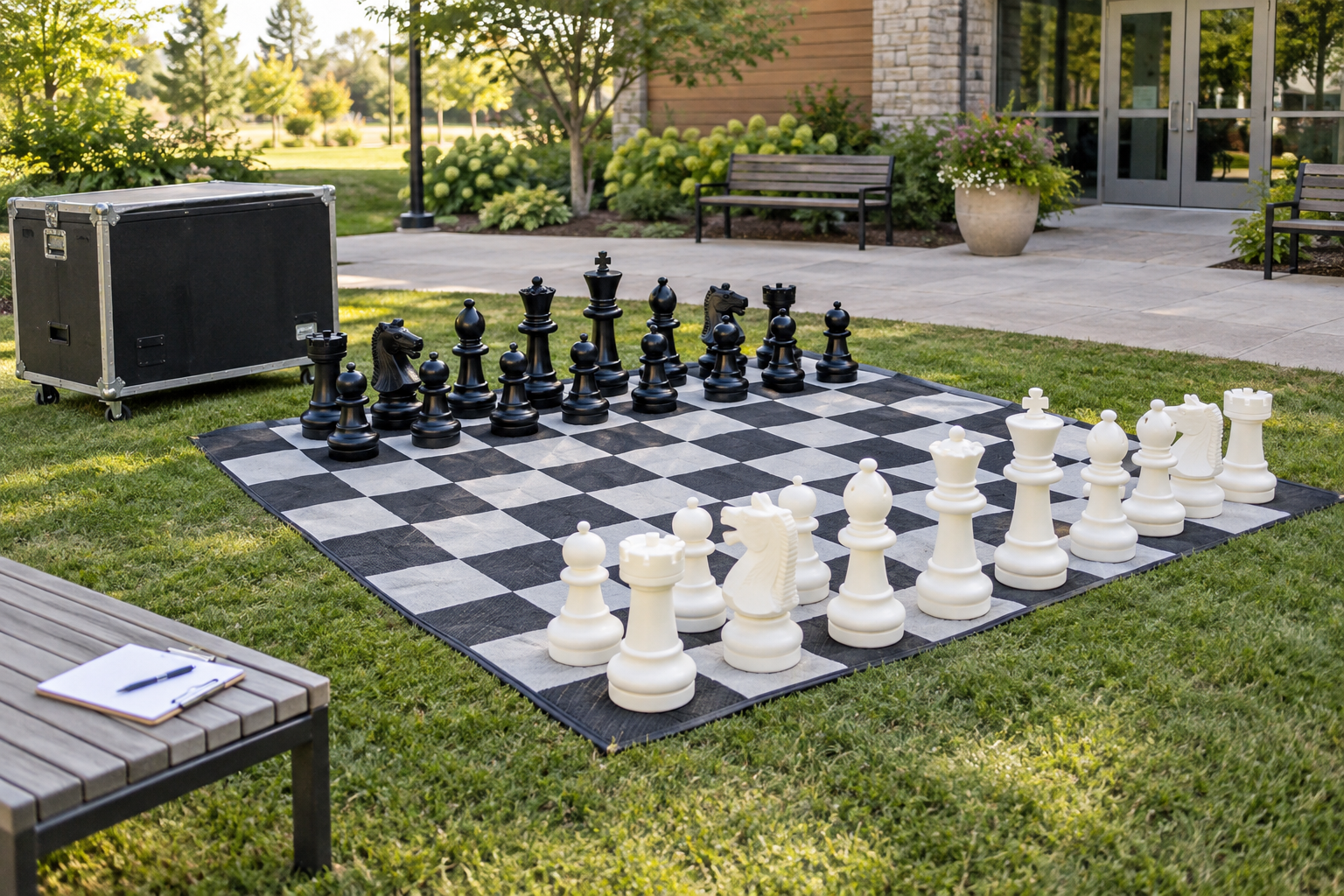
Ask for current dimensions of the board when fully assembled, the tallest and widest pieces, and the packed containers. Mark that footprint at the venue, then add the route people need around it. Keep doors, paths, seating, service areas, and other activities in the venue plan; do not assume the board dimensions equal the required event space.
Walk the delivery route as well. Record door widths, steps, lifts, gates, long carries, parking or loading restrictions, and the distance between storage and play. Confirm requirements and accessible routes with the venue rather than treating a generic setup photograph as proof of fit.
Get the complete rental commitment in writing
| Decision check | What to verify | Red flag |
|---|---|---|
| Equipment | Board format, all pieces, packed containers, dimensions, and permitted substitutions. | Only the tallest piece or a representative photo is supplied. |
| Delivery and setup | Arrival window, unloading point, who assembles it, required access, and when the area must be ready. | The delivery window overlaps guest arrival or leaves no inspection time. |
| Collection or return | Who dismantles and packs it, exact collection or return time, and late terms. | The venue closes before the documented handoff can occur. |
| Money | Rental charge, delivery, setup, tax, deposit, cancellation, late, cleaning, loss, and damage terms. | An attractive headline charge excludes necessary logistics. |
| Outdoor use | Provider instructions, surface requirements, weather restrictions, and the cancellation or relocation process. | The plan depends on favorable weather with no indoor or smaller alternative. |
Cost is more than the rental charge
Compare the total written commitment, not a day rate. Include delivery or pickup, setup, any required staffing, tax, deposit timing, collection, and plausible cancellation exposure. Also count organizer time: measuring, gaining venue approval, receiving the set, checking the inventory, monitoring the activity, closing it, and resolving the return.
Buying adds a different set of costs: storage volume, transport equipment, cleaning and care under the maker's instructions, replacement planning, and responsibility between events. Borrowing can remove a fee but still needs an inventory, suitable vehicle, agreed condition record, and reliable return owner.
Plan setup, operation, and reset
- Obtain the current inventory, dimensions, setup instructions, and terms before booking.
- Confirm the exact activity zone and delivery route with the venue.
- Name the people who will receive, inspect, assemble, monitor, close, count, and hand back the set.
- Inspect the pieces, board, containers, and existing marks before guests arrive, following the provider's reporting process.
- Keep the provider's instructions and contact route available during setup.
- Stop new games early enough for the agreed count, packing, collection, or return.
Have a real weather and venue alternative
For an outdoor event, ask the provider what conditions and surfaces are permitted and what happens if those conditions change. Ask the venue which areas may be used and who makes the relocation or cancellation decision. Do not improvise weights, anchors, covers, repairs, or wet-weather use outside the provider's instructions.
A useful fallback is specific: an approved indoor space that fits the verified setup, a large-piece tabletop board, or another compact activity already available. If the fallback would disappoint the group or cannot be deployed quickly, treat that as part of the booking decision.
Who should skip a giant chess rental?
Skip it when giant chess is only background decoration, the likely player count is low, the site is cramped, the transport route is difficult, the schedule leaves no inspection buffer, or the contract places unclear responsibility on the organizer. It is also a poor fit when no one can own the setup and return workflow.
For a quieter or tighter event, use a large-piece tabletop chess and checkers set. If the event needs many ordinary games rather than one oversized attraction, use the separate guide to renting a batch of standard chess sets.
Questions to ask before paying
- What exact board, pieces, containers, dimensions, and setup are included?
- Who delivers, unloads, assembles, dismantles, packs, and collects the equipment?
- What access, surface, power, storage, or staffing does the provider require?
- How and when should existing marks, missing pieces, or damage be recorded?
- What current weather, cancellation, rescheduling, deposit, late, loss, damage, and cleaning terms apply?
- What happens if the venue or delivery route cannot accept the set?
Escalate unclear answers to the provider and venue before booking. If a material term remains verbal or uncertain, delay rather than building the event around an assumption.
Bottom line
Rent giant chess when one event can give it enough suitable space, the logistics are documented, the full commitment fits the budget, and a named team can receive and return it. Buy for credible repeat use, borrow when the handoff is genuinely simpler, and choose a tabletop alternative when the giant format adds more operational work than event value.