
A used chess clock can be worth buying when you can identify the exact model, test both sides through a complete game-like cycle, inspect its power compartment or charging port, and confirm that its documented timing options fit how you play. Choose new or use an app when the clock cannot be fully tested, its manual is unavailable, or the saving disappears after missing parts and uncertain return terms.
This guide helps casual players and small clubs inspect secondhand analog and digital clocks. It does not certify timing accuracy, electrical safety, repairability, or acceptance at a particular tournament. Verify event equipment rules with the organizer and use the exact model's current or archived manual for operating details.
As an Amazon Associate, The Good Chess & Checkers may earn from qualifying purchases.
Establish a new-clock baseline
Compare current chess clock formats
Use new listings as a reference for manuals, included power accessories, display layout, documented timing modes, dimensions, and return terms. Do not compare on asking price alone.
Quick verdict
- Buy when the exact model is identifiable, every control and display segment works during a complete test, the power area is clean, the needed modes are documented, and the all-in cost is sensible.
- Test further when the clock powers on but you have not run both sides, pause, reset, mode selection, and a longer countdown.
- Negotiate only for a clearly understood issue such as a missing removable cover or power lead that has an identifiable replacement; include that replacement in the total cost.
- Choose new when you need straightforward instructions, consistent units for a club, or useful return support.
- Walk away when the display is incomplete, controls stick or fail, the power compartment shows residue or damaged contacts, the exact model cannot be confirmed, or the seller will not demonstrate it.
Identify the exact clock before judging it
Ask for clear photographs of the front, controls, underside, model label, power area, and included accessories. Similar-looking clocks may use different setup sequences or support different timing modes. Search for the manual using the exact maker and model information, then compare the physical controls with the manual illustrations.
A manual is especially useful for a digital clock because a display that lights up does not prove you can select, adjust, pause, resume, or reset the mode you need. For an analog clock, identify how each dial is set and how the flag or end-of-time indicator is meant to behave. If you cannot establish ordinary operation, do not assume experimentation will solve it after purchase.
Run a complete function test
- Start from off. Confirm the power switch, battery cover or power input, and startup behavior.
- Inspect both displays or dials. Look for missing display segments, unreadable areas, loose hands, damaged faces, or indicators that do not return to their starting position.
- Set a simple countdown. Use a documented basic mode before trying delay, increment, or multi-period settings.
- Alternate the two player controls. Press each side repeatedly and confirm that one side stops as the other starts.
- Pause and resume. Follow the manual and check that the state remains understandable.
- Let both sides run. A quick power-on check can miss intermittent display or button problems. Use enough time to observe ordinary operation.
- Reset and repeat. Make sure a new game can be started without an unexplained sequence or unreliable control.
This confirms observable function during the test; it is not a calibration or accuracy certification. When precise timing matters, use equipment that meets the requirements of the particular organizer or setting.
Inspect power and physical condition
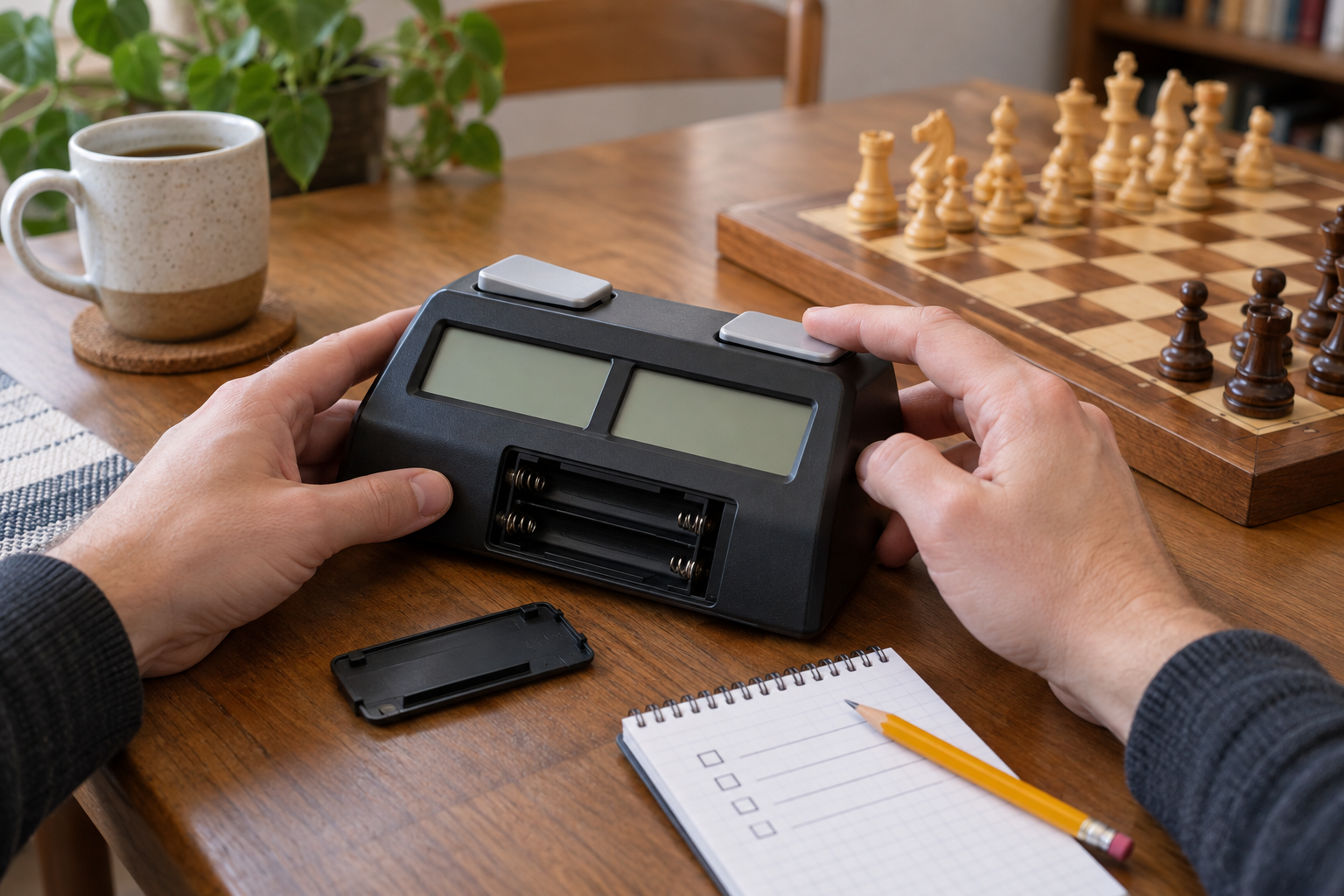
With the clock switched off and batteries removed, look at the battery compartment for clean contacts, an intact cover, readable polarity markings, and a compartment that closes normally. Do not handle residue or attempt a repair based on a buying-guide article. If there is residue, corrosion, heat damage, a swollen battery, a broken charging port, an unfamiliar adapter, or other electrical uncertainty, stop the inspection and skip the clock.
For a rechargeable model, confirm the exact charging requirement from the manual and whether the correct cable or adapter is included. A port that resembles a familiar connector does not establish its required power. For the case and controls, check for cracks, missing feet, loose buttons, sticky plungers, and a housing that rocks on the table. Cosmetic scratches matter less than controls that cannot be operated consistently.
Check the modes you will actually use
Make a short list before shopping: a basic countdown, an increment or delay if your casual group uses one, separate starting times if needed, and any sound setting that matters in the room. Confirm each requirement in the exact model's manual and test the setup sequence. Do not infer a mode from an abbreviation on a display or from a seller's memory.
If you only want a visible countdown for relaxed games, a simpler clock may be easier to share. If you are preparing for a particular event, ask the organizer what players must bring and what equipment or settings are used. Tournament acceptance and time-control rules are not universal product features.
Compare the complete cost and risk
| Decision area | Used clock check | New-clock baseline |
|---|---|---|
| Operation | Exact unit must pass the full test | Manual and stated features should be available before purchase |
| Power | Inspect compartment or port; identify missing accessories | Confirm included items and documented power requirements |
| Modes | Verify on this model and test the setup | Compare documented modes, not listing shorthand |
| Transaction | Seller demonstration, pickup test, and return terms carry more weight | Compare the current seller's return terms and support |
| Club use | One different unit may add setup friction | Matching units can simplify instructions and storage |
Add the asking price, travel or delivery, the correct power accessory, replacement batteries where appropriate, and any missing cover or storage item you can actually source. Then compare that total with a suitable new clock. A lower sticker price is not enough when the used purchase carries unresolved function or return risk.
Who should skip a used chess clock?
- Beginners who have not yet decided whether timed play makes their games more enjoyable.
- Gift buyers who cannot test the exact unit and need a complete, clearly documented package.
- Clubs that want several clocks with one shared setup routine.
- Players who need equipment for a specific event but have not checked the organizer's requirements.
- Anyone facing an unclear model, unavailable manual, incomplete display, unreliable control, damaged power area, or no practical return option.
If the goal is only to try timed casual play, use a timer app for several sessions before buying hardware. If a physical clock suits the table but the power system is the remaining question, read whether a rechargeable chess clock fits a casual club.
Questions to ask the seller
- What exact maker and model is shown on the clock's label?
- Can you provide clear photographs of both displays or dials, every control, the underside, and the empty power compartment or charging port?
- Can you demonstrate both player controls, pause, resume, reset, and the specific timing mode I need?
- Are the battery cover, cable, adapter, manual, and storage case included?
- Do all buttons move and return normally, and does the case sit flat?
- Can I test the clock before pickup, or what return terms apply to the exact item?
Bottom line
A used chess clock is worth considering only when the exact unit—not merely the product category—passes a complete, documented test. Identify the model, inspect the power area, run both sides through start, switching, pause, resume, and reset, and verify the needed modes in the manual. Compare the all-in cost and transaction risk with a suitable new clock.
Buy when the evidence is complete and the clock has a clear job in your regular games. Test further when any ordinary function remains uncertain, and walk away from unclear displays, unreliable controls, damaged power areas, missing model information, or a seller who will not demonstrate the unit. The planned beginner-chess pillar is not yet built; for the broader equipment path, continue through the site's sets and gear hub.