
Choose laminated worksheets when each learner needs to solve, mark, or reset a chess position independently. Choose a dry-erase board when one teacher needs to build a position, draw attention to a square, and discuss it with the whole group. The better reusable format depends less on the word “classroom” and more on who needs to write and who needs to see.
This comparison covers generic teaching-supply categories, not named products we tested. Verify the actual writing area, board grid, marker compatibility, cleaning instructions, support method, and packed dimensions before buying.
As an Amazon Associate, The Good Chess & Checkers may earn from qualifying purchases.
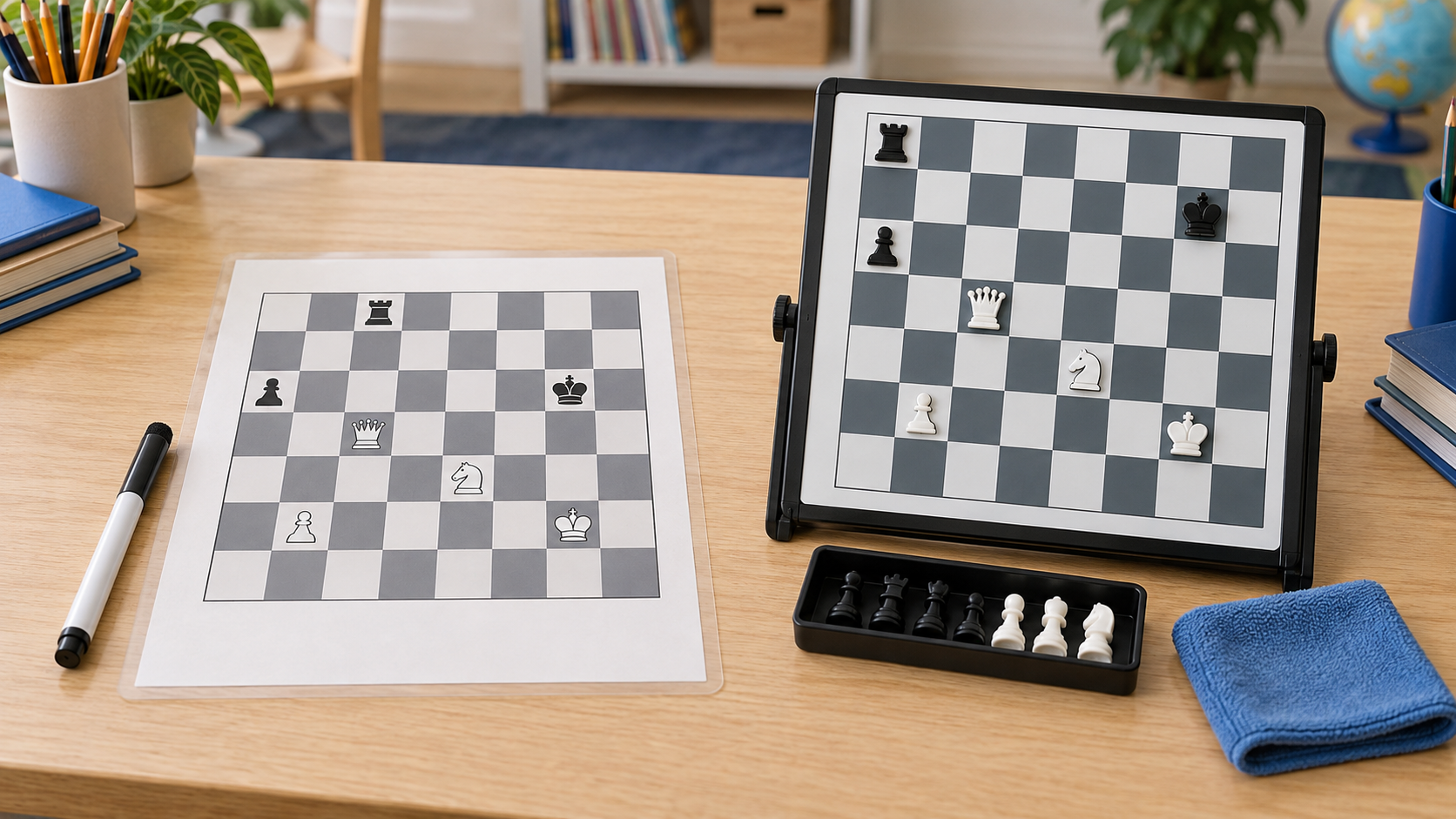
Match the surface to the audience
Compare both reusable lesson formats
For worksheets, confirm the sheet size, visible chess content, lamination or sleeve compatibility, and whether every learner gets enough writing room. For boards, measure the grid and total display area, then confirm how it stands, erases, and stores.
Quick decision
- Choose laminated worksheets for individual puzzles, move arrows, square naming, notation practice, or station work that several learners complete at once.
- Choose a dry-erase board for teacher-led explanations, a shared position, group move suggestions, or notes everyone must see.
- Use both when the teacher models one position and learners then solve a related prompt independently.
- Skip a specialized purchase if a printed page inside a reusable sleeve or an ordinary whiteboard beside a physical chess set already handles the lesson.
The core difference: individual work or shared display
A laminated worksheet preserves a fixed prompt. The board diagram, instructions, answer spaces, and coordinates stay in the same place while learners add temporary marks. That makes it useful when a teacher wants to repeat one exercise across several sessions or hand the same activity to several pairs.
A dry-erase chess board is more flexible. The teacher can create a new position, remove pieces, draw an arrow, or write a short note without preparing another sheet. Its value is visibility and improvisation, not giving every learner a private work surface.
Do not assume either tool includes accurate lesson content. A blank board is only a surface. A prepared worksheet should be checked for a true 8-by-8 grid, familiar piece symbols, legal positions, readable coordinates, and instructions that match the learners' level.
Compare the practical criteria
| Criterion | Laminated worksheet | Dry-erase board |
|---|---|---|
| Best audience | One learner or pair per sheet | One teacher and a group that can see the display |
| Lesson content | Fixed prompt can be checked in advance | Position and notes can change during discussion |
| Writing area | Limited by page and diagram size | Usually more room, but grid size must be measured |
| Reset routine | Collect, erase, inspect, and sort sheets | Erase one shared surface and return pieces or markers |
| Storage | Flat in a folder, binder, or portfolio | Needs space for the full board, stand, and accessories |
| Low-cost trial | Page protector over an ordinary printout | Plain whiteboard beside a physical chessboard |
When laminated chess worksheets fit better
Use worksheets when the same learner action repeats: circle every attacked piece, draw one legal move, identify coordinates, record a short line, or choose a checkmate square. The fixed prompt reduces setup between groups and lets the teacher inspect what each learner marked.
Look for enough open space around the board diagram for the intended marks. A crowded page can make arrows and answers hard to distinguish. Confirm whether the surface is genuinely laminated or simply glossy, and follow the seller's marker and cleaning guidance. “Reusable” does not establish which ink will erase cleanly over time.
Skip laminated worksheets when the position changes constantly, when learners need real-piece handling practice, or when preparing and maintaining one sheet per learner creates more work than it saves.
When a dry-erase board fits better
Use a board when the lesson depends on a shared conversation. A teacher can place a position, ask for candidate moves, mark a diagonal or file, erase the mark, and continue. A freestanding or supported format can also keep the display visible while a tabletop chess set remains available for learners.
Measure viewing distance and the actual grid rather than trusting “large” or “classroom” in a listing. Check whether the product is a printed chess grid, a blank grid, or an ordinary whiteboard. If it uses movable magnetic pieces, confirm piece count, piece-to-square fit, storage, and the maker's supported display method.
Skip the board when only one learner needs the prompt, when the room has no stable display location, or when a document camera already shows a physical board clearly. For group-display tradeoffs, compare a magnetic demonstration board with a dry-erase chess board.
A useful hybrid lesson
- Show one simple legal position on the shared board and define the task in plain language.
- Ask learners to identify the important square or candidate move without writing yet.
- Give each learner or pair a related reusable worksheet and one compatible marker.
- Have them mark a move and explain it to a partner using piece names and square coordinates.
- Return to the shared board, compare answers, and correct the position visibly.
- Erase every surface, check for residue or damage, count accessories, and file the worksheet by lesson rather than leaving it in a game-set bin.
The worksheet should support the board activity, not replace moving real pieces. For absolute beginners, first use the site's guide to how chess pieces move and practice each pattern on a physical board.
Try the workflow before buying a full set
Print one worksheet and place it inside a clear letter-size page protector. Use the marker already approved for that sleeve, run the actual lesson, then erase and inspect it. For the shared-display trial, draw notes on an ordinary whiteboard while keeping the chess position on a tabletop board.
After two or three sessions, record what caused friction: learners waiting for a turn, a diagram that was too small, markers rolling away, glare, incomplete erasing, slow distribution, or nowhere to store the board. Buy the format that removes the repeated problem. If neither trial reveals a problem, keep the simpler setup.
If the sleeve trial works, use the dry-erase worksheet sleeve guide to compare exact insert fit, closures, marker loops, glare, cleaning, and filing before buying a group quantity.
What to verify before ordering
- Exact dimensions: page size, diagram size, board grid, stand footprint, and packed size.
- Visible content: a complete 8-by-8 grid, recognizable pieces, coordinates if the lesson needs them, and no hidden assumptions about notation.
- Marker compatibility: the maker's stated marker type and cleaning method; do not infer compatibility from appearance.
- Quantity: enough worksheets, sleeves, markers, cloths, and board pieces for the real group.
- Glare and contrast: inspect real imagery and test the planned room angle when possible.
- Storage: a flat home for sheets and a supported location for the board, markers, cloth, and movable pieces.
Bottom line
Laminated chess worksheets are better for repeated individual responses; a dry-erase board is better for one flexible position the group discusses together. Start with a page protector or ordinary whiteboard trial, measure the complete lesson setup, and buy only when the reusable format solves a recurring distribution, visibility, or reset problem.