
Menchik–Graf 1937: Why the Rook Could Enter d7
Prepared November 7, 2026 · The Good Chess & Checkers editorial desk
Menchik could offer her rook on d7 because taking it would pull Black’s queen away from a useful counterchecking diagonal. In the illustrative capture line, White then offers the queen to open a bishop’s route to mate. The actual game ended with 21.Rd7 and Graf’s resignation, not checkmate.
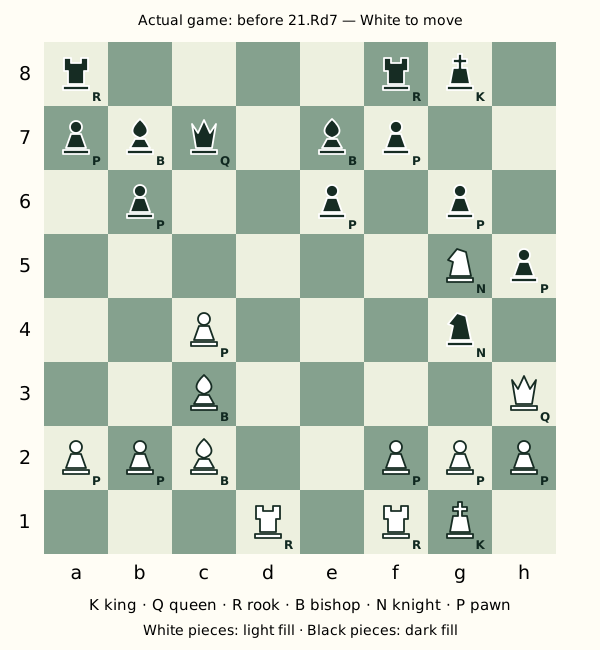
Three routes to notice first
A diagonal runs through squares touching corner to corner. A file is a vertical column; an open file has no pawns of either color. Here the d-file is open, and d2 through d7 are empty. White’s rook can travel from d1 to d7 even though Black’s queen attacks d7: a rook may enter an attacked square if its own king remains safe.
- Black queen c7: its clear diagonal ends at White’s pawn on h2, beside the king on g1. That gives Black a potential capture with check, ...Qxh2+.
- White queen h3: it can capture the black pawn on h5 through the empty h4 square.
- White bishop c2: its diagonal runs c2–d3–e4–f5–g6–h7. The black pawn on g6 currently blocks it.
Deflection means drawing a piece away from a job. Here the important job is counterattacking with check. Capturing the rook would move Black’s queen from c7 to d7 and remove its immediate c7–h2 route. That is why counting the offered rook’s value alone misses the point.
A championship match, not the Stockholm tournament
Vera Menchik had White against Sonja Graf in game 14 of their 1937 women’s championship match at Semmering. Europe Échecs dates the game July 13, 1937; that exact day rests on this one specialist historical reconstruction. It is a different event from the women’s championship tournament held in Stockholm that year. The German Chess Federation’s Graf history corroborates the title match. This lesson does not establish that game 14 clinched the title.
The score and final move are reproduced in Europe Échecs’ historical feature and independently reproduced on Wikipedia’s Menchik game record. We use the moves as a historical record; the diagrams and teaching prompts here are original editorial work.
Read the moves without rushing
Q means queen, R rook, B bishop and N knight. A pawn move has no piece letter. x means capture, + check and # checkmate. An ellipsis, as in 20...Ng4, marks Black’s move. In Rad1, the “a” identifies the rook that came from the a-file. 1-0 records a White win; it does not itself mean checkmate.
If the letters or squares are unfamiliar, start with how chess pieces move and a beginner’s introduction to using notation.
- 16.Qe2 b6 17.Ng5 g6: White’s knight reaches g5. Black’s pawn moves from g7 to g6, placing it on the bishop c2’s diagonal.
- 18.Qf3 Bb7 19.Qh3 h5: White’s queen reaches h3; Black’s h-pawn advances to h5, within that queen’s reach.
- 20.Rad1 Ng4: the a-rook arrives on d1. Black’s knight moves to g4. Pause here and compare the three routes above before moving the rook.
The actual ending: 21.Rd7, then resignation
The rook travels up the clear d-file to d7, next to Black’s queen on c7. Graf resigned, so the recorded game stops here with a White win. Black would be next to move. Black is not in check, and this position is not checkmate. Resignation is a player’s decision to concede; a game need not continue until mate.
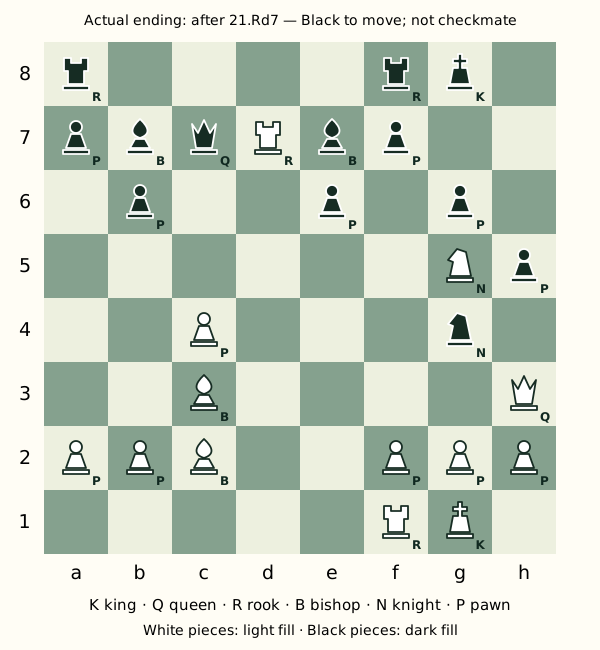
Unplayed teaching variation: what if the queen takes?
These moves were not played by Graf and Menchik in this game: 21...Qxd7 22.Qxh5 gxh5 23.Bh7#.
- 21...Qxd7: Black’s queen takes the rook but leaves c7. Its immediate checking diagonal to h2 disappears.
- 22.Qxh5: White’s queen takes the h5 pawn and offers itself to the pawn on g6.
- 22...gxh5: that pawn captures the queen. Moving off g6 clears the bishop’s c2–h7 diagonal.
- 23.Bh7#: the bishop reaches h7 and checks the king on g8. White’s knight g5 covers f7 and h7, including the bishop’s square. Black’s own rook f8 and pawn f7 occupy escape squares. White’s other bishop on c3 covers g7 and h8 along c3–d4–e5–f6–g7–h8; the knight covers h7. No legal capture, block or king move ends the check.
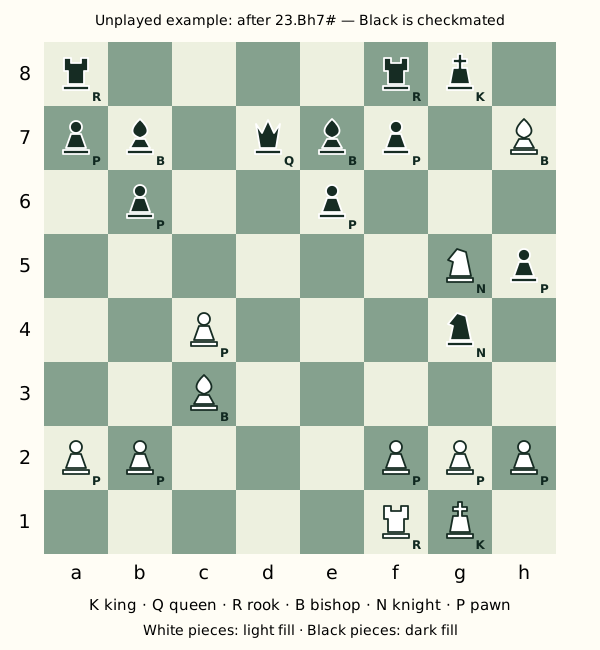
This legally replayed branch explains one capture response. It is not an exhaustive defence analysis, engine evaluation or proof of optimal play. Black was not obliged to choose these captures.
Try the defender-duty exercise
Use the first diagram or set it up on a board you already own. Before opening the answer, write:
- Queen that loses its checking route: color _____; start _____; capture square _____.
- Its original diagonal to h2: _____ → _____ → _____ → _____ → _____ → _____.
- Pawn that must move to release the bishop: _____ → _____. Bishop’s starting square _____; mating square _____.
- Actual last move _____; actual result by _____; side next to move _____.
Check the squares and ending
Black queen: c7 to d7. Its original route is c7–d6–e5–f4–g3–h2. Black’s pawn moves g6 to h5 in the unplayed branch. White’s bishop starts on c2 and mates on h7. The actual last move is 21.Rd7; White won by resignation, with Black next to move.
Take the question into your next game
Before taking an offered piece, name a job your capturing piece would abandon: guarding a square, blocking a line, or giving a countercheck. Then check the opponent’s reply. A tempting pattern is a reason to calculate, not permission to sacrifice without checking legal responses.
For a manageable next study session, compare tactics puzzles with annotated games. If a physical board would help you keep the position in view, use the Staunton versus themed pieces guide to judge readability before buying. You can complete this exercise without new equipment.
Complete game score and sources
Copy the unannotated PGN below into a compatible board viewer. The recorded game contains 41 half-moves and ends at 21.Rd7; the teaching branch is deliberately excluded.
[Event "Women's World Championship match"]
[Site "Semmering"]
[Date "1937.07.13"]
[Round "14"]
[White "Vera Menchik"]
[Black "Sonja Graf"]
[Result "1-0"]

1. c4 e6 2. Nc3 d5 3. d4 Nf6 4. Nf3 Nbd7 5. e3 c6 6. Bd3 Be7 7. O-O O-O 8. e4 dxe4 9. Nxe4 Nxe4 10. Bxe4 Nf6 11. Bc2 c5 12. dxc5 Qa5 13. Be3 Bxc5 14. Bd2 Qc7 15. Bc3 Be7 16. Qe2 b6 17. Ng5 g6 18. Qf3 Bb7 19. Qh3 h5 20. Rad1 Ng4 21. Rd7 1-0
Historical sources checked November 7, 2026: Europe Échecs for the score, game number and exact date; the German Chess Federation for match context; Wikipedia for a score and resignation cross-check. Exact-date corroboration remains limited to one specialist source. No original score sheet was inspected, and no copied annotations, portraits or source diagrams are used.
Prepared by The Good Chess & Checkers editorial desk with AI-assisted research organization and drafting. Legal replay checks establish move legality and diagram positions, not engine strength or optimal defence. All board artwork and letter-marked vector pieces were created for this lesson and released under CC0; no external piece artwork was used. See our publishing approach.