
Family learning-format comparison
Printed Rulebook vs Video Lesson: Which Helps a Family Start Chess and Checkers?
Choose a printed rulebook when the family needs a stable reference beside the board and expects to pause often for rule lookups. Choose a video lesson when seeing a move unfold is the main obstacle and everyone can view, pause, and replay the same screen. Many families need one short demonstration first and a printed reference during the game.
This is a format comparison, not a ranking of named books, channels, or courses. Check the exact book contents or official video preview before relying on it. “Chess and checkers” coverage can mean two complete beginner sections—or one full game and a brief mention of the other.
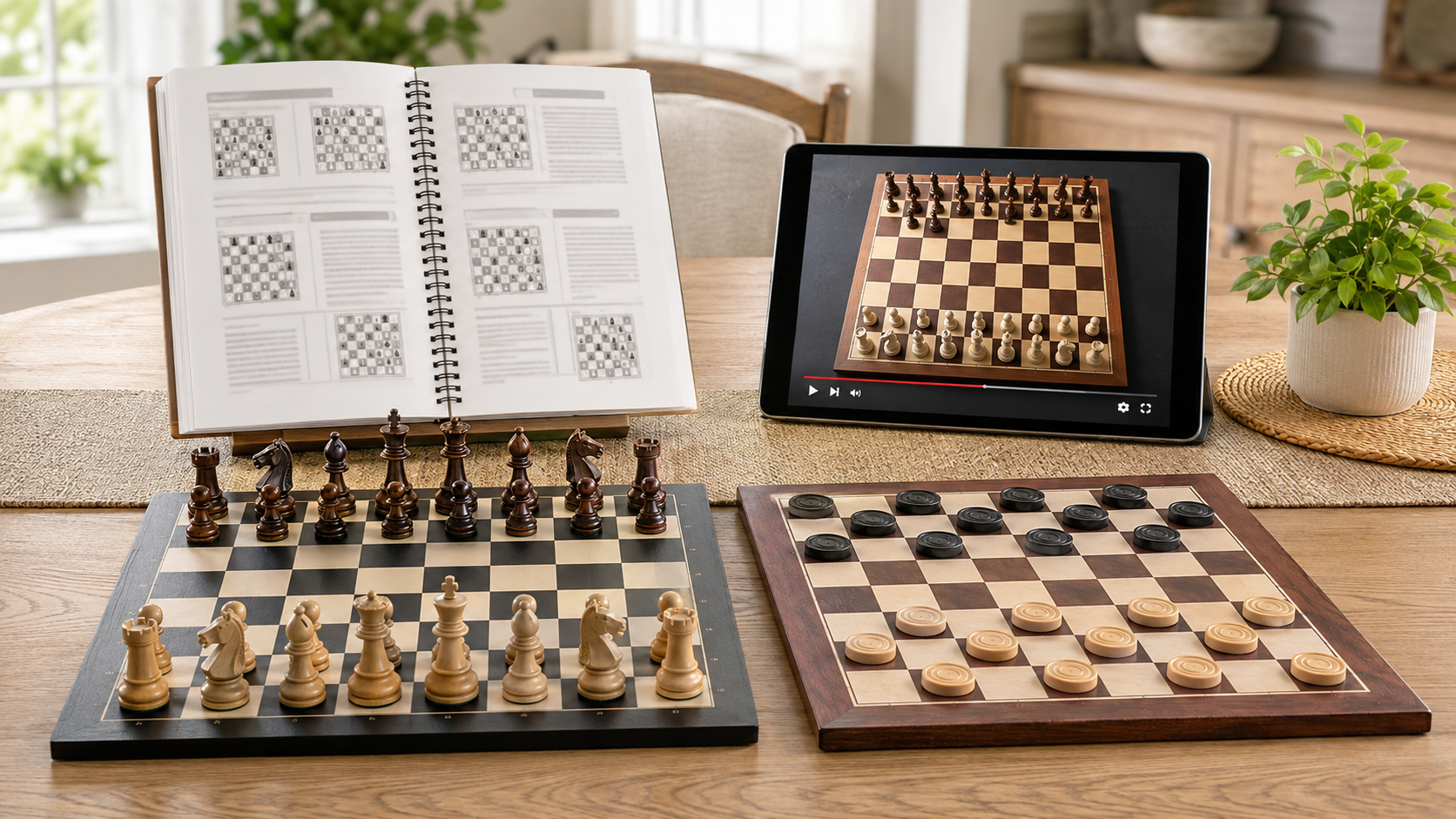
Quick decision
Pick print if different family members will consult the rules at different times, the guide needs to sit beside the board, or screen access is unreliable. A useful book lets someone find setup, movement, captures, kinging, check, and checkmate without replaying a whole lesson.
Pick video if static arrows and diagrams are confusing, one person can control playback for the group, and short demonstrations are easy to replay. Verify that the lesson pauses long enough to rebuild the position on a real board.
Use both lightly when the family learns from motion but plays better with a quick reference nearby. Watch only the segment needed for tonight’s game, then close the screen and use a printed page or rule card for interruptions.
Side-by-side comparison
| Family need | Printed rulebook | Video lesson |
|---|---|---|
| Finding one rule | A contents page, index, tabs, or headings can make repeat lookups quick. | Chapters and timestamps help only when they are accurate and easy to navigate. |
| Seeing movement | Uses diagrams or sequences that the reader must interpret. | Can show direction, capture, and position changes over time. |
| Shared use | Can be passed around, but only one spread is visible at once. | A large enough screen can give everyone the same demonstration. |
| Access | Works without an account, power, or connection once the correct copy is available. | May require a device, connection, account, app, or continuing access; verify the exact source. |
| During play | Easy to leave open next to the board for short checks. | Searching and replaying can interrupt the game more noticeably. |
| Age and reading fit | Depends on vocabulary, print size, diagrams, and adult support. | Depends on pace, narration, captions, screen visibility, and controls. |
Check coverage before choosing either format
A family reference should match the games and rules you plan to play. For chess, look for board orientation, starting setup, every piece’s movement, captures, check, checkmate, castling, and pawn promotion explained at a genuine beginner level. For checkers, look for starting setup, diagonal movement, captures, multiple jumps, kinging, and an explicit note about the ruleset being taught.
Checkers rules vary. A source should say whether captures are compulsory and how kings move in its chosen version rather than presenting every family or regional tradition as identical. If compulsory captures are the immediate question, keep the site’s required-jump explainer beside the board.
When a printed rulebook works better
- The family wants one reference that lives with the board and pieces.
- Players will look up isolated questions more often than follow a lesson in order.
- A table of contents, index, color diagrams, or page tabs make both games easy to locate.
- The print and vocabulary suit the least experienced reader, with an adult available when needed.
- The binding stays open without occupying the squares or forcing players to hold the page.
Skip a book if its preview hides the contents, its diagrams are too small to follow, or it does not label which checkers variation it teaches. A chess-only guide is not a family chess-and-checkers reference merely because a retailer groups it with board-game books. If the household specifically wants a table-side chess reference, compare family chess rule-book formats by lookup speed and complete basic rule coverage.
When a video lesson works better
- A learner needs to see a knight move, a multi-jump, kinging, castling, or another sequence happen step by step.
- The group can see the board on screen from normal seats and one person can pause without taking over the lesson.
- Chapters or short clips separate setup, movement, captures, and winning conditions.
- Captions, narration, playback speed, and visual contrast suit the people watching.
- The official source clearly states any account, connection, app, payment, or access requirement.
Skip a video that races through unexplained terms, relies on tiny on-screen coordinates, or mixes several rule variations without labels. Do not assume a high view count, polished presenter, or long running time makes a lesson complete.
Run a ten-minute family trial
- Choose one small task: use checkers kinging or the chess knight’s move rather than an entire game.
- Preview the print source: ask one new player to find the rule and explain the diagram.
- Preview the video source: watch an official free segment on the same task, pausing where needed.
- Rebuild it: put the position on the physical board without copying every frame or sentence.
- Try a new example: confirm the learner can apply the rule from a different square.
- Name the friction: choose based on whether searching, reading, seeing motion, controlling playback, or sharing the source caused trouble.
Keep the reference from replacing play
The goal is not to finish a book or video series before touching the pieces. Teach enough to begin a small legal game, expect pauses, and add one rule at a time. The family teaching guide uses mini-games and short sessions to keep the first week manageable.
If the physical set itself is hard to read or incomplete, learning media will not solve that friction. Use the family chess and checkers set guide to compare recognizable pieces, board contrast, storage, and age fit before adding more instruction.
Who should buy neither yet?
- A family that has not tried the site’s free chess movement guide and beginner checkers guide.
- A household that already owns a clear unused rule reference.
- Players who need a person to answer questions during the first game more than another resource.
- A buyer who cannot inspect contents, samples, ruleset labels, or current access terms.
Bottom line
A printed rulebook is the stronger family tool for stable, screen-free lookup during play. A video lesson is stronger for demonstrating movement and sequences before play. Choose by the obstacle the family actually has, confirm that both games and their rule variations are covered, and test one small lesson before buying anything.